
Best Thermal Binoculars (2026): 8 Picks From $1,150 to HD

Advertisement
Thermal binoculars let you see what the dark is hiding, with both eyes open. A hog in a cut cornfield at midnight or a wounded deer bedded in cover glows on the screen, even in total darkness or light fog.
Searches for "thermal imaging binoculars" are climbing fast this fall, and prices have dropped into a range more hunters can justify. We compared eight models EuroOptic had in stock on October 5, 2026, from a $1,150 PARD to a $6,000 HD Pulsar, using the makers' own specs and EuroOptic's live prices. This is a research guide, not a hands-on test.
The short answer
For most hunters, the Nocpix QUEST H50R is the thermal binocular to beat right now. Our picks:
- Best overall: Nocpix QUEST H50R, about $3,500. Check price at EuroOptic →
- Best value: AGM ObservIR LRF 35-640 (thermal + night vision), about $3,000. Check price at EuroOptic →
- Best Pulsar deal: Pulsar Merger LRF XP50, about $3,800 (discontinued, still in stock). Check price at EuroOptic →
- Most detail: Nocpix QUEST S50R (1280x1024), about $5,000. Check price at EuroOptic →
- Lowest price: PARD Harrier 480, about $1,150. Check price at EuroOptic →
Prices checked at EuroOptic on October 5, 2026, before tax. Several models showed only 2 to 5 units left.
How we chose
Nobody at OSS America used these binoculars for this guide. We started from the search data (Google's related searches for "binoculars" show "thermal imaging binoculars" rising about 150% over the last 30 days), then pulled every thermal binocular EuroOptic listed new and in stock on October 5, 2026. We dropped units that only showed "add to cart for price" or were backordered (ATN's BinoX 6 line), plus night-vision-only units.
Specs come from the makers: Pulsar's Merger LRF spec tables, AGM's ObservIR pages, Nocpix's QUEST series and US product pages, and PARD's Harrier page. We weighed sensor resolution and pixel size, sensitivity (NETD), lens and field of view, displays, rangefinder, battery setup, weight and price. Owner reviews are still thin for most of these on EuroOptic.
All eight at a glance
| # | Binocular | Sensor | Lens | Field of view | Detection (maker) | Rangefinder | Weight | EuroOptic |
|---|---|---|---|---|---|---|---|---|
| #1 | Nocpix QUEST H50R | 640x512, 12 µm | 50 mm F1.1 | 8.8 x 7.0 deg | up to 2,600 m (2,850 yd) | 1,000 yd | 700-750 g series | $3,499.00 |
| #2 | AGM ObservIR 35-640 | 640x512, 12 µm | 35 mm F1.0 | 12.5 x 10.1 deg | 1,800 m/yd (AGM) | 1,000 m | 2.01 lb | $2,995.00 |
| #3 | Pulsar Merger XP50 | 640x480, 17 µm | 50 mm F1.0 | 12.4 x 9.3 deg | 1,800 m | 1,000 m | 0.95 kg | $3,799.99 |
| #4 | Nocpix QUEST S50R | 1280x1024, 12 µm | 50 mm F1.1 | 17.5 x 14 deg | up to 2,600 m (2,850 yd) | 1,000 yd | 700-750 g series | $4,999.00 |
| #5 | Pulsar Merger XL50 | 1024x768, 12 µm | 50 mm F1.0 | 14 x 10.5 deg | 2,300 m | 1,000 m | 0.95 kg | $5,999.99 |
| #6 | Pulsar Merger XP35 | 640x480, 17 µm | 35 mm F1.0 | 17.8 x 13.3 deg | 1,350 m | 1,000 m | 0.83 kg | $3,499.97 |
| #7 | AGM ObservIR 25-256 | 256x192, 12 µm | 25 mm | 7.0 x 5.3 deg | 1,200 m/yd (AGM) | 1,000 m | 1.96 lb | $1,495.11 |
| #8 | PARD Harrier 480 | 480x360, 12 µm | 35 mm | 9.4 x 7.1 deg | 1,800 m (PARD) | 1,000 m | 553.5 g | $1,149.99 |
EuroOptic prices are new, in-stock listings checked October 5, 2026, before tax. Specs from each maker; detection ranges aren't tested the same way across brands. Nocpix lists 700-750 g for the QUEST series.
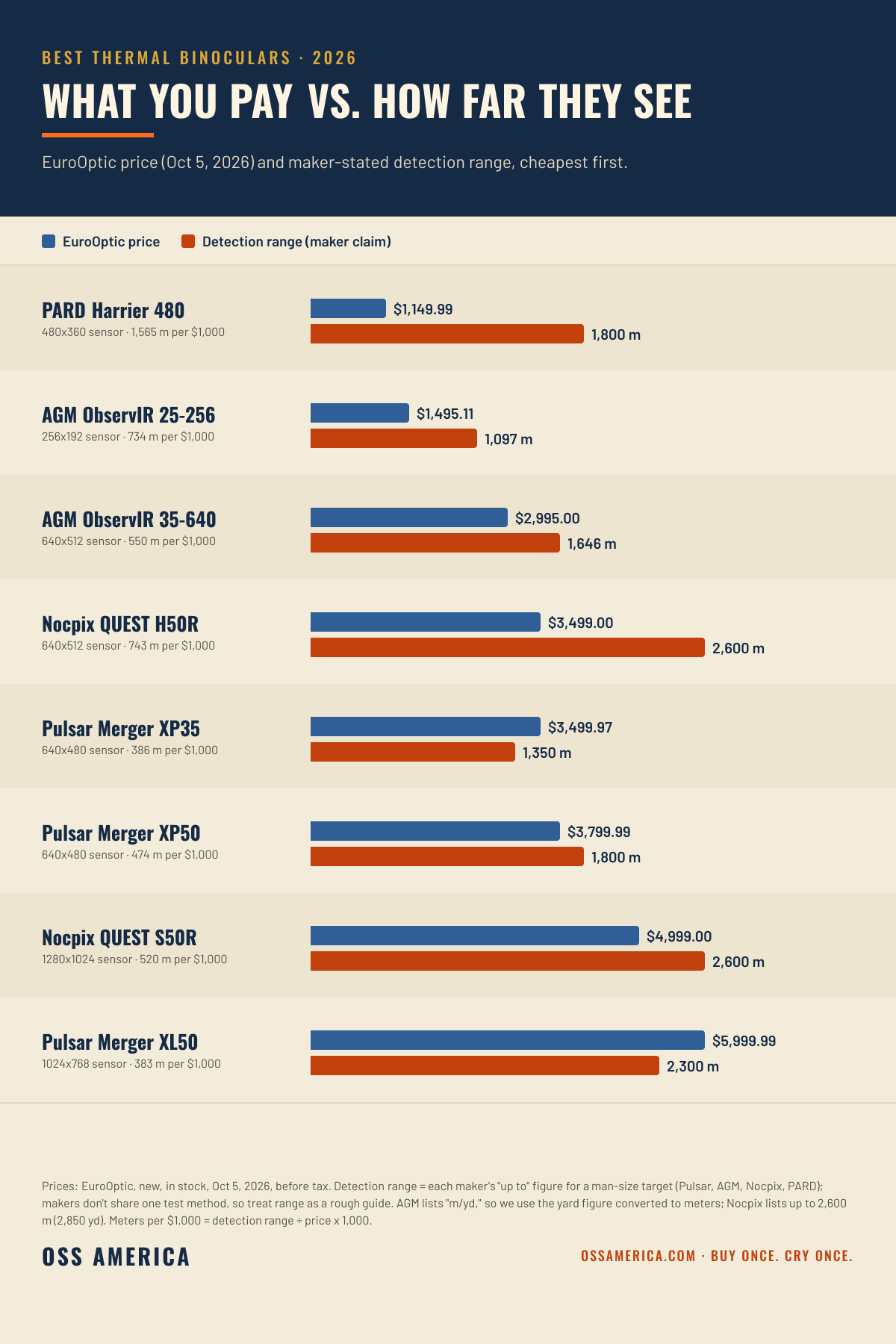
How to read the chart: compare the two bars in each row. When the orange (detection) bar is much longer than the blue (price) bar, you're getting more range per dollar. The Nocpix QUEST H50R stands out among the 640-class units at about 743 meters of claimed detection per $1,000, versus about 474 for the Pulsar XP50. The PARD's number is off the charts, but it's based on PARD's own, optimistic-looking claim.
Before you buy: rules and export
Using thermal optics for scouting and observation is legal in most places, but some states restrict thermal or night vision devices for hunting certain game, or at night. Check your state's current regulations before you take one afield. EuroOptic's thermal listings also carry a U.S. export-control notice: by ordering, you confirm you're a U.S. person and won't export the device. Our Is EuroOptic legit? guide covers how the store handles orders and returns.
The 8 best thermal binoculars, ranked
Nocpix QUEST H50R
Best thermal binoculars overall
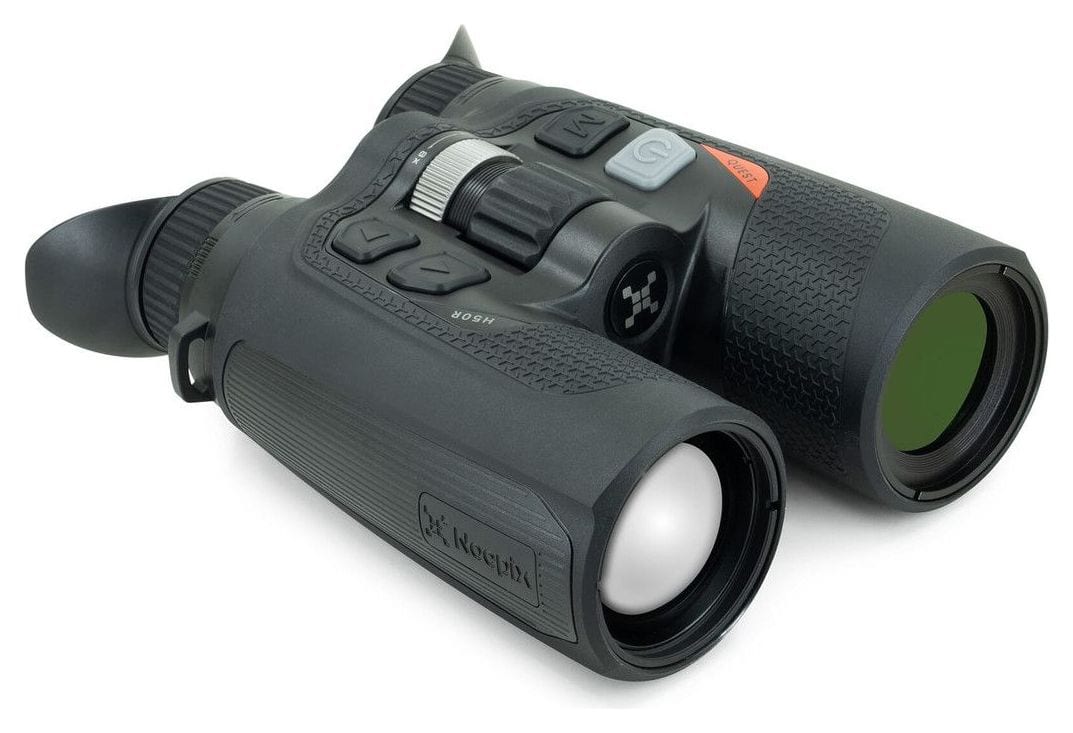
EuroOptic: $3,499.00 (was $3,850.00) · Sensor: 640x512, 12 µm · Detection: up to 2,600 m (2,850 yd)
The QUEST H50R puts the specs you'd expect from a $5,000 binocular into a package that was $3,499.00 at EuroOptic on October 5, 2026. It pairs a 640x512, 12-micron sensor rated at 15 mK or better with a 50 mm F1.1 lens, and it sends that image to two 1920x1200 AMOLED displays, one per eye at full resolution, refreshing at 60 Hz.
Nocpix lists a detection range of up to 2,600 meters (its US site says 2,850 yards), the longest in this guide along with its 1280 sibling, plus a built-in 1,000-yard laser rangefinder that can fire once or run continuously. Magnification runs 4x to 32x. Power is clever: an internal USB-C battery plus a removable 18650 cell (Nocpix USA includes two), so you can hot-swap without shutting down. Nocpix puts the whole QUEST series at 700 to 750 g, lighter than the Pulsars here, with an IP67 rating and a binocular harness in the box.
The trade-off is the narrow 8.8 x 7.0-degree field of view that comes with 4x base magnification. It's built for big open country. Nocpix is a younger brand, and EuroOptic's listing had no reviews yet.
| Sensor | 640x512, 12 µm, NETD ≤15 mK, 60 Hz |
| Lens / magnification | 50 mm F1.1 / 4-32x |
| Field of view | 8.8 x 7.0 deg (15 x 12 m at 100 m) |
| Displays | Dual 1920x1200 AMOLED |
| Rangefinder | 1,000 yd |
| Detection | Up to 2,600 m (Nocpix) |
| Power / weight | Internal + removable 18650 / 700-750 g (series) |
| Protection | IP67 |
Pros
- + Longest detection claim here for under $3,500
- + Full-resolution AMOLED display for each eye
- + Hot-swappable battery setup
- + Lightest 50 mm binocular in this guide
Cons
- − Narrow field of view at 4x base magnification
- − Only 3 left at EuroOptic when we checked
- − Few published owner reviews so far
AGM ObservIR LRF 35-640
Best value: thermal + night vision
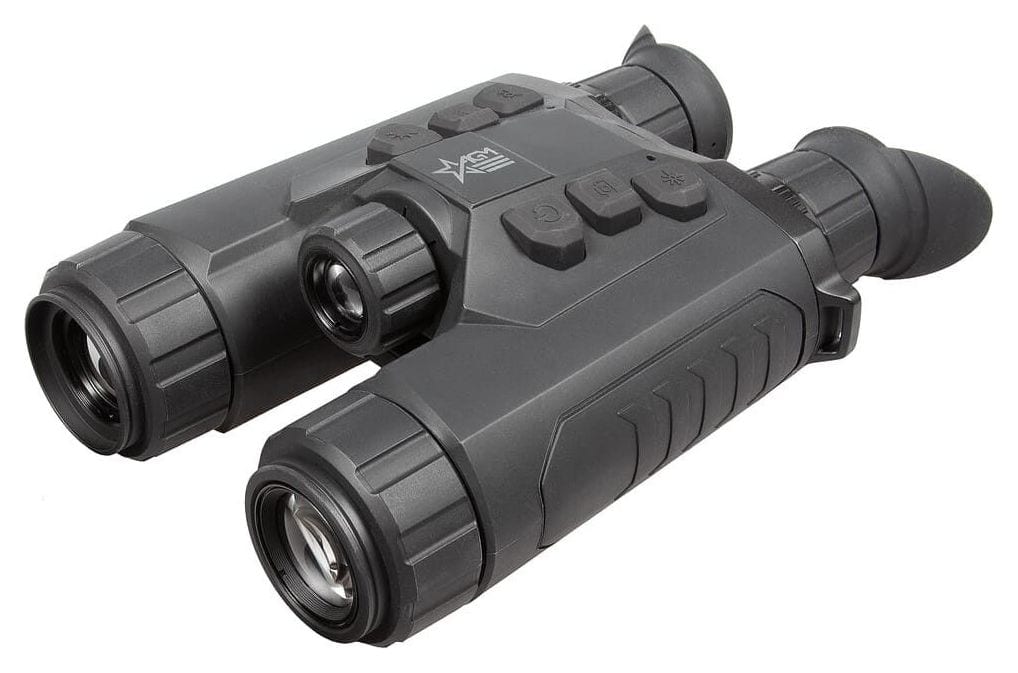
EuroOptic: $2,995.00 (was $4,295.00) · Sensor: 640x512, 12 µm · Detection: 1,800 m/yd (AGM)
The ObservIR LRF 35-640 is really two optics in one housing. One side is a 640x512, 12-micron thermal channel rated under 15 mK; the other is a 4K (3840x2160) ultra-low-light camera with a built-in IR illuminator. The idea, as EuroOptic's listing puts it, is to detect an animal with thermal and then confirm what it is with night vision, which matters when you need to tell a hog from a calf before you shoot.
AGM lists a 35 mm lens, 3x base and 3-22x digital magnification, a 12.5 x 10.1-degree field of view (66 x 53 feet at 100 yards), a 1920x1080 OLED display, 64 GB of storage, IP67 and up to 8 hours of runtime. EuroOptic adds a 1,000 m laser rangefinder, a digital compass and GPS. AGM's detection figure is "1,800 m/yd," and we use the more conservative yard reading in our chart. At 2.01 lb, it's the heaviest binocular here.
The price is what earns it second place. AGM's own site listed it at $3,295; EuroOptic had it at $2,995.00 (was $4,295.00) on October 5, which is a lot of sensor and features for the money.
| Thermal sensor | 640x512, 12 µm, NETD <15 mK, 50 Hz |
| Day/night channel | 3840x2160 low-light sensor + IR illuminator, fusion mode |
| Lens / magnification | 35 mm / 3x base, 3-22x digital |
| Field of view | 12.5 x 10.1 deg |
| Rangefinder | 1,000 m (EuroOptic listing) |
| Detection | 1,800 m/yd (AGM) |
| Battery / weight | Up to 8 h / 2.01 lb |
| Protection | IP67 |
Pros
- + Thermal and 4K night vision in one unit
- + 640 sensor under $3,000 the day we checked
- + Compass, GPS and 64 GB storage
- + Moderate field of view for general scanning
Cons
- − Heaviest binocular here at 2.01 lb
- − Shorter detection claim than the 50 mm models
- − Single 1080p display rather than one per eye
Pulsar Merger LRF XP50
Best Pulsar deal (while it lasts)
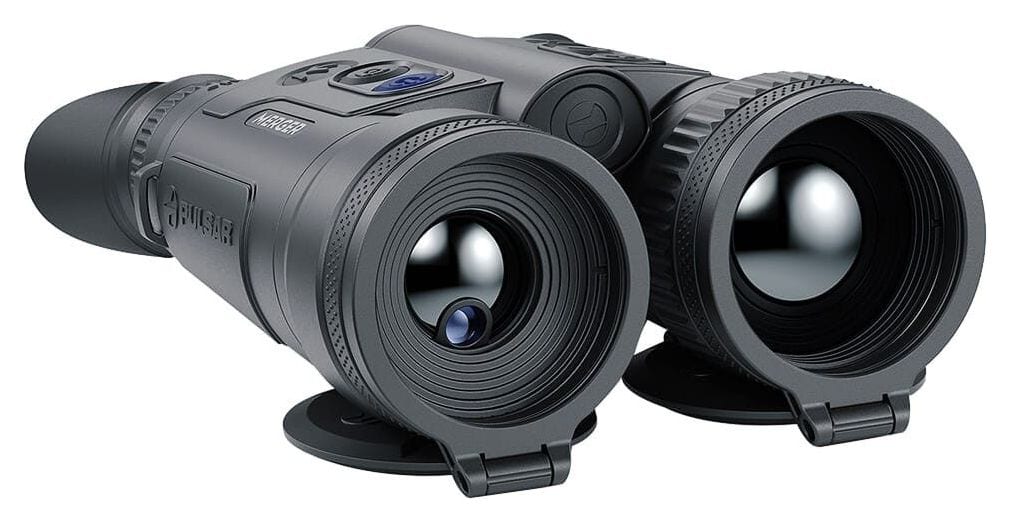
EuroOptic: $3,799.99 (was $5,898.97) · Sensor: 640x480, 17 µm · Detection: 1,800 m
Pulsar's Merger LRF is the thermal binocular a lot of hunters picture when they hear the term, and the XP50 was its long-range workhorse. One thing to know up front: Pulsar's own Merger page now marks the XP50 as discontinued. EuroOptic still had new units in stock on October 5, 2026 at $3,799.99 (was $5,898.97), which is why it's here.
Pulsar lists a 640x480 sensor with 17-micron pixels (under 25 mK at the sensor, under 18 mK for the system), a fast 50 mm F1.0 germanium lens, 2.5-20x magnification, a 12.4 x 9.3-degree field of view, a 1024x768 AMOLED display, a 1,000 m rangefinder and 1,800 m of detection. Two batteries (a removable APS3 pack plus a built-in cell) give up to 8.5 hours, the magnesium housing is IPX7 waterproof, and it weighs 0.95 kg (about 2.1 lb).
Next to our top pick, the XP50 has older 17-micron pixels and a shorter detection claim for slightly more money; what you get is Pulsar's long track record. Just know that "discontinued" can affect future firmware and accessory support.
| Sensor | 640x480, 17 µm, <25 mK sensor / <18 mK system |
| Lens / magnification | 50 mm F1.0 / 2.5-20x |
| Field of view | 12.4 x 9.3 deg |
| Display | AMOLED 1024x768 |
| Rangefinder | 1,000 m |
| Detection | 1,800 m (Pulsar) |
| Battery / weight | Up to 8.5 h, dual / 0.95 kg |
| Status | Discontinued by Pulsar; new stock at EuroOptic |
Pros
- + Big discount from its former list price
- + Fast F1.0 50 mm lens
- + Dual batteries, long runtime
- + IPX7 magnesium housing
Cons
- − Discontinued by Pulsar
- − Older 17-micron sensor
- − Costs more than the Nocpix H50R with a shorter detection claim
Nocpix QUEST S50R
Best high-resolution (1280) pick
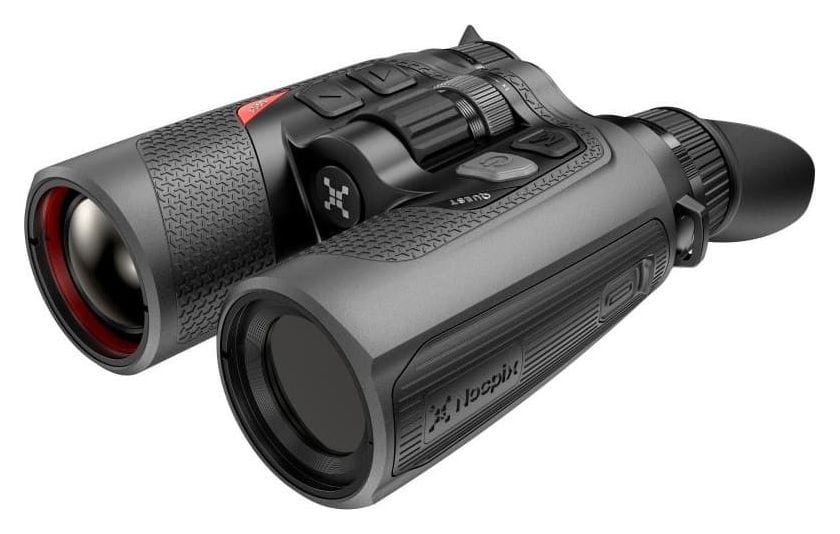
EuroOptic: $4,999.00 · Sensor: 1280x1024, 12 µm · Detection: up to 2,600 m (2,850 yd)
If you want the sharpest thermal image you can buy in a binocular without spending $6,000 or more, the QUEST S50R is the one. It uses a 1280x1024, 12-micron sensor rated at 15 mK or better behind a 50 mm F1.1 lens, which is four times the pixel count of a 640x512 sensor.
The other big win is the field of view: Nocpix lists 17.5 x 14 degrees at its 2x base magnification (30 x 24 m at 100 m), tied for the widest here, so it works for close-range scanning as well as long fields. Magnification runs 2x to 16x digital, detection is up to 2,600 m per Nocpix, and you get the same 1,000-yard rangefinder, dual AMOLED displays, 60 Hz refresh, image stabilization, Wi-Fi app and hot-swap battery setup as the H50R.
EuroOptic listed it at $4,999.00 on October 5, 2026, the same as Nocpix's US price (sold out there). For comparison, Pulsar's own 1280x1024 Merger LRF XT50 was $5,499.97 at EuroOptic the same day.
| Sensor | 1280x1024, 12 µm, NETD ≤15 mK, 60 Hz |
| Lens / magnification | 50 mm F1.1 / 2-16x |
| Field of view | 17.5 x 14 deg (30 x 24 m at 100 m) |
| Displays | Dual AMOLED |
| Rangefinder | 1,000 yd |
| Detection | Up to 2,600 m (Nocpix) |
| Power / weight | Internal + removable 18650 / 700-750 g (series) |
| Protection | IP67 |
Pros
- + 1280x1024 sensor for the most detail
- + Wide field of view for close and far
- + About $500 less than Pulsar's 1280 Merger at EuroOptic
- + Light for a 50 mm binocular
Cons
- − $5,000 is a lot of money
- − Only 5 left at EuroOptic when we checked
- − Few owner reviews yet
Pulsar Merger LRF XL50
Best premium Pulsar
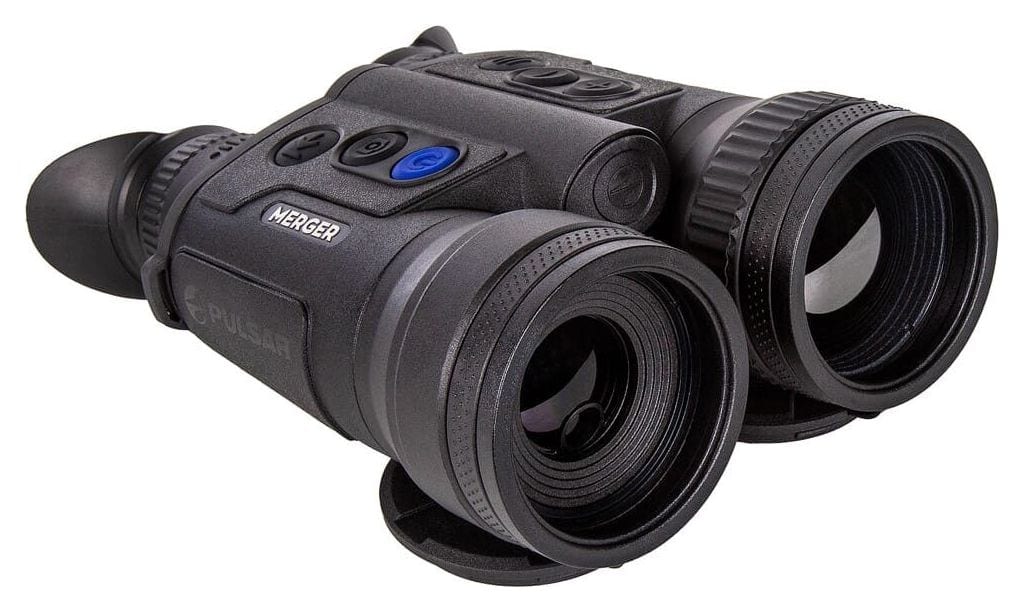
EuroOptic: $5,999.99 · Sensor: 1024x768, 12 µm · Detection: 2,300 m
The Merger LRF XL50 was Pulsar's first HD thermal binocular, and it's still a current model. Pulsar lists a 1024x768, 12-micron sensor (under 40 mK at the sensor, under 20 mK for the system), a 50 mm F1.0 lens, 2.5-20x magnification, a 14 x 10.5-degree field of view and a matching 1024x768 AMOLED display. Pulsar's detection claim is 2,300 m, and the rangefinder reads to 1,000 m.
You also get 64 GB of memory, IPX7 waterproofing, a magnesium housing and the same dual-battery system as the other Mergers, rated for about 7 hours. It weighs 0.95 kg. EuroOptic had it at $5,999.99 on October 5, 2026, with only three left.
Here's the honest comparison: on paper, the Nocpix S50R has more pixels, a wider field of view and a longer detection claim for $1,000 less. The XL50 is the pick if you trust Pulsar's ecosystem, already own Pulsar gear, or want the brand most guides and outfitters carry.
| Sensor | 1024x768, 12 µm, <40 mK sensor / <20 mK system |
| Lens / magnification | 50 mm F1.0 / 2.5-20x |
| Field of view | 14 x 10.5 deg |
| Display | AMOLED HD 1024x768 |
| Rangefinder | 1,000 m |
| Detection | 2,300 m (Pulsar) |
| Battery / weight | About 7 h, dual / 0.95 kg |
| Memory / protection | 64 GB / IPX7 |
Pros
- + HD sensor from the best-known thermal brand
- + Fast F1.0 lens and 64 GB memory
- + Current Pulsar model
- + Rugged magnesium, IPX7 housing
Cons
- − Most expensive binocular here
- − Fewer pixels than the cheaper Nocpix S50R
- − Only 3 left at EuroOptic
Pulsar Merger LRF XP35
Widest view for close cover
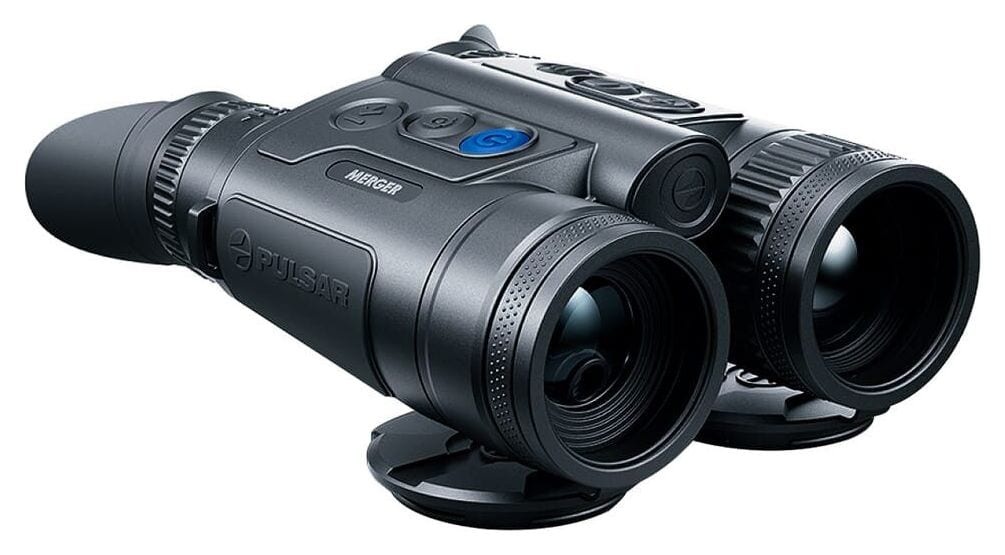
EuroOptic: $3,499.97 · Sensor: 640x480, 17 µm · Detection: 1,350 m
Most deer and hogs are spotted well inside a mile, and in brush or timber you need to see a wide slice of ground, not a pinhole far away. The Merger LRF XP35 is Pulsar's answer: its 35 mm lens gives a 17.8 x 13.3-degree field of view at 2x, which Pulsar calls the widest in its class, and it's the lightest Merger at 0.83 kg (about 1.8 lb).
Pulsar lists a 640x480, 17-micron sensor (under 25 mK sensor, under 18 mK system), 2-16x magnification, a 1024x768 AMOLED display, a 1,000 m rangefinder, IPX7, 16 GB of memory and the longest runtime of any Pulsar here at about 9 hours. The detection claim is 1,350 m, shorter than the 50 mm models, which is the trade for the wide view.
EuroOptic had it at $3,499.97 on October 5, 2026 with two left. Same money as the Nocpix H50R: pick wide and close (XP35) or narrow and far (H50R).
| Sensor | 640x480, 17 µm, <25 mK sensor / <18 mK system |
| Lens / magnification | 35 mm F1.0 / 2-16x |
| Field of view | 17.8 x 13.3 deg |
| Display | AMOLED 1024x768 |
| Rangefinder | 1,000 m |
| Detection | 1,350 m (Pulsar) |
| Battery / weight | About 9 h, dual / 0.83 kg |
| Protection | IPX7 |
Pros
- + Widest field of view in this guide
- + Lightest Pulsar here
- + Longest Pulsar runtime
- + Current model
Cons
- − Shortest detection claim of the 640-class units
- − 17-micron sensor
- − Only 2 left at EuroOptic
AGM ObservIR LRF 25-256
Best budget thermal + night vision
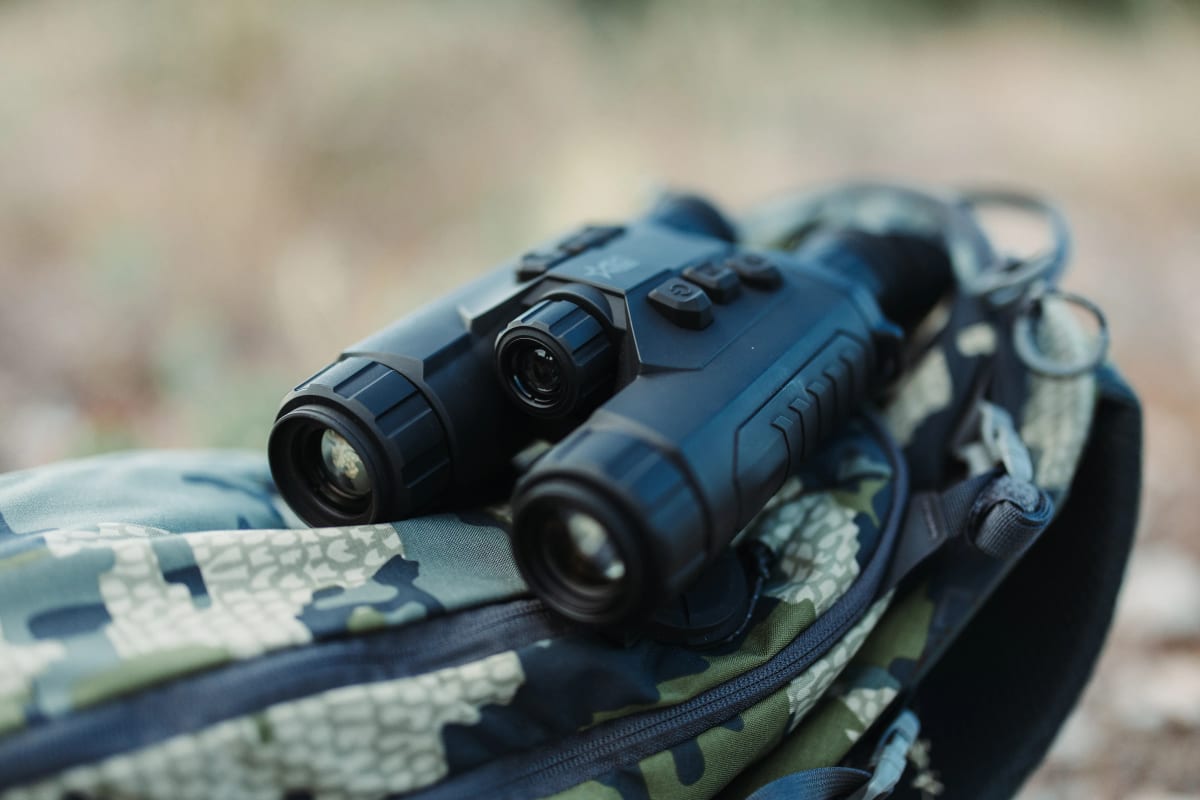
EuroOptic: $1,495.11 (was $1,595.00) · Sensor: 256x192, 12 µm · Detection: 1,200 m/yd (AGM)
If you want thermal binoculars with a rangefinder and night vision for about $1,500, the ObservIR LRF 25-256 is the entry ticket. It shares the larger ObservIR's design: a thermal channel plus a 4K ultra-low-light day/night camera with IR illuminator, a fusion mode, a 1080p OLED display, 64 GB storage, compass, GPS, Wi-Fi and up to 8 hours of runtime.
The thermal sensor is the compromise: 256x192 pixels at 12 microns, under 35 mK, behind a 25 mm lens. AGM lists 4.5x base magnification (4.5-18x digital), a narrow 7.0 x 5.3-degree field of view and a "1,200 m/yd" detection figure. It weighs 1.96 lb.
EuroOptic listed it at $1,495.11 (was $1,595.00) on October 5, 2026 (AGM's own site: $1,644.50). If you can stretch your budget, the 640-sensor ObservIR 35-640 is a big step up in image quality.
| Thermal sensor | 256x192, 12 µm, NETD <35 mK, 50 Hz |
| Day/night channel | 3840x2160 low-light sensor + IR illuminator |
| Lens / magnification | 25 mm / 4.5x base, 4.5-18x digital |
| Field of view | 7.0 x 5.3 deg |
| Rangefinder | 1,000 m (EuroOptic listing) |
| Detection | 1,200 m/yd (AGM) |
| Battery / weight | Up to 8 h / 1.96 lb |
| Protection | IP67 |
Pros
- + Thermal, night vision and a rangefinder for about $1,500
- + Compass, GPS, 64 GB storage
- + Long 8-hour runtime
- + In stock with free 2-day shipping listed
Cons
- − Low-resolution 256x192 thermal sensor
- − Narrow field of view
- − Heavy for its class
PARD Harrier 480 35 LRF
Lowest price
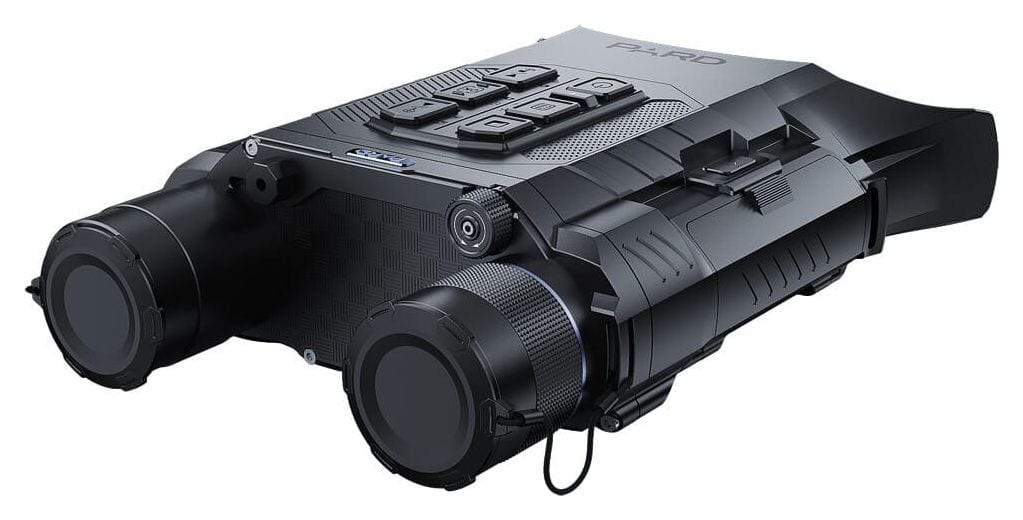
EuroOptic: $1,149.99 (was $2,999.00) · Sensor: 480x360, 12 µm · Detection: 1,800 m (PARD)
The PARD Harrier 480 was the cheapest rangefinding thermal binocular we found in stock: $1,149.99 at EuroOptic on October 5, 2026, marked down from $2,999.00. For that, PARD lists a 480x360, 12-micron VOx sensor rated at 20 mK or better, a 35 mm multi-coated lens, 2.4x optical magnification with 2/4/6/8x digital zoom, a 9.4 x 7.1-degree field of view and a 1,000 m rangefinder.
It's also the lightest binocular here at 553.5 g with its battery, and it runs on a common 21700 Li-ion cell for up to 8 hours. The display is a 640x480 LCD, a step down from the AMOLED screens on the pricier units.
PARD claims 1,800 m of detection, which is why it tops our meters-per-dollar math by a mile. Take that number with a grain of salt: makers don't use one shared test, and a 480x360 sensor behind a 35 mm lens claiming the same range as Pulsar's 50 mm XP50 is optimistic. Judge it as a solid, light, low-cost scanner for typical hunting distances. EuroOptic showed only two left.
| Sensor | 480x360, 12 µm VOx, NETD ≤20 mK, 50 Hz |
| Lens / magnification | 35 mm / 2.4x optical, 2-8x digital |
| Field of view | 9.4 x 7.1 deg |
| Display | LCD 640x480 |
| Rangefinder | 1,000 m |
| Detection | 1,800 m (PARD claim) |
| Battery / weight | One 21700, up to 8 h / 553.5 g |
| Protection | IP67 |
Pros
- + Lowest price in this guide
- + Lightest binocular here
- + Common 21700 battery and microSD storage
- + Rangefinder, Wi-Fi and HDMI out
Cons
- − LCD display, not AMOLED
- − Detection claim looks optimistic for the hardware
- − Only 2 left at EuroOptic when we checked
Which should you buy?
- You want the best all-around thermal binocular under $3,500: Nocpix QUEST H50R.
- You need to identify, not just detect (hogs vs. livestock): AGM ObservIR LRF 35-640 with its night-vision channel.
- You want a Pulsar for less: Pulsar Merger LRF XP50 while stock lasts.
- You want the most image detail: Nocpix QUEST S50R, or the Pulsar Merger LRF XL50 if you're set on Pulsar.
- You hunt timber and brush: Pulsar Merger LRF XP35 for the widest view.
- Your budget is about $1,500 or less: PARD Harrier 480 or AGM ObservIR LRF 25-256.
What to look for in thermal binoculars
- Sensor resolution. 640x480 or 640x512 is the sweet spot for most hunters. 1024x768 and 1280x1024 sensors show more detail and zoom better; 256x192 and 384x288 sensors are fine for detection but struggle with identification at distance.
- Pixel size and NETD. Smaller pixels (12 microns vs. 17) and a lower NETD (15 to 25 mK) generally mean a crisper image with more contrast in fog, rain and humid nights.
- Lens and field of view. A 50 mm lens reaches farther; a 35 mm lens usually gives a wider view for close cover. Match it to where you hunt.
- Display. Dual full-resolution displays (Nocpix) or AMOLED screens (Pulsar) are easier on your eyes during long scanning sessions than a single LCD.
- Rangefinder and power. Every unit here has a built-in rangefinder (about 1,000 m or yards). Look for removable or hot-swappable batteries if you sit for long nights.
Weighing other night optics? See our best thermal scopes guide. For daytime glass, our best binoculars for hunting roundup covers traditional optics, and the 25 hunting essentials list fills out the rest of the pack.
Frequently asked questions
What are the best thermal binoculars for the money?
Based on specs and October 5, 2026 prices, the Nocpix QUEST H50R: a 640x512, 12-micron sensor, dual 1920x1200 AMOLED displays, a 1,000-yard rangefinder and up to 2,600 m of detection for $3,499.00 at EuroOptic. The AGM ObservIR LRF 35-640 at $2,995.00 is the value pick if you also want night vision.
Are thermal binoculars better than a thermal monocular?
For long scanning sessions, many hunters prefer binoculars because you look with both eyes, which is less tiring and feels natural. Monoculars are lighter and cheaper for the same sensor, so they suit quick looks.
How far can thermal binoculars see?
Makers list detection ranges for a man-size heat signature: from about 1,100 m (AGM ObservIR 25-256) to up to 2,600 m (Nocpix QUEST 50 mm models) in this guide. Detection means you can see a warm spot, not identify what it is. Identification happens at much shorter distances, and fog, rain and humidity cut range.
Do thermal binoculars work in daylight?
Yes. Thermal sensors read heat, not light, so they work day or night. In daylight they help spot animals in shade or tall grass and find downed game.
Is it legal to hunt with thermal binoculars?
Using thermal for observation and scouting is legal in most of the U.S., but rules for using thermal or night vision devices while hunting vary by state and by species, and some states restrict nighttime use. Check your state wildlife agency's current regulations. This isn't legal advice.
What does NETD mean on a thermal binocular?
NETD (noise equivalent temperature difference) is the smallest temperature difference the sensor can detect, in millikelvin (mK). Lower is better: the units here range from 15 mK or better (Nocpix, AGM 640) to under 40 mK at the sensor (Pulsar XL50, which Pulsar rates under 20 mK for the full system).
The bottom line
Buy the Nocpix QUEST H50R if you want the most thermal binocular for under $3,500. Pick the AGM ObservIR LRF 35-640 if you need night vision to confirm targets, and grab the Pulsar Merger LRF XP50 while it's discounted if you want a Pulsar. Check your state's thermal and night-hunting rules first.
Get the free Blackout-Ready Home Checklist — join the OSS America newsletter for honest gear guides like this one, straight to your inbox.
Talk soon,
OSS AMERICA
God · Family · Country · Gear that earns its keep.
Advertisement
FTC Disclosure: OSS America contains affiliate links. We earn a commission from qualifying purchases at no extra cost to you — we only point you at gear we'd stake our own trip on.
More reviews
 Top PickHunting
Best Duck Hunting Shotguns (2026): 8 Picks From $530 to Premium
Benelli SBE 3, Franchi Affinity 3.5, Winchester SX4, Beretta A400, Mossberg 940 and more: we compare eight duck guns on action, chamber, weight and real October 2026 prices, with honest pros and cons.
 Top PickHunting
Best Duck Decoys (2026): 8 Picks From Avian-X, Higdon, GHG, MOJO and Lucky Duck
Avian-X, Higdon, Greenhead Gear, MOJO and Lucky Duck: we compare eight duck decoy packs and motion decoys on price per decoy, size, keel and ratings, with real October 2026 prices.
 Top PickHunting
Best Hunting Chairs (2026): 8 Swivel and Blind Chairs, Ranked
Browning, Muddy, ALPS, BOG, Millennium, Allen and Ameristep: we compare eight hunting and blind chairs on swivel, height, capacity, weight and real October 2026 prices.
 Top PickHunting
Best Deer Feeders (2026): 7 Picks From $30 to 600 lb
Moultrie, American Hunter, Wildgame, Boss Buck and Tectonic: we compare seven deer feeders on capacity, timers, power and real October 2026 prices, with honest pros and cons and a cost-per-pound chart.
 Top PickHunting
Best Elk Hunting Rifles (2026): 7 Picks for Every Budget
Tikka, Bergara, Christensen, Browning, Weatherby, Savage and Winchester: seven elk rifles in .300 Win Mag, 7mm PRC, .300 Wby Mag and .30-06, compared on weight, fit, guarantees and real October 2026 prices.
 Top PickHunting
Best Heated Vests (2026): 8 Picks for Men, Women and Hunters
ActionHeat, Fieldsheer and Muddy heated vests compared on heat zones, battery, listed runtime and real October 2026 prices, with men's and women's options and honest pros and cons.