
WOSPORTS NV400 Night Vision Binoculars Review: Affordable Eyes in the Dark
Advertisement
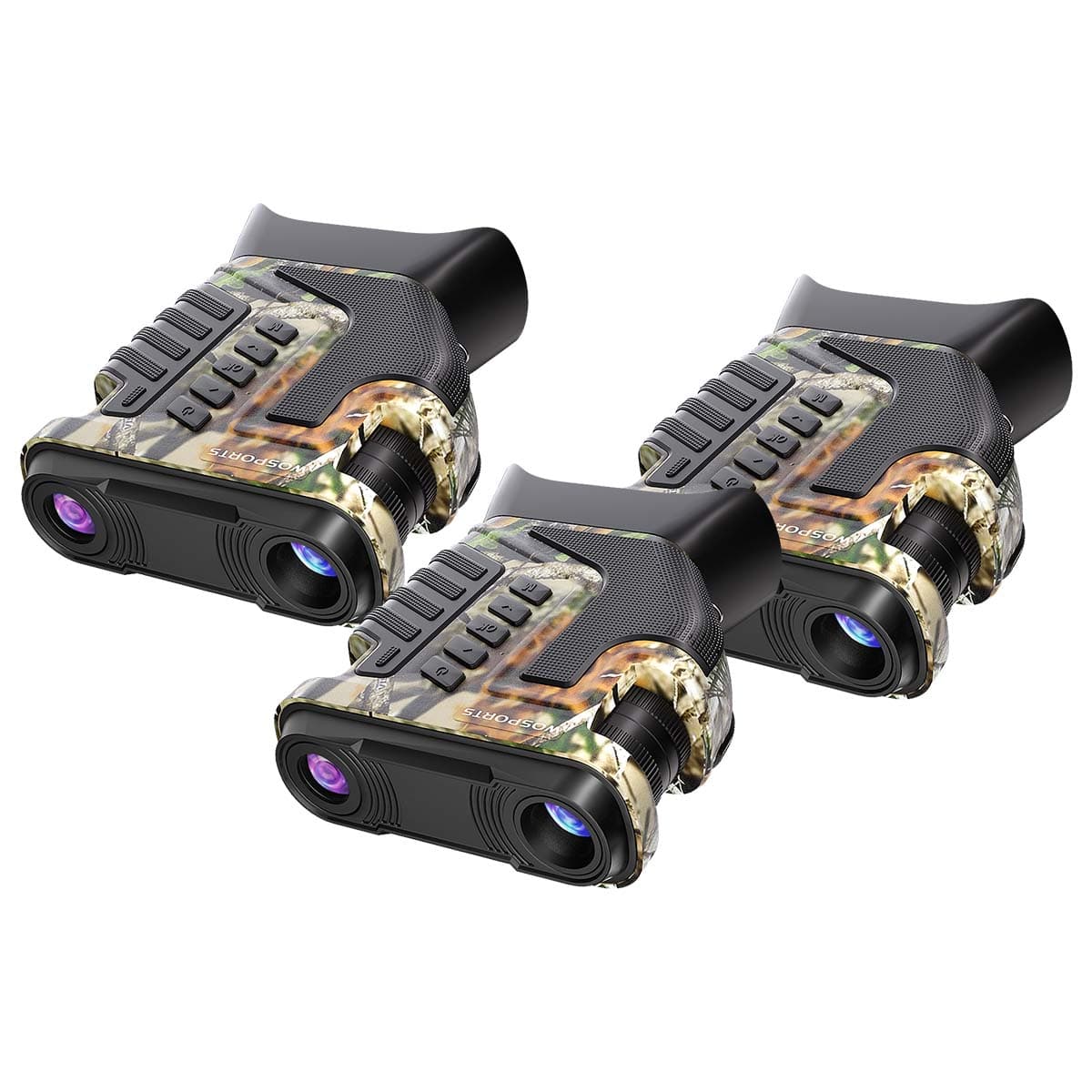
Something's in the chicken coop at 2 a.m. The coyotes are working the back fence. A truck rolls slow past the gate with its lights off. The common thread? It all happens in the dark — and the naked eye gives you nothing. The WOSPORTS NV400 hands you the one advantage that changes that: the ability to see when whatever you're watching for still thinks it's invisible.
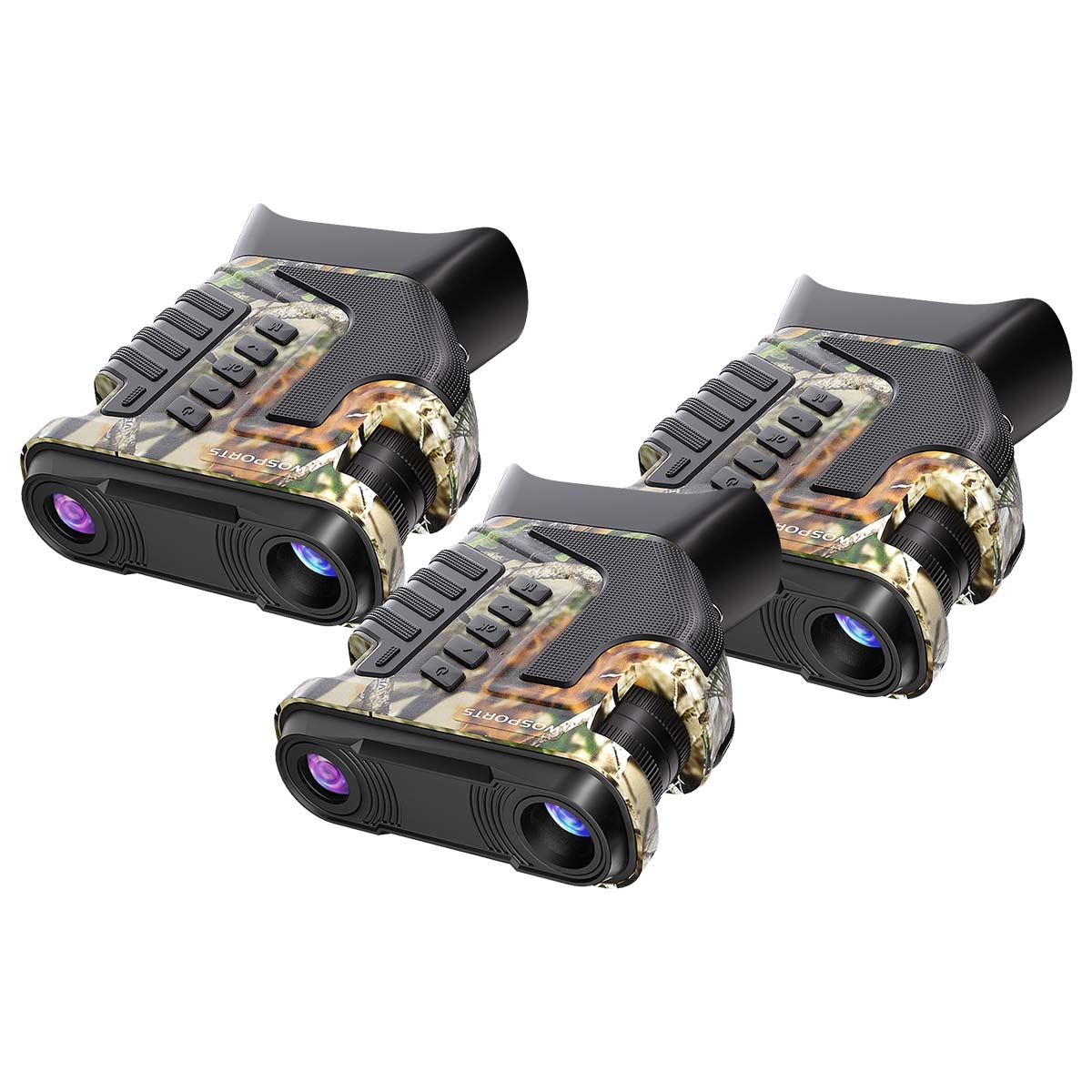
Real night vision used to mean $2,000 minimum and a two-week wait for a Gen-2 tube. Digital IR binoculars flipped that math. The NV400 costs a fraction of that, hits usable 300-meter range on a moonless night, records what you see to an SD card, and — in the bundle we've been recommending — ships as a 3-pack so the whole crew has eyes instead of passing one unit around and missing the animal.
Check today's price on the NV400 3-Pack →
The short version
The WOSPORTS NV400 is a digital infrared binocular built around a 4x optical / 8x digital zoom, a 2.31″ internal display, a 3W IR illuminator, and up to 300 meters of pitch-black viewing range. It photos and videos to a microSD card so you're not just looking — you're recording. At its price point it isn't competing with $3,000 Gen-3 monoculars; it's competing with staring into the darkness with a $30 flashlight and hoping. That's the fight it wins.
Real specs (not marketing bullets)
From the WOSPORTS spec sheet, verified against the product page:
| Specification | WOSPORTS NV400 |
|---|---|
| Optical zoom | 4x |
| Digital zoom | Up to 8x |
| Sensor | 1/3″ CMOS, 1280 x 720 |
| Display | 2.31″ internal TFT LCD |
| IR illuminator | 3W, 7-level adjustable, 850nm |
| Effective range (full dark) | Up to ~300m / 984 ft |
| Photo resolution | 1280 x 960 (JPEG) |
| Video resolution | 1280 x 720 @ 30fps (AVI) |
| Storage | microSD, up to 32GB (not included) |
| Power | 8 x AA batteries (not included) |
| Battery runtime | ~4-6 hrs continuous with IR on |
| Ports | Mini USB, AV out, microSD |
| Weight | ~1.3 lb / 590 g |
| Water resistance | IPX4 (splash-resistant, not submersible) |
Two numbers matter most: the 300-meter range and the 3W IR illuminator. That IR power is what separates the NV400 from the sub-$100 toys that top out at 50-100 meters and lose the image any time a stiff breeze kicks up dust. Three watts is enough to punch through light fog, spot a coyote at the tree line, and give you a full-frame image of a deer at the far end of a bean field.
Why the sensor and IR wavelength actually matter
The spec sheet says "850nm IR" and most buyers scroll past it. That single number is the biggest reason the NV400 outperforms the $80 toys and undercuts the $600 units on real-world usability.
850nm is the wavelength most digital IR systems land on because it hits the sweet spot between two competing pressures: sensor sensitivity and covertness. CMOS sensors respond strongly to near-infrared in the 800-900nm band, which is why the image is bright and usable. But 850nm still emits a faint red glow at the emitter — visible to a human standing next to you, invisible to almost every hoofed and canid animal you're glassing at. Some premium digital systems shift to 940nm to be fully covert to human eyes as well, and typically give up some illumination range at the same power. The NV400 splits the difference correctly for the job most owners bought it to do.
The 1/3-inch CMOS sensor is the second underrated number. That's a mid-tier sensor size — larger than the 1/4-inch chips in the $80 units, smaller than the 1/2.7-inch and 1/2.3-inch chips in the $600 tier. Sensor area drives low-light performance directly: more surface area, more photons captured per pixel. A 1/3-inch chip is the smallest size we'd tolerate for the 300-meter range claim to hold up in the field. Anything smaller and you're extrapolating.
Where it fits
Specs are one thing. Here's where the NV400's stated capabilities line up with real jobs.
Predator control on a farm or ranch
Coyotes working the back fence at night is the classic job for this unit. A 3-pack puts one glasser at the barn, one at the gate and one walking the fence line. The stated range of up to ~300 meters and the 7-level IR are built for picking up movement at the treeline, and recording to microSD means you can review what came through instead of relying on memory.
Pre-season deer scouting
Before opening day, the question is where deer are crossing at night. This is pure observation with no weapon in hand. The 4x optical zoom is for scanning the field; the 8x digital zoom is for identifying what you just spotted. Recorded clips from several nights can help you map movement patterns before you hang a stand. Check your state's rules first (see the FAQ below).
Family camp
Around a campfire, a 3-pack lets the kids take turns spotting wildlife at the treeline without anyone stepping away from the fire with a flashlight, and the recorded video can go home as the trip souvenir. The point of the 3-pack is right here — one unit for a family of six is a fight; three units is a shared experience.
Cold-weather use
The failure mode to watch for in the cold is battery sag. Alkalines fade fast under IR draw; lithium AAs hold up far better in low temperatures (see the tips below). Cold performance is a function of your batteries more than the unit itself.
What to expect from the image
The image on the internal screen is monochrome green-tinted (standard for digital IR — this is the sensor showing you infrared reflectance, not amplified starlight). Center-frame sharpness is clean out to about 200 meters; past 250 you're identifying shapes and movement rather than reading a face. That's fine for the jobs these are actually for.
The 7-level IR adjustment is the feature most owners underuse. On max IR at close range (say, checking a barn 30 feet away) you'll blow out the image — everything reflective goes bright white. Dial it to level 2 or 3 for anything under 100 feet and the image cleans up dramatically. Save the max setting for genuine long-range scanning.
Battery life on 8x AA lithium (Energizer Ultimate or Amazon Basics lithium) is where the runtime numbers hold. Alkalines fade fast when the IR is running at full power — plan on rechargeable NiMH or lithium AAs and you'll double the practical runtime.
Who this is for
- Property owners running predator control — coyotes, hogs, and raccoons work the fence line at night. A 3-pack means one glasser at the barn, one at the gate, one at the pasture, all seeing the same field.
- Hunters scouting a stand or property before opening day — legal, no-round-in-the-chamber observation of movement patterns, bedding areas, and travel corridors after dark.
- Rural homeowners with a security concern — driveway watch, livestock check, "what was that noise" without stepping outside with a flashlight that announces you.
- Camping and overland groups — night hikes, wildlife spotting around camp, checking on the kids in the tent from 50 yards out.
- Anyone teaching kids about the outdoors after sundown — a 3-pack turns "sit still in the dark" into "look what's out there right now," and that's the trip they remember.
Who this is NOT for
Honest limits, because the wrong buyer is the one who leaves a 1-star review that helps nobody:
- Anyone expecting military-grade Gen-2 or Gen-3 performance. The NV400 is a digital IR system. On a moonless overcast night with no IR, you see nothing. It is not a passive light-amplification tube. If that distinction matters to your mission, save up for a PVS-14 and skip this entirely.
- Long-range shooters. There is no reticle, no ranging, no rail mount, no windage or elevation adjustment. This is an observation binocular. It shows you what's there — a weapon-mounted night vision setup is a different product category.
- Anyone glassing in heavy fog, snow, or dense rain. IPX4 shrugs off splash, but the IR beam scatters badly in weather. Wait for a clear window.
- Users who want no learning curve. First-time digital-IR owners always compare it to daylight optics and get disappointed. Give it three sessions before you form an opinion — you'll find the IR settings and framing that make it click.
- Ultra-long-range spotters. Past 300 meters you're guessing. If your property is 800 acres of open field, you want a thermal spotter, not this.
How it compares to the other digital IR binoculars people cross-shop
These are the three units the NV400 gets compared to on shooting and hunting forums. All are Amazon-available digital IR binoculars in a similar class. All have real trade-offs.
| Model | Range | Zoom | Recording | Notes |
|---|---|---|---|---|
| WOSPORTS NV400 (3-Pack) | ~300m | 4x / 8x digital | 720p video, JPG photo | Best value in a multi-unit bundle; whole crew equipped for the price of one competitor |
| Nightfox Corsac 7x50 | ~150m | 7x | None (view-only) | Higher magnification, no recording, shorter effective IR range; better glass, worse for documentation |
| Bestguarder NV-800 | ~400m | 7x / 2x digital | 1080p video, photo | Longer stated range and higher video resolution, roughly 2-3x the single-unit price of an NV400 |
| CREATIVE XP Digital Night Vision Goggles | ~400m | 3x / 8x digital | 1080p video, photo | Head-strap style monocular pair, hands-free, higher price per unit; different use case (walking) vs. glassing |
The pattern: for a single-user glasser who wants the longest range and highest recording quality, the Bestguarder NV-800 or a CREATIVE XP is the honest pick. For anyone who needs to equip a group — a hunting party, a property crew, a family — the NV400 3-pack math wins by a wide margin. Three units for less than one premium unit is not a rounding error; it's a different job entirely.
Pro tips
- Buy the microSD before the trip. The NV400 takes up to 32GB microSD and records everything to it. Nothing worse than seeing a bobcat in the pasture and realizing you can't prove it. A $10 SanDisk 32GB Class 10 is all you need.
- Run lithium AAs, not alkalines. Alkalines sag under the IR draw and run out noticeably sooner. Energizer Ultimate Lithium AAs hold their voltage better under the IR load and don't die when it's 20°F outside.
- Kill the IR when you don't need it. Under a bright moon, the ambient light is often enough for the sensor. Turn IR off (or to level 1) and your effective range actually improves because you're not washing out reflective surfaces in close.
- Match magnification to the job. 4x optical is for scanning fields; 8x digital is for identifying what you just spotted. Don't glass on max zoom or you'll miss half the movement in the frame.
- Learn the AV-out trick. The NV400 has an AV output. Run a $8 RCA-to-HDMI adapter and you can spot a coyote through the binocular while everyone else in the cabin watches the same feed on the TV. Great for training new users.
- Handhold or tripod? Above 4x, image shake is real. Any $30 tabletop tripod with a standard 1/4"-20 mount stabilizes the frame and doubles your identification range.
- Stage them where they'll be used. In a 3-pack, one goes at the truck (glovebox), one lives at the barn or observation post, one stays with the person walking the property. Nobody has to remember where "the night vision" is.
Care and maintenance — make these last 10 years, not 2
Digital IR binoculars are more electronics than glass. Treat them like a trail camera plus a camcorder and they'll outlive the trend. Neglect them like a set of cheap toys and the sensor stack, the IR emitter, or the AA contacts will fail inside two seasons.
Clean the objective and IR emitter with the right cloth. A microfiber lens cloth is fine for the objective lenses. The IR emitter lens is the small dome that looks slightly recessed on the front — do not wipe it with a shirt or a paper towel. Micro-scratches on that surface scatter the beam and cut your effective range. A puff of canned air first, then a microfiber pass, is the whole routine.
Pull the batteries between sessions. AA cells left in the tray for months are the single most common reason these units die. Alkalines leak potassium hydroxide onto the spring contacts and the corrosion works its way into the PCB. If the unit is going in a drawer for more than two weeks, batteries come out.
Storage climate matters. The internal LCD and CMOS sensor hate humidity swings. A cheap dry box (Pelican-style, with a $3 silica pack) prevents fogging on the internal optic path — a symptom that reads as blurry-image-that-won't-focus and gets misdiagnosed as a broken unit. Store the unit at room temperature with the objective caps on.
Protect the AV and USB port covers. The rubber flaps over the AV-out and mini-USB ports are what makes the IPX4 rating real. Once those tear off, you have open holes into the electronics. Replacement flaps are not a stocked part; a small strip of gaffer tape is a serviceable field fix if one goes missing.
Warranty path. WOSPORTS honors a manufacturer warranty on defects; the practical route is to contact them through the seller of record on your order (Amazon return window covers most out-of-box issues; direct WOSPORTS support handles anything past 30 days). Keep the order confirmation email and the serial number on the underside of the unit — both are asked for on the first support ticket.
Alternatives at three price tiers
If the NV400 3-pack isn't the right shape for your situation, here's the honest map of what a $50-ish, $200-ish, and $500-ish night vision purchase actually gets you.
The budget tier (~$50-80): entry-level digital IR
Units in this bracket — the kids-oriented digital night vision goggles that flood Amazon — max out around 100-150 meters, drop to a ~1/4-inch sensor, and record at 480p if they record at all. They're a real product for what they are (backyard fun, teaching kids to spot wildlife inside 50 yards) and a terrible product for anything past that. The rule of thumb: if the listing lead image has a child using them, they're not a serious observation tool.
The value tier (~$200-350): where the NV400 sits
The NV400 3-pack, the single-unit Nightfox Corsac 7x50, and the CREATIVE XP digital night vision binoculars all live here. 200-300 meter honest range, 720p or 1080p recording, real 3W-class IR emitters, mid-tier CMOS sensors. This is the tier where the product actually earns its keep for predator control, scouting, and property watch. The NV400 wins on unit-count (3 in the pack) rather than on any single-spec superiority.
The premium tier (~$500-800): longer range, higher resolution
The Bestguarder NV-800 and the ATN BinoX 4K anchor this tier. You're paying for a larger sensor (1/2.7-inch or better), a stronger IR emitter (5W-plus), longer effective range (400-500m), and 1080p or 4K recording with rangefinding on the ATN. This is the honest step up for a single-user glasser who needs the range and image quality more than they need three units. Above this tier you're in real thermal spotter territory ($1,500+) and that's a different tool for a different job.
Want night vision on your rifle instead of in your hands? See our best night vision scopes guide.
FAQ
Does the NV400 work in complete darkness?
Yes — that's the entire point of the built-in IR illuminator. The 3W IR emitter throws its own infrared "flashlight" that the sensor sees but human eyes cannot. On a moonless overcast night with the IR on max, you get usable image out to roughly 300 meters. With the IR off in true zero-light, you see nothing (this is digital IR, not light amplification).
Can I use these for hunting? Is that legal?
Rules vary sharply by state and by species. In many states night vision is legal for coyote, hog, and other non-game predator control on private land — but not for taking whitetail or other game animals. Check your state's specific regulations before you glass with intent. Observation and scouting (with no weapon in hand) is legal essentially everywhere.
What's the difference between digital night vision and Gen-2/Gen-3 night vision?
Gen-2 and Gen-3 use a physical image-intensifier tube to amplify ambient starlight — no IR illuminator needed, no digital sensor, image is analog and instant. That tech starts at $1,500 and runs past $4,000. Digital night vision (like the NV400) uses a CMOS sensor and an IR illuminator to see in the infrared spectrum, then shows you the image on an internal screen. Cheaper, more versatile (records video), but you're painting the scene with IR rather than passively amplifying light.
Do animals see the IR beam?
Most mammals cannot see 850nm IR — coyotes, hogs, deer, raccoons all pass. Some species (particularly certain cats and a few nocturnal predators) can pick up a faint red glow from the emitter at close range. For 95% of predator-control and observation work, the IR is invisible to your target.
Can these mount to a rifle or scope?
No, and you shouldn't try. The NV400 is a handheld binocular observation tool with no rail interface, no reticle, and no recoil rating. Trying to Frankenstein it onto a weapon is how you ruin a good binocular and miss shots. If you want weapon-mounted night vision, that's a different (and much more expensive) product category — an ATN or Sightmark digital scope, or a real PVS-14 on a clip-on mount.
How long does the battery last?
On 8 x lithium AA batteries with the IR at level 3-4, expect 5-6 hours of continuous use. On alkalines, cut that roughly in half. If you're running a long night session, throw a fresh set of 8 in your pack — a full swap takes under a minute.
Will it work through a window?
Partially. IR reflects hard off glass — the emitter will bounce a bright halo back into the sensor and blow out the near-field image. If you're glassing from inside a cabin or a truck, kill the IR entirely and rely on whatever ambient light is available (moon, porch light, distant streetlight). Alternately, crack the window and shoot the beam through the opening rather than through the pane. Fully closed double-pane windows are essentially unusable.
What microSD card format does it need?
FAT32-formatted microSD, class 10 or faster, up to 32GB. Cards larger than 32GB (or formatted exFAT out of the package) will not mount. If a new card doesn't read, format it to FAT32 on a laptop first — Windows' default format tool handles this natively; on a Mac use Disk Utility and choose MS-DOS (FAT). A SanDisk 32GB Ultra runs about $10 and is the reliable pick.
Can two units interfere with each other in the same area?
Effectively no. All three NV400s in a 3-pack emit at the same 850nm wavelength, but IR from one unit doesn't confuse another unit's sensor unless you deliberately shine one directly into another's objective from close range. On a property with glassers spread 100+ yards apart, each unit sees its own IR-lit field independently.
What's the field of view at 4x?
Roughly 10-11 degrees horizontal at the 4x optical setting — enough to hold a full-width bean field at 200 meters in one frame. On 8x digital the FOV narrows to about 5 degrees, which is why we recommend spotting at 4x and identifying at 8x. Trying to scan on 8x means you'll miss half the movement in the frame.
Can I charge it with a USB battery bank instead of using AAs?
The mini-USB port on the NV400 is for data transfer to a computer, not for powering the unit. It will not run off a USB battery bank in the field. If AA logistics bother you, buy a set of 8 Eneloop Pro rechargeable NiMH AAs and a smart charger — one set on the unit, one set on the charger, and you have effectively unlimited runtime with no landfill.
The verdict
The WOSPORTS NV400 isn't pretending to be a $4,000 thermal scope, and we're not going to pretend for it. What it is: affordable, honestly-spec'd, share-the-whole-camp night vision that earns its keep for predator control, property watch, night scouting, and the family camping trip where the kids get to see their first raccoon at 100 feet without a flashlight scaring it off.
The 3-pack changes the calculation entirely. Every real-world night job is more effective with more eyes — one at the fence line, one at the barn, one walking the property — and paying single-unit prices for three glassers has always been the barrier. WOSPORTS removed it.
Buy the pack, buy a 32GB microSD, load it with lithium AAs, and go see what's actually been out there.
Advertisement
FTC Disclosure: OSS America contains affiliate links. We earn a commission from qualifying purchases at no extra cost to you. Every pick is research-based: specs, verified prices and owner reviews.
More reviews
 Top PickHunting
Best Hunting Knives (2026): Fixed, Folding & Replaceable Blade
Benchmade Steep Country, Buck 110, Buck PakLite, Outdoor Edge RazorPro and more: eight hunting knives compared on steel, blade length, weight and real October 2026 prices, with honest pros and cons.
 Top PickHunting
Best Rifle and Scope Combos (2026): Hunting Rifles That Come Scoped
Savage, Mossberg, Winchester and Ruger: we compare seven factory-scoped hunting rifles on the scope in the box, trigger, fit and real October 2026 prices, with honest notes on when to upgrade the glass.
 Top PickHunting
Best Muzzleloaders (2026): 6 Picks for Muzzleloader Season
Traditions NitroFire, NitroFire Pro and NitroBolt, CVA Optima V2 and two T/C Encore rifles compared on ignition, barrel, fit and real October 2026 prices, with honest pros and cons.
 Top PickHunting
Best Heated Socks (2026): 7 Battery and Rechargeable Picks for Hunting and Cold Days
We compare seven ActionHeat heated socks on heat, run time, battery type, fabric and real October 2026 prices, from $25 AA socks to 150-degree 5V wool socks, with honest pros and cons.
 Top PickHunting
Best Predator Calls (2026): 8 Electronic and Hand Calls, Ranked
FOXPRO, ICOtec, Lucky Duck and Western Rivers: we compare eight predator calls on sounds, remote range, decoys, power and real October 2026 prices, with honest pros and cons.
 Top PickHunting
Best Hunting Gloves (2026): 8 Picks for Bow, Cold, Ducks and Wet Weather
King's Camo, Sitka, Glacier Glove and ActionHeat: we compare eight hunting gloves for bowhunting, cold stand sits, duck hunting, wet weather, wool and heat, with real October 2026 prices and honest pros and cons.