
Benjamin Marauder Gen 3 Review: The Value King of PCP Air Rifles

Advertisement
Some rifles get sold on marketing. The Benjamin Marauder Gen 3 gets sold on trigger pulls. Twenty years into its life, this is still the PCP air rifle serious shooters recommend when a friend asks the honest question: "What do I actually buy first?" Not the hype king. Not the imported target rig. The Marauder — because it works, it's quiet, it's accurate, and it doesn't punish beginners for buying it before they were ready.
The Gen 3 is Crosman's third major revision of the platform, and it's the one that fixed the last complaints people had about the older guns. Better trigger. Cleaner fill. More consistent shot strings straight out of the box. What used to be a tinkerer's rifle is now a plug-and-play PCP that new shooters can pick up and use without spending a weekend on YouTube tutorials.
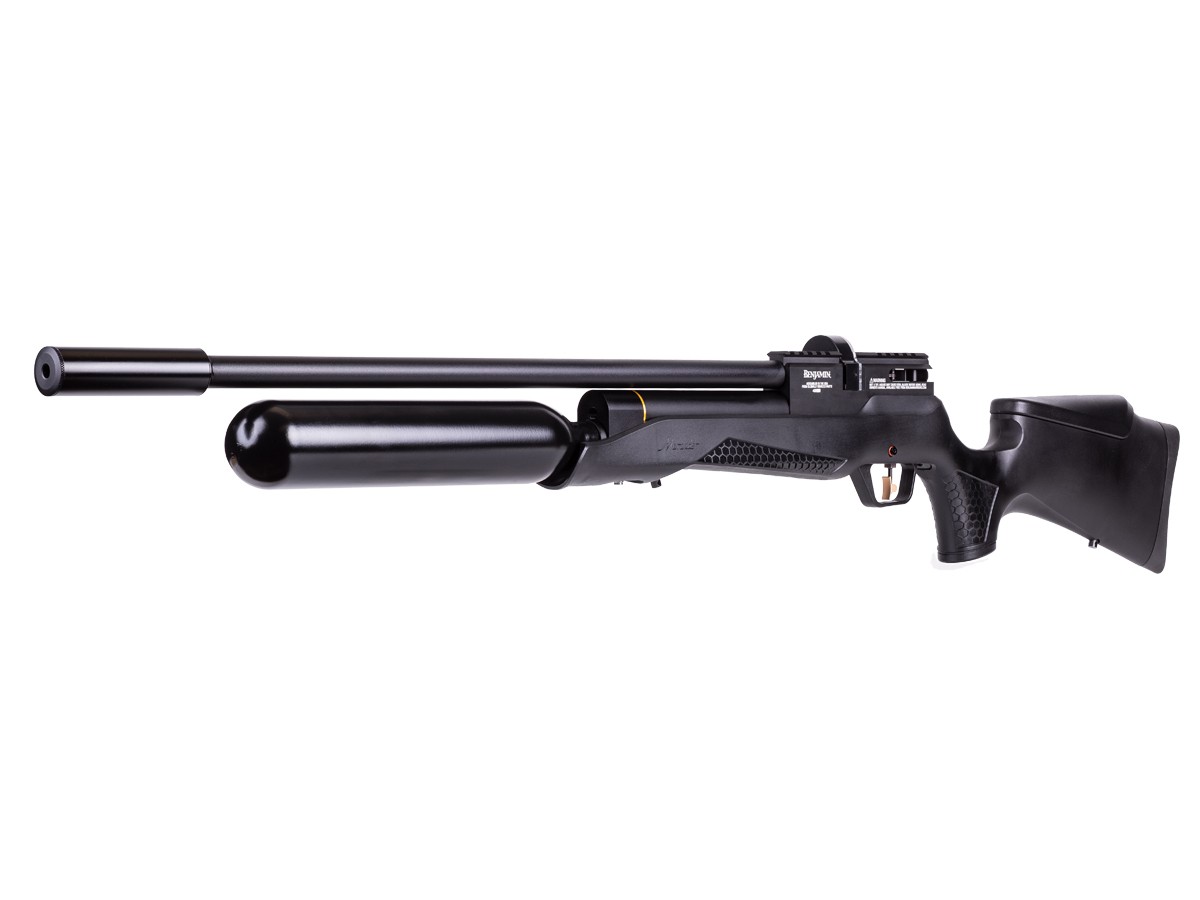
Check today's price on the Marauder Gen 3 at Pyramyd Air →
The Quick Verdict
If you're deciding right now: the Marauder Gen 3 is the best value in serious PCP air rifles under $700. Nothing at the price point matches its combination of factory shroud (backyard-quiet without an aftermarket suppressor), 3,000 PSI fill, adjustable two-stage trigger, and choked barrel accuracy. The Umarex Gauntlet 2 is cheaper and regulated; the Air Venturi Avenger is cheaper and regulated too. Neither is as quiet, and neither has the parts availability or the two-decade community knowledge base that comes with owning a Marauder.
The FX Impact is better in every measurable way — and it costs three times as much and requires you to already know what you're doing. This is the rifle that gets you shooting today.
Real Spec Sheet (Manufacturer Published)
These are pulled straight from Crosman/Benjamin's product literature for the Marauder Gen 3 platform. No fluff, no inflated marketing numbers — just what the manufacturer publishes.
| Spec | Detail |
|---|---|
| Calibers offered | .177, .22, .25 |
| Action | Bolt-action (side-lever available on select variants) |
| Fill pressure | 3,000 PSI (207 bar) |
| Manufacturer velocity (.177, alloy pellet) | Up to 1,100 FPS |
| Manufacturer velocity (.22, alloy pellet) | Up to 1,000 FPS |
| Manufacturer velocity (.25, alloy pellet) | Up to 900 FPS |
| Magazine | 10-shot (.177 / .22), 8-shot (.25) |
| Barrel | Choked, shrouded rifled steel |
| Trigger | Two-stage, fully adjustable |
| Stock | Hardwood (walnut) |
| Overall length | ~42.8 in |
| Weight | ~8.2 lb (unscoped) |
| Optics rail | Picatinny/Weaver dovetail (no iron sights) |
The velocities above are the manufacturer's published maximums with lightweight alloy pellets. In the real world with standard lead pellets (which is what most people shoot), expect roughly 900–950 FPS in .22 and 850–900 FPS in .25 — plenty for pest control, small-game hunting, and 50-yard target work.
The Gen 3 Upgrades That Actually Matter
Crosman didn't rebadge an old rifle and call it Gen 3. The changes are meaningful, and every one of them fixes something owners of the Gen 1 and Gen 2 used to complain about on the forums.
- Redesigned trigger. The Gen 3 ships with a genuinely good adjustable two-stage trigger from the factory. Older Marauders required a trigger-job (or the "GTX" drop-in) to feel right; Gen 3 owners can leave it alone.
- Improved fill probe and manometer. The onboard air-pressure gauge is easier to read, and the fill probe is less finicky. Small change, huge quality-of-life improvement when you're topping off in the field.
- Better factory shot-string consistency. Older guns benefited from a hand-tune to get the velocity curve flat; the Gen 3 arrives closer to optimal out of the box, which means new shooters don't have to know what a "shot string" is to get good groups.
- Refined bolt/stock fit. The bolt cycles smoother and the stock inletting is cleaner than the Gen 2 wood.
None of these are revolutionary. Together, they make the Marauder finally feel like a $600 rifle instead of a $400 rifle that needs $200 in fixes.
Backyard-Quiet, Pest-Control Effective
The Marauder's factory shrouded barrel is the feature that sells this rifle to suburban owners. In .22 caliber with standard-weight lead pellets, most owners report the report is roughly on par with a decent air-gun moderator — quiet enough that you can shoot in a suburban backyard without the neighbors calling anyone. Louder than a spring gun with a moderator. Much quieter than an unshrouded PCP.
That single feature is why the Marauder is the go-to answer for backyard pest control: squirrels in the attic, rabbits in the garden, starlings on the barn. It puts the game down cleanly at real distances (20–50 yards for most owners) without the acoustic signature that draws attention.
How the Marauder Shows Up in the Field
The spec sheet tells you what a rifle can do. What it actually feels like to own is a different story. Here are four scenarios owners describe after a season with the Gen 3 — the good, the annoying, and the honestly-just-fine.
Scenario 1: The suburban squirrel problem
Three-quarter-acre lot, two big oaks, and a family of gray squirrels that has decided the attic soffit is a great place to raise a litter. Traditional trapping is slow. A springer is loud enough that a neighbor two houses down will hear the report. With a Marauder in .22 and standard-weight lead pellets, most owners in this situation report the same experience: they can post up on the back deck at 25 to 30 yards, work through the ten-shot magazine while the coffee is still warm, and never once have anyone call across the fence to ask what they just heard. That is the entire selling point of the factory shroud in one paragraph.
Scenario 2: Weekend paper punch at 50 yards
Set the rifle on a rear bag on a picnic table, zero at 30 yards, and shoot 10-shot groups at 50. With a pellet the barrel likes — usually a mid-weight JSB or H&N variant, but chrono your own to be sure — most owners see groups that stay well under an inch, sometimes tighter when the wind cooperates. This is where the choked, shrouded barrel earns its keep. It is also where new PCP owners stop believing spring-piston reviewers who told them "fifty yards is for the pros." It is not; it is just for the right tool.
Scenario 3: Backyard training for the kids
The Marauder is not the first air rifle we would hand a nine-year-old — it is heavy, the fill process needs supervision, and the trigger is nice enough to encourage bad habits if the fundamentals are not already there. But for teenagers who have already learned to shoot on a springer or a break-barrel, transitioning to a PCP with a real two-stage trigger is transformative. Kids who could not group a springer suddenly ring a spinner every shot at 25 yards. Confidence goes vertical. Pellet cost stays negligible.
Scenario 4: The trip to a friend's property
Load the rifle, one full backup carbon-fiber tank, a tin of pellets, and a scope cover into a soft case. Total kit weight for a full day is under 20 pounds. No trip to a range required, no range fees, no cleaning session at the end. Just spinners, a berm, and a rifle that resets to a full fill in about a minute off the tank. This is why PCP owners rarely go back to powder-burning trainers for casual practice.
Who It's For
- The first-time PCP buyer who wants a rifle they won't outgrow in a year.
- The suburban pest-control shooter dealing with tree rats, rabbits, or nuisance birds and needs quiet, humane accuracy.
- The small-game hunter in states or counties that allow air-gun hunting for squirrel, rabbit, or larger with the .25.
- The tinkerer who wants a platform with 20 years of aftermarket parts, mods, and community knowledge on tap.
- The budget-conscious buyer who wants FX-adjacent capability without spending FX money.
Who It's NOT For (Honest)
The Marauder isn't the right rifle for everyone. If any of these describe you, buy something else and don't waste your money:
- You don't want to buy a hand pump, tank, or compressor. A PCP rifle is not a self-contained system. You need a way to fill it — a Benjamin hand pump ($200), a scuba/carbon-fiber tank ($300–$800), or a small compressor ($500–$1,500). Factor this in before you buy.
- You want a rifle that arrives fully regulated. The Marauder Gen 3 is unregulated from the factory. It shoots a flatter curve than older Marauders, but if you want true regulated consistency (same FPS shot-to-shot across the whole fill), look at the Air Venturi Avenger or a regulator upgrade.
- You want a target rifle for 100-yard-plus benchrest. The Marauder is a 50-yard rifle in real hands. For long-range field-target or extreme benchrest, step up to an FX or Daystate.
- You want iron sights. The Marauder ships without them. You need to add a scope or red-dot.
- You want light and packable. At 8.2 pounds unscoped, this is a full-size rifle. Not a walkabout gun.
Competitor Comparison
The Marauder doesn't exist in a vacuum. Here's how it stacks up against the three PCP rifles most commonly cross-shopped with it. All three are legitimate alternatives depending on what you value.
| Rifle | Price | Regulated? | Best For |
|---|---|---|---|
| Benjamin Marauder Gen 3 | ~$600 | No (semi-flat curve) | Best all-around value; backyard-quiet |
| Umarex Gauntlet 2 | ~$400 | Yes | Lowest-price entry into regulated PCP |
| Air Venturi Avenger | ~$330 | Yes (adjustable) | Tinkerer's regulated budget king |
| FX Impact M3 | ~$2,000+ | Yes | Top-tier target/long-range |
Umarex Gauntlet 2 (~$400) — The Gauntlet undercuts the Marauder by $200 and adds a regulator the Marauder doesn't have. What it doesn't have: the Marauder's factory shroud (Gauntlet is noticeably louder), the same parts availability, or the twenty-year community of tuners. If your budget caps at $400 and you don't need backyard-quiet, this is a legitimate pick. If you'd rather have quiet than regulated, get the Marauder.
Air Venturi Avenger (~$330) — The Avenger is the tinkerer's darling: fully regulated, externally adjustable, and priced like a budget rifle. Groups well, shoots flat, and the community has figured out every mod worth doing. What you give up: a plastic stock (not wood), a louder report than the Marauder, and a shorter track record. Great rifle for someone who enjoys the tuning journey. Less good for someone who wants to open the box and go shoot.
FX Impact M3 (~$2,000+) — The dream rig. Better in every measurable way: adjustable everything, superior barrels, higher shot-count, target-grade regulation. It's also three to four times the price of a Marauder, and it assumes you already know what you're doing. Buy this after the Marauder, not instead of it.
Pro Tips (Real, Not Filler)
Owners who have run the Marauder for a season learn a handful of things that aren't in the manual. Here are the ones that actually change your results.
- Chrono your pellets before you commit. The Marauder is famously pellet-picky in the best way — it will shoot some pellets phenomenally and others merely well. Buy a sampler pack (JSB, H&N, Crosman Premier) and shoot 10-shot groups at 30 yards with each. Whichever tightens up wins your business for the next case.
- Fill to 3,000 PSI, shoot to about 2,000, refill. The Marauder's sweet spot on the shot curve lives roughly in the middle third of the fill. Shooting all the way down past 1,800 PSI drops velocity noticeably. Refill sooner and your groups stay tighter.
- Buy a hand pump AND plan for a tank or compressor. The hand pump is the "you can start today" solution. It's also exhausting to fill from empty. Most owners run a hand pump for the first month, decide they hate it, and buy a scuba/carbon-fiber tank or a small compressor. Budget for both.
- Torque your scope base and rings properly. A shrouded PCP has almost no recoil, so people skip torquing the optics. Then their zero drifts and they blame the rifle. Use a FAT wrench, follow the scope-maker's torque spec, and confirm zero after 100 rounds.
- Clean the barrel with a felt pellet, not a rod. Air rifle barrels don't like steel rods. Push a felt cleaning pellet through every 500–1,000 shots. That's the whole maintenance program.
- Store it partially charged (not empty, not full). Leaving a Marauder empty for months can be hard on seals. Leaving it full can be hard on seals. Somewhere around 1,500–2,000 PSI for long-term storage is the community consensus.
The 2-Year Kit vs. the 10-Year Kit
The Marauder rewards owners who plan for long ownership. A rifle you baby will still be shooting minute-of-squirrel a decade after you unbox it. A rifle you neglect will start leaking down between shots by year three, and the fix is always more expensive than the prevention. Here is the split most owners land on.
The 2-year kit (bare minimum)
- Silicone chamber oil. A single small bottle lasts years. A drop on the fill probe o-ring every handful of fills keeps the seal soft. Never substitute petroleum-based oils in a PCP — they can detonate under fill pressure. Silicone only.
- Felt cleaning pellets. One tin lasts a very long time. Push one through the barrel every 500 to 1,000 shots. That is the entire barrel-maintenance program.
- Scope torque wrench. Not optional. Mount your scope once, torque to the manufacturer's published spec, confirm zero after 100 rounds. Most "the rifle lost zero" forum posts are actually loose scope rings.
- Storage pressure discipline. Store the rifle around 1,500 to 2,000 PSI between sessions. Not empty. Not full. Seals last longer at partial charge.
The 10-year kit (long-haul owner)
- A spare o-ring / seal kit. Crosman and third-party suppliers sell full seal kits for the Marauder platform. Even if you never touch it, having one on the shelf means a leak you notice on a Saturday morning does not end your shooting weekend — it is a table-top job with a hex key and an hour.
- A degassing tool. If you ever need to work on the internals — replacing a seal, installing an aftermarket regulator, swapping a trigger group — you have to safely bleed the reservoir first. Do not skip this. A shrouded PCP holds a real amount of stored energy.
- A dedicated air source that isn't your hand pump. Most owners graduate from the pump to a scuba or carbon-fiber tank, or a small compressor, within the first six months. Pumping a rifle to 3,000 PSI is a workout the first time and a chore the tenth.
- The manual, printed and stashed in the case. Warranty inquiries and parts orders with Crosman go faster when you can quote the serial number and the schematic reference on the phone.
Total investment across both kits is well under $150 spread over ten years. Compared to running a similar-quality centerfire rifle, PCP ownership is genuinely cheap once the initial fill setup is paid for.
Frequently Asked Questions
Is the Marauder Gen 3 regulated?
No. Crosman didn't add a regulator to the Gen 3 platform. The Gen 3 does shoot a flatter velocity curve than the Gen 2 out of the box, but if you want true regulated performance you'll either need to install an aftermarket regulator (Huma-Air makes a popular one) or shop the Umarex Gauntlet 2 / Air Venturi Avenger instead.
What caliber should I get — .177, .22, or .25?
For most buyers, .22 is the right answer. It's the sweet spot for pest control (heavy enough for humane kills on squirrels and rabbits), it's the caliber the community has tuned the most, and pellet availability is excellent. Pick .177 if you're mostly shooting paper at closer ranges and want the flattest trajectory. Pick .25 if you're hunting larger game (raccoon-sized) where the extra pellet weight matters — but expect fewer shots per fill and a stiffer pellet budget.
How quiet is it, really?
In .22 with standard lead pellets, most owners describe the report as roughly like a book falling off a shelf — noticeable up close, easy to miss from 30 yards away. Quieter than a springer with a moderator, dramatically quieter than an unshrouded PCP, and quiet enough for suburban backyard use in most neighborhoods (check your local ordinances). Not silent — no PCP is — but as close as you'll get without adding an aftermarket moderator.
Do I really need a special way to fill it?
Yes. The Marauder fills to 3,000 PSI, and that's not a pressure you can hit with a bicycle pump or a shop compressor. You need one of: a dedicated high-pressure hand pump (Benjamin, Air Venturi, or Hill), a scuba or carbon-fiber tank filled at a dive shop or paintball shop, or a small electric high-pressure compressor. Factor $200–$800 into your budget on top of the rifle itself.
Is it legal in my state / city?
Air-rifle law varies more than firearm law and it changes. In most U.S. states, air rifles are unregulated at the state level, but many cities and counties restrict discharge within city limits regardless of the tool. Some states (New Jersey, for example) treat certain air rifles as firearms. Always check your local municipal code and your state's fish-and-game regulations before you buy, and definitely before you use it for pest control or hunting.
How many shots per fill can I actually expect?
Ballpark from a single 3,000 PSI fill, most owners report roughly 30 to 40 useful shots in .22, 25 to 30 in .25, and 40 to 50 in .177 — where "useful" means the shots stay inside the flat portion of the velocity curve. You can squeeze more out of a fill if you do not care about consistency, but groups open up as pressure drops. Refill sooner, shoot tighter.
Does it come with a scope?
Some retailer bundles include a scope; the base Marauder Gen 3 SKU does not. If a product listing shows a scope in the photo, read the title and description carefully — you are looking for "combo" or "package" language. Otherwise, plan on adding an air-gun-rated optic separately.
Why an air-gun-rated scope specifically?
PCP rifles recoil in the opposite direction of a powder-burning firearm — the valve cycle sends the erector tube inside the scope backward and then forward, and inexpensive firearm-only scopes are sprung to survive one direction. Two-way-recoil-rated (that is, air-gun-rated) scopes hold zero on a Marauder. Non-rated scopes eventually shed their reticles onto the sidewalls of their own tubes. Buy the right glass once and forget about it.
Is the walnut stock ambidextrous?
The Gen 3 hardwood stock is a right-hand-friendly shape — a right-hander shooting from the right shoulder finds the cheek weld natural, and lefties usually adapt without complaint but occasionally swap to an aftermarket ambidextrous stock. The bolt sits on the right side of the receiver on most SKUs; the side-lever variants change that geometry if you prefer left-side operation.
Can I fill it from a shop air compressor?
No. A typical shop compressor tops out around 150 to 200 PSI. The Marauder needs 3,000 PSI. The two pressures are separated by more than an order of magnitude — a shop compressor cannot get within sight of it. Use a dedicated high-pressure hand pump, a scuba or carbon-fiber tank, or a purpose-built high-pressure electric compressor.
Will Crosman still service Gen 1 or Gen 2 Marauders?
Yes. Twenty years of continuous production means parts, seals, and service are all still available for older Marauders — one of the practical reasons the platform is the community's default recommendation. A Gen 1 rifle from the late 2000s can be brought back to life with parts still on the shelf today. Buying into the Marauder platform is a bet on longevity you actually get to collect on.
The Bottom Line
Twenty years in, the Benjamin Marauder is still the answer to the question "what's the best PCP air rifle for the money?" The Gen 3 didn't reinvent the platform — it just finished it. The trigger works. The fill works. The velocity curve is flat enough. The shroud is quiet enough. The parts are everywhere. The community has already answered every question you'll have.
If the FX Impact is the dream rig, the Marauder Gen 3 is the smart-money way into the same quiet, ammo-cheap world. It'll still be earning its keep in your backyard long after the impulse buys are gone. The best PCP most people will ever need.
Advertisement
FTC Disclosure: OSS America contains affiliate links. We earn a commission from qualifying purchases at no extra cost to you. Every pick is research-based: specs, verified prices and owner reviews.
More reviews
 Top PickShooting
Best Shooting Ear Protection (2026): 8 Muffs and Earbuds Ranked by NRR
Howard Leight, Walker's, Pro Ears, AXIL and Sordin: eight electronic and passive picks for the range and the field, compared on NRR, battery, Bluetooth and real October 2026 prices.
 Top PickShooting
Best Shooting Glasses (2026): 7 Ballistic-Rated Picks, Budget to Oakley
Wiley X, Oakley, Radians and Walker's: seven shooting glasses compared on ANSI Z87.1 and MIL-PRF-32432 ratings, lenses, prescription options and real October 2026 prices.
 Top PickShooting
Best .22 Rifles (2026): 7 Picks, Semi-Auto to Youth
Ruger 10/22, CZ 457, Ruger American Rimfire, Savage Mark II, Henry Classic, Winchester Wildcat and the Crickett compared on trigger, weight, sights and real October 2026 prices.
 Top PickShooting
Best 6.5 Creedmoor Ammo (2026): 8 Loads for Hunting, Match and Practice
Hornady Precision Hunter, Federal Fusion and Terminal Ascent, ELD Match, Barnes, Deer Season XP and more: real October 2026 prices, cost per round, and honest pros and cons.
 Top PickShooting
Best Weapon Lights (2026): 7 Pistol and Rifle Lights, Ranked
SureFire X300U-B, Streamlight TLR-1 HL, TLR-7 X, ProTac HL-X Pro, Cloud Defensive REIN 1.5 HC and more, compared on lumens, candela, weight and real October 2026 prices.
 Top PickShooting
Best 10mm Pistols (2026): 8 Picks From $600 to Colt
Glock 20, M&P 10mm, SIG P320-XTEN, Springfield XD-M Elite, FN 510 and three 10mm 1911s compared on capacity, weight, optics and real October 2026 prices.