The 15 Best-Selling Fishing Lines of 2026 (And What Each Is For)

Advertisement
This is not our ranking. It is Amazon's sales data, and the two are not the same thing.
Below are the fifteen best-selling fishing lines on Amazon right now, counted down from number fifteen to number one. Number one outsells everything. Number fifteen outsells everything except the fourteen above it — which still puts it in the top fifteen of a category with thousands of products in it. That is worth saying plainly up front, because a countdown format tricks people into reading the bottom as a loser. It is not. Every line on this page sells in serious volume, and the one at the bottom has been made in America since 1958.
What a sales rank does not tell you is whether a line is right for what you fish. So that is the work we did. Every entry below covers the same four things: what the line actually is, what job it was built for, what it does well, and where it will let you down. Some of these are outstanding. One of them is the product most likely to make a new angler give up on fluorocarbon entirely, and we say so.
Find the job you are trying to do, buy the line built for it, and ignore the other fourteen.
🏆 The Quick Winners (Skip the Whole Guide)
Best Braid Overall: Power Pro Spectra — The best abrasion resistance here and the only line we would spool once and genuinely fish for three seasons.
Best Value Braid: Reaction Tackle X8 — Real braid at a price that makes anything else feel like a decision you have to justify. Buy the 1000-yard spool.
Best Leader Material: Seaguar Blue Label — The only piece of your setup that touches the fish. This is where the money belongs.
Best Line for a Beginner: Berkley Trilene XL — Under ten dollars, forgiving of every mistake, and still the right answer for crankbaits at any experience level.
Best for Toothy Fish: AFW Surflon Wire Leader — Kings, cudas, pike, and muskie shear monofilament. They do not shear this.
How We Analyzed These 15
Amazon picked the products. We picked how to judge them, and all fifteen were held to the same three questions:
What job was this line built for? A line is not good or bad in isolation. Fused superline is superb for vertical jigging and wrong for cover; monofilament is obsolete for jig fishing and still the best choice on a crankbait. We judged each line against its purpose.
Where does it fail? Every line here has a real weakness and we name it. If we would not warn a friend about it, we have not earned your trust.
Is the price honest? Fishing line has the widest quality-to-price spread in tackle. Some lines here cost triple for a difference you will feel. Some do not. We say which is which.
Full disclosure: every link below is an affiliate link. You pay the same price. This post costs you nothing.
🔧 #15 → #11 — The Specialists and the Bulk Buys
The bottom of this list is the most misunderstood part of it. These five sell less than the rest not because they are worse, but because each one answers a narrower question — a wire leader for toothy fish, three thousand yards of utility mono, a fused line built for jigging. Buy the right one and it is the best line on the page. Buy it for the wrong job and you will wonder what everyone sees in it.
#15 — Stren Original Monofilament

Monofilament · 4–30 lb test · 100 to 2400 yd spools · clear, low-vis green, hi-vis gold · typically $7–$25
What it is for: The all-purpose spinning-reel line for someone who wants one spool that does everything competently.
Pros:
It has been made in America since 1958 and the formula is genuinely good — smooth casting, low memory for a mono, and knot strength you can trust.
The hi-vis gold is the best bite-detection color on this list. You watch the line, not the rod tip.
Cheap enough to respool every spring without thinking about it.
Cons:
It is monofilament, which means stretch, which means you will miss light bites in deep water and struggle to set a hook at distance.
UV and water degrade it. Line older than a season is line that breaks at the worst moment.
Our take: Being fifteenth on a best-seller list does not make this the worst line here — it makes it the lowest-selling of the fifteen most popular lines in America, which is a very different thing. Stren Original is a genuinely good monofilament that has been catching fish since the Eisenhower administration. It sells less than the others because mono has ceded ground to braid, not because it stopped working.
#14 — BLUEWING Monofilament Fishing Line

Monofilament · 6–400 lb test · 50 to 3000 yd spools · clear · typically $10–$40
What it is for: Bulk mono for leaders, backing, trotlines, jug lines, and anything where you need a lot of clear line and do not need a famous name on the spool.
Pros:
The range is the whole pitch. Nothing else here spans 6 lb to 400 lb, and the 3000 yd spools cost a fraction of what a name brand charges per yard.
Genuinely useful as backing under braid, where nobody sees it and nothing about it needs to be premium.
Clear and low-visibility enough for leader work on non-finicky fish.
Cons:
House-brand consistency. Most spools are fine, but diameter and break strength vary more batch to batch than Berkley or Stren.
More memory than a premium mono — it comes off the spool in coils and takes a few casts to settle.
Our take: This is a commodity line and it is priced like one, which is exactly right. Nobody should spool a bass rod with it and expect Trilene manners. But for backing, for jug lines, for a shop spool you cut leaders off all season, buying 3000 yards for the price of 300 is simply the correct decision. Know which job you are buying it for.
#13 — Berkley FireLine Superline

Thermally fused superline — not a woven braid · 2–50 lb test · 125 to 300 yd spools · smoke, flame green, crystal · typically $15–$38
What it is for: Vertical presentations — jigging, drop shot, and anything where you need to read the bottom through the rod.
Pros:
Fused rather than woven, which makes it thinner than any braid at the same rating and the single most sensitive line on this list.
Zero stretch translates every twitch of the rod tip straight into the bait, and every tick of gravel straight back into your hand.
Casts exceptionally far on light spinning gear.
Cons:
It fuzzes with age. That is inherent to a fused line and there is no way around it — plan on replacing it more often than braid.
Stiffer and less forgiving of a sloppy knot. Wet it and cinch it slowly or it will fail at the connection.
Our take: FireLine is a specialist and it is unfair to judge it against the braids. Fusing the fibers instead of weaving them buys sensitivity that no woven line matches, which is exactly what you want dragging a jig across a rock pile in forty feet of water. The fuzzing is the price of admission. Pay it if you fish vertically; buy a braid if you fish moving baits in cover.
#12 — Power Pro Spectra Fiber Braid

3-strand Spectra fiber with Enhanced Body Technology · 5–250 lb test · 100 to 3000 yd spools · moss green, hi-vis yellow, white, vermilion red · typically $16–$70
What it is for: Structure fishing and saltwater abuse — the line you spool once and stop thinking about.
Pros:
The most abrasion-resistant line here. Dock pilings, oyster bar, submerged timber — it takes the beating and keeps its rating.
Enhanced Body Technology gives it a stiffer body that resists digging down into itself on the spool under drag.
Twenty-plus years as the standard means every knot and every leader connection is already proven against it.
Cons:
Three-carrier construction is louder through the guides than the 8-strand braids. If guide noise bothers you, this is the noisiest premium line on the list.
Premium pricing, and the bulk spools are a real up-front investment.
Our take: Power Pro is the pickup truck of fishing line — not refined, not quiet, and it will outlast everything parked next to it. The three-strand construction that makes it noisy is the same construction that survives being dragged across barnacles, and for anyone fishing rock or saltwater that is the correct trade. This is what we would put on a reel we intended to abuse.
#11 — AFW Surflon Nylon-Coated 1x7 Wire Leader
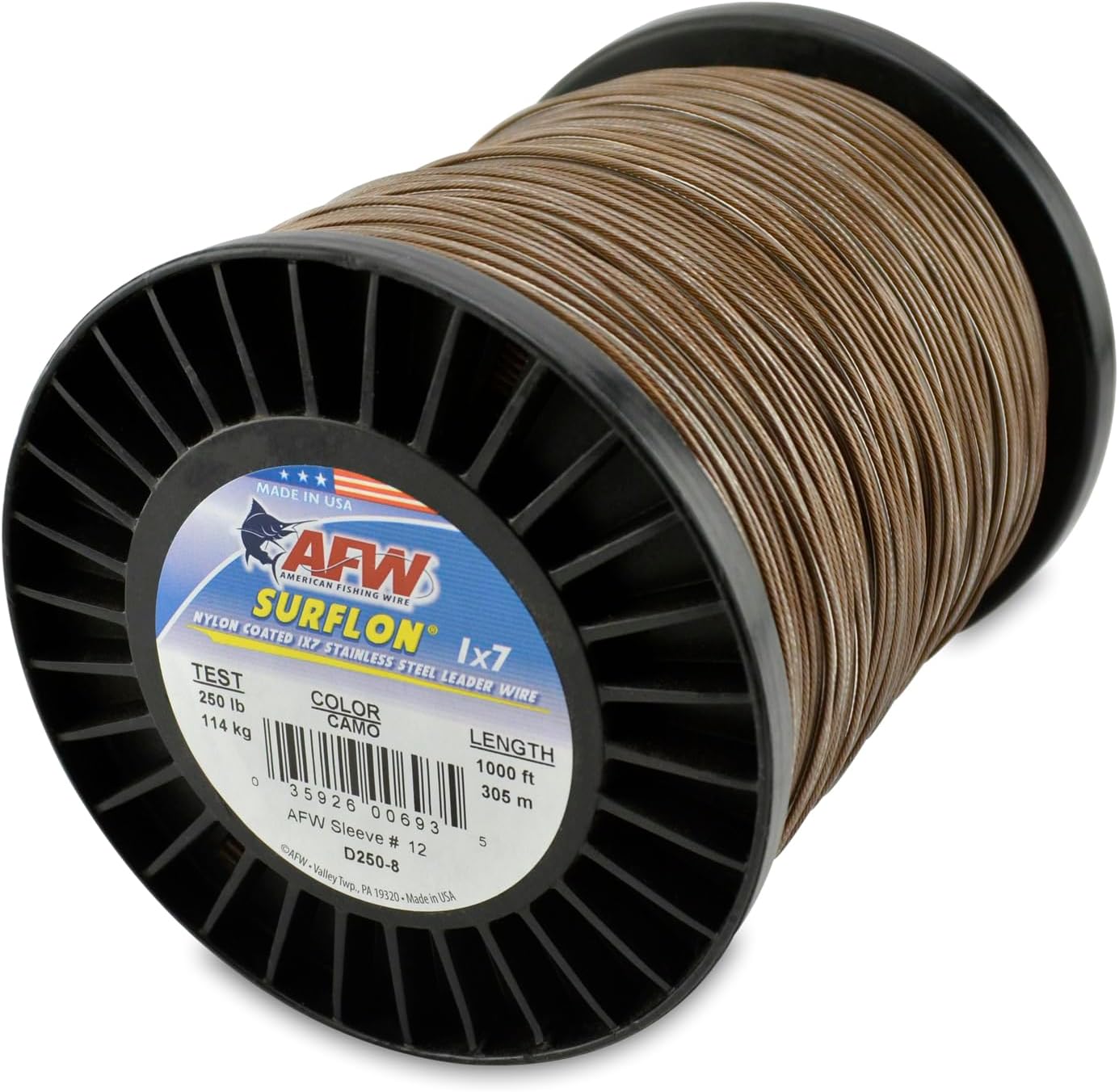
Seven-strand stainless steel cable with a nylon jacket · 15–480 lb test · 30 to 1000 ft coils · bright, camo brown, black · typically $12–$40
What it is for: Toothy fish, full stop. King mackerel, barracuda, bluefish, pike, muskie, and anything else that will shear monofilament like it is not there.
Pros:
Nothing with teeth cuts it. That is the entire job and it does the job absolutely.
The nylon jacket kills the flash of bare stainless and adds abrasion resistance where the leader rubs a gill plate.
It crimps cleanly and the smaller diameters take a haywire twist, so you are not fighting your terminal tackle.
Cons:
It is visible and it is stiff. On a line-shy fish in clear water a wire leader costs you bites, and no coating changes that.
Kink it once and it is finished — a kinked stainless cable has lost most of its strength and must be cut off and retied.
Our take: This is the one product on the list that is not competing with the other fourteen. It is not a main line and it is not a general-purpose leader; it is the answer to one specific problem, which is that some fish have teeth and monofilament does not survive them. If you chase kings, cudas, pike, or muskie, a coil of this lives in your box permanently. If you fish for bass, you will never need it.
🎣 #10 → #6 — The Everyday Workhorses
The middle of the list is where most American anglers actually live. Two fluorocarbon leaders, a fluorocarbon main line, the monofilament that taught half the country to fish, and the cheapest real braid money buys. Nothing here is exotic. Everything here earns its spot by doing an ordinary job without complaint.
#10 — Reaction Tackle 100% Pure Fluorocarbon

100% fluorocarbon · 4–80 lb test · multiple lengths including bulk spools · clear · typically $14–$38
What it is for: The angler who ties a lot of leaders and wants premium behavior without paying premium prices for every foot.
Pros:
Genuine 100% fluorocarbon, not a fluoro-coated copolymer — a distinction plenty of cheap lines blur and one that matters.
Sinks hard and fast, which is the whole point of a fluorocarbon leader.
Larger spools than the premium leader brands, so your cost per leader tied drops sharply.
Cons:
Stiffer than Seaguar at the same test. Knots need a wet, slow cinch or they will slip.
Abrasion resistance is a clear step below Blue Label, and you notice it the moment teeth are involved.
Our take: This sits in the honest middle of the fluorocarbon category, which is a genuinely useful place to be. For freshwater leader work — bass, walleye, trout — the performance gap between this and the premium stuff is smaller than the price gap. Where Seaguar earns its money is around oyster and teeth. For clear-water bass leaders you are cutting and retying all day, this is the smarter buy.
#9 — Seaguar InvizX Fluorocarbon

100% fluorocarbon main line · 4–25 lb test · 200 yd spools · clear · typically $20–$36
What it is for: Filling an entire baitcaster or spinning reel with fluorocarbon for clear-water bass fishing.
Pros:
The softest, most manageable fluorocarbon at this price. It is genuinely castable as a main line, which most fluorocarbon is not.
Low memory for the category — it lays on the spool instead of springing off it in coils.
Excellent knot strength. It does not punish you the way budget fluoro does.
Cons:
200 yd is the largest spool, so filling a big reel takes two of them and real money.
It is still fluorocarbon. Wet every knot, cinch slowly, and check your line after fishing cover.
Our take: InvizX answers a specific question: what if you want fluorocarbon on the whole reel, not just the last three feet? For clear-water bass fishing with jigs, worms, and cranks that is a real advantage — the line sinks, so you keep contact with the bait, and there is nothing visible in the water. This is the most affordable line soft enough to do that job without ruining your day.
#8 — Seaguar Blue Label Fluorocarbon Leader

100% fluorocarbon leader material · 12–130 lb test · 25, 30, 50 and 100 yd spools · clear · typically $19–$60
What it is for: Leader only — the three to six feet of shock and bite protection between your braid and your hook.
Pros:
The reference standard. When a fishing article says fluorocarbon leader without qualifying it, this is the line it means.
Abrasion resistance in a different class from everything else here. It survives gill plates and structure that shreds other leaders.
The smallest diameter per pound test on this list, which means better bait action and fewer refusals.
Cons:
Expensive per yard, and it comes on leader-sized spools, so the cost per foot is high compared with bulk fluorocarbon.
Not a main line. A 25 yd spool will not fill a reel and was never meant to.
Our take: This is the one place on the list where buy once, cry once applies literally. The leader is the only part of your system that touches the fish, and it is the last variable you should economize on. If you run braid main line — and most people reading this should — a spool in 20 lb and a spool in 40 lb covers virtually all American inshore and freshwater fishing.
#7 — Berkley Trilene XL Monofilament

Monofilament · 2–30 lb test · 110 to 3000 yd spools · clear, low-vis green, hi-vis · typically $5–$20
What it is for: Beginners, panfish, and crankbaits — the line that gets a rod fishing today for less than lunch costs.
Pros:
The most forgiving line made. It ties, it casts, it does not backlash badly, and it never punishes a novice for being a novice.
The Extra Limp formula means far less memory than typical mono, so it lays flat on a spinning reel.
Crankbaits genuinely fish better on it — the stretch keeps treble hooks from tearing out on the hookset.
Cons:
Stretch costs you deep bites and long-distance hooksets. Past about twenty feet of water you are guessing.
Low abrasion resistance next to Big Game or any braid. Cover eats it.
Our take: Trilene XL is where nearly every American angler started and there is nothing embarrassing about still using it. On a spinning reel with a crankbait or a bobber it outfishes braid, because the stretch cushions the hookset and panfish do not tear off. Wrong line for jigs and cover. Right line for a kid's first rod and a spring crappie trip. Respool it every year and it will never let you down.
#6 — KastKing SuperPower Braid

4-strand PE braid (8-strand in some tests) · 6–150 lb test · 150 to 1097 yd spools · multiple colors · typically $10–$30
What it is for: Backing, backup reels, kids' combos, and anyone who needs braid on a rod this weekend for the least money possible.
Pros:
The lowest cost per yard on this entire list, and nothing else is close.
Knot strength holds up far better than the price suggests — the Palomar cinches clean and stays put.
The test range starts at a true 6 lb, which is rare. Most budget braids bottom out at 15.
Cons:
Four-carrier construction means it is squared off rather than round. You will hear it in the guides and it wears guide inserts faster over years.
The labeled diameter is optimistic. A 30 lb KastKing is closer to 40 lb elsewhere — fine for strength, annoying for spool capacity.
Our take: KastKing SuperPower is the line you spool onto the rod you loan out. It is not refined and does not pretend to be, but it is real braid at a price that makes buying mono feel silly. Use it as backing, on the kids' combos, on the beat-up rod that lives in the truck. If it is going on your primary rod, spend ten dollars more and get an 8-strand.
🏆 #5 → #1 — What America Actually Buys
The top five are the top five for reasons that have very little to do with which line is technically best and everything to do with price, availability, and twenty years of habit. Three of them are outstanding. One of them is the most divisive product on this page. All five sit at the top of Amazon's fishing-line best-seller list.
#5 — Beyond Braid 8X

4-strand and 8-strand PE braid · 10–150 lb test · 300 to 2000 yd spools · blue camo, moss camo, Bahama blue, white, green, pink · typically $17–$60
What it is for: The angler filling several big spinning reels who wants serious yardage and does not want to reorder line for two years.
Pros:
The bulk yardage is the real story. A 2000 yd spool fills a wall of reels and the cost per reel drops to almost nothing.
The 8X is genuinely round and smooth — it competes with braids costing considerably more.
No-fade, bleed-free color holds up better than most value braids, and the camo patterns break up the line's silhouette.
Cons:
The 4-strand version is rough and noisy. The 8X is the one worth buying and the price gap between them is small.
Diameter consistency batch to batch is good rather than great. Occasionally a spool runs thick.
Our take: Beyond Braid built its business on a simple bet — that anglers would rather buy 2000 yards once than 300 yards six times — and that bet was correct. The line itself is solid upper-mid-tier braid: not quite Power Pro for abrasion, but smooth, round, and entirely adequate for what most Americans actually fish for. If you run multiple boat rods, this is the spool that ends the reordering.
#4 — Berkley Vanish Fluorocarbon

100% fluorocarbon · 2–30 lb test · 110 to 1100 yd spools · clear · typically $8–$22
What it is for: Cheap leader material in bulk, and finding out whether fluorocarbon suits you before spending real money on it.
Pros:
By a wide margin the cheapest 100% fluorocarbon on Amazon. Nothing else is in the neighborhood on price per yard.
It sinks and it disappears — the refractive index really is close enough to water to matter in clear conditions.
Big spools mean leader material costs pennies per rig.
Cons:
It is stiff, it holds memory, and it is fussy about knots. A dry, fast-cinched knot will fail on it, and that is how most people meet it.
As a main line on a spinning reel it throws coils and wind knots. Experienced anglers use it as leader material and nothing else.
Our take: We are going to be blunt, because this is the pick most likely to cause a bad first experience: Vanish is the line that makes people think they hate fluorocarbon. Spool it on a spinning reel and you will fight memory all day. Cut three feet off as a leader tied to braid, wet the knot, and cinch it slowly, and it does what expensive fluorocarbon does for a fifth of the money. Buy it knowing which of those two things you are buying.
#3 — SpiderWire Stealth Braid

8-strand Dyneema braid with fluoropolymer treatment · 6–100 lb test · 125 to 500 yd spools · moss green, hi-vis yellow, blue camo · typically $13–$45
What it is for: The bass angler who wants braid that behaves quietly in the guides and does not announce itself on every cast.
Pros:
The fluoropolymer treatment does something real. It shoots through the guides quieter and farther than untreated braid straight out of the package.
Round, tight 8-strand construction that lays on the spool evenly instead of stacking.
Sold in every big-box store in America, so you can match your spool anywhere on a road trip.
Cons:
The coating is the whole trick and it is a consumable. After a heavy season the line gets fuzzy and loses its slickness.
Less abrasion-resistant around rock and barnacle than the heavier three-strand braids.
Our take: SpiderWire Stealth is the braid most American anglers tried first, and it earned that honestly. Year one it is excellent; year two it is merely good, because the coating has worn off. For a bass fisherman who respools annually that is not a defect at all. For someone who wants to spool a reel and forget it for three seasons, buy Power Pro instead and accept the guide noise.
#2 — Berkley Trilene Big Game

Monofilament · 8–130 lb test · quarter-pound, one-pound and three-pound bulk spools · clear, green, steel blue · typically $9–$28
What it is for: Trolling, catfish, surf casting, shark leaders, and filling large-capacity reels for the least money in American fishing.
Pros:
The best value per yard of anything here by a wide margin. A three-pound bulk spool fills a shelf of reels.
The controlled stretch is a feature, not a flaw — it is a shock absorber that keeps hooks buttoned through violent head shakes and protects your knots on a hot run.
Excellent UV and abrasion resistance for a monofilament. It survives sun, sand, and being left on the boat all summer.
Cons:
Memory. It comes off the spool in coils and takes a few casts to lay down, especially in cold weather.
That same stretch destroys your sensitivity past about twenty feet. You will not feel a light bite deep.
Our take: Big Game has landed more American saltwater fish than everything else on this list combined, and it costs less than a tank of gas to fill four reels with it. The stretch that finesse anglers complain about is exactly what a trolling angler wants when a fish crashes a bait at speed — it is a built-in shock leader. Second place on the best-seller list is not an accident.
#1 — Reaction Tackle X8 Braided Line

4-strand and 8-strand PE braid · 10–200 lb test · 150 to 1500 yd spools · 20+ colors including hi-vis and camo · typically $11–$45
What it is for: The angler who spools three or four reels every season and refuses to pay premium-brand prices to do it.
Pros:
The cheapest honest braid on Amazon. Genuine ultra-high-molecular-weight polyethylene fibers, not a rebadged copolymer — that is why it sits at number one.
An enormous color range, and the hi-vis options let you watch your line for the bite you never felt.
Bulk 1000 and 1500 yd spools make filling multiple reels cost almost nothing per reel.
One brand covers the whole garage, from 10 lb ultralight to 200 lb offshore.
Cons:
The 4-strand is noticeably rougher and louder through the guides than the X8. Pay the small upcharge and get the 8-strand.
Color fades after a hard season in the sun — cosmetic rather than structural, but it bothers some people.
Diameter runs slightly thicker than the labeled test, which is normal for value braid and worth knowing when you calculate spool capacity.
Our take: America's best-selling fishing line got there for one unsentimental reason: it is the cheapest way to put real braid on a reel without buying garbage. It is not the smoothest braid here and it is not the toughest. But the fibers are genuine, the knot strength is there, and nobody has ever lost a fish because they used this instead of something twice the price. Buy the X8, buy the 1000-yard spool, and stop thinking about line for two years.
🧭 Which Line Actually Belongs on Your Reel
Four questions get almost every angler to the right spool.
Bottom contact, or moving baits? Jigs, worms, and drop shot mean braid or fused line — you cannot feel a light bite through monofilament's stretch. Crankbaits and anything with treble hooks fish better on mono, because that same stretch keeps trebles from tearing out. This question decides more than any other.
Main line, or leader? The list mixes them freely and they are not interchangeable. Blue Label is leader material and will not fill a reel; InvizX is a fluorocarbon built to fill one. Buy a 25-yard leader spool expecting to spool a reel and you will be disappointed, and it will not be the line's fault.
Do the fish you chase have teeth? If the answer is kings, cudas, bluefish, pike, or muskie, no amount of fluorocarbon saves you and wire is the only correct answer. If the answer is bass and walleye, wire will cost you bites for no benefit.
How many reels are you filling? If the answer is one, buy the good line — the difference across a single spool is under twenty dollars and it is the cheapest upgrade in fishing. If the answer is six, buy bulk: a 1000 or 2000 yard spool of Reaction Tackle or Beyond Braid changes the math entirely.
❓ Common Questions
Does a low best-seller rank mean a line is bad?
No, and this list is a good example of why. Stren Original sits at fifteen and is a genuinely excellent monofilament that has been catching American fish since 1958. It sells less than the braids above it because the whole category has shifted toward braid, not because the line stopped working. Sales rank measures popularity, price, and shelf presence. It does not measure quality.
Do I really need a fluorocarbon leader if I run braid?
In clear water, yes. Braid is opaque and fish see it — three to six feet of fluorocarbon gives you braid's sensitivity and strength with fluorocarbon's invisibility at the business end. In muddy water or heavy cover plenty of anglers tie straight to braid and catch just as many. Start with a leader and drop it when the fish tell you it does not matter.
Is 8-strand braid worth more than 4-strand?
Yes, and the upcharge is usually under ten dollars. More carriers means a rounder line, which is quieter through the guides, casts farther, and wears your guide inserts less. The one place 4-strand wins is raw abrasion resistance, which is exactly why the toughest line here — Power Pro — is only three carriers.
What pound test should I use for bass?
For most American bass fishing, 30 to 50 lb braid with a 12 to 20 lb fluorocarbon leader covers nearly everything. Straight 15 to 20 lb fluorocarbon for clear-water finesse, 10 to 12 lb mono for crankbaits. Braid ratings are deceptive — 30 lb braid is roughly the diameter of 8 lb mono, so going heavy costs you nothing in castability.
How often should I replace my line?
Monofilament and fluorocarbon: once a season minimum, sooner if the reel lived in the sun. Both degrade under UV and both absorb water. Braid: two to three seasons, and when it fades you can often strip the top hundred yards and reverse what remains. Fused line like FireLine fuzzes faster and needs watching more closely.
Why does my braid dig into itself on the spool?
Because it was spooled loose, and thin braid under drag pressure cuts down into the softer wraps beneath it. Spool it under firm tension — run it through a wet rag under thumb pressure — and lay down a monofilament backing first. Stiffer-bodied braids like Power Pro resist it better than the slick, supple ones.
The Bottom Line
Fifteen lines, and for most American anglers the decision comes down to two purchases.
Power Pro Spectra on the reel. It is noisier through the guides than the 8-strand braids, and that same three-carrier construction is why it survives rock, dock, and oyster longer than anything else here. Spool it once, fish it three seasons, stop thinking about line.
Seaguar Blue Label tied to the end of it. The leader is the only part of your system that touches the fish, and this is the last place to save twelve dollars. One spool ties hundreds of leaders.
If money is the constraint, Reaction Tackle X8 and Reaction Tackle fluorocarbon do those same two jobs for roughly half the total and give up less than you would expect. If you chase anything with teeth, add a coil of AFW Surflon and stop losing fish to bite-offs. And if you are buying your first spool of anything at all, buy Trilene XL, go catch fish, and figure the rest out on the water where it belongs.
Prices and availability change constantly on Amazon and vary widely by test and spool size — check the current listing before you buy. Every product link in this article is an affiliate link, which means OSS America earns a small commission if you purchase through it, at no additional cost to you. We only write about gear we would put on our own reels.
Advertisement
FTC Disclosure: OSS America contains affiliate links. We earn a commission from qualifying purchases at no extra cost to you. Every pick is research-based: specs, verified prices and owner reviews.
More reviews
 Top PickFishing
Best Ice Fishing Shelters (2026): 7 Hub and Flip-Over Picks for Every Crew
Eskimo QuickFish 3HD and 6HD, Outbreak 850XDP, Otter Vortex Cabin and Monster Lodge, a budget insulated hub and the Eskape 2000 flip-over: October 2026 prices and cost per square foot compared.
 Top PickFishing
Best Ice Augers (2026): 7 Electric, Gas, Drill and Hand Picks
ION, Eskimo and StrikeMaster: we compare seven ice augers across battery, gas, drill-driven and hand power, with real October 2026 prices, listed weights and honest pros and cons.
 Top PickFishing
Best Fishing Reels (2026): 8 Picks for Spinning, Baitcasting, Saltwater and Fly
Shimano, Penn, Pflueger, Orvis and Piscifun: we compare eight fishing reels across every main type on drag, weight, gear ratio, sealing and real October 2026 prices, with honest pros and cons.
 Top PickFishing
Best Fishing Kayaks (2026): 8 Picks for Budget, Pedal and Lightweight
Pelican, Lost Creek, Lifetime, Old Town, Intex and Oru: eight fishing kayaks compared on weight, capacity, pedal vs paddle, fishing features and real October 2026 prices, with honest pros and cons.
 Fishing
13 Fishing & Recreational Boats and Kayaks Ranked (2026)
13 fishing and recreational boats and kayaks ranked #13 to #1 — from a $123 Intex inflatable to a $1,299 Old Town Sportsman 120 pedal kayak. Real specs, verified in-stock, honest picks.
 Fishing
Top 5 Boots for Florida and Gulf Coast Fishermen (2026 Buyer's Guide)
The best boots for Florida and Gulf Coast fishermen in 2026: five real XTRATUF models that handle wet decks, sun-baked marinas, mangrove flats, and 14-hour charter days without quitting on you.