Best Survival Knives (2026): 8 Fixed Blades Ranked

Advertisement
A survival knife is the one tool you'd want if you could only carry one: it has to cut cord, carve tinder, split small wood, build shelter and handle game, and it can't break when you need it most. That's why most people searching for a survival knife end up looking at full-tang fixed blades, not folders.
We compared eight fixed-blade survival knives people are searching for right now, from the classic KA-BAR USMC and Buck 119 to the Gerber StrongArm, Cold Steel's 3V SRK and a compact ESEE kit. Every price is a live listing checked on October 8, 2026, and every spec comes from the retailer listing. This is a research guide built on published specs and owner ratings, not a hands-on test.
The short answer
For most people, the Gerber StrongArm is the survival knife to beat. Our picks:
- Best overall: Gerber StrongArm, about $110. Check price at Sportsman's →
- Best full-size classic: KA-BAR USMC, about $100. Check price at Sportsman's →
- Best Buck: Buck 119 Special, about $80. Check price at Sportsman's →
- Best budget (fire starter included): Buck 863 Selkirk, about $56. Check price at Sportsman's →
- Best compact kit: ESEE Izula with survival kit, about $109. Check price at Adept Knives →
Prices on October 8, 2026, before tax and shipping.
How we chose
Search interest in survival knives is strong this fall. In Google Trends data for the past 30 days, "best survival knife" leads the related searches, followed by "fixed blade survival knife," "best knife for survival," and brand searches for Gerber and Cold Steel, with "buck survival knife" and "best outdoor survival knife" breaking out. So we stuck to fixed blades and covered the brands people are asking about.
We pulled live prices, stock status, specs and owner ratings from Sportsman's Warehouse and Adept Knives product pages on October 8, 2026. We weighed blade length (long enough to baton wood, short enough to control), steel (toughness, rust resistance and ease of field sharpening), weight, handle grip, sheath and extras like fire starters, owner ratings, and price. We left out folding knives and replaceable-blade knives; for those see our hunting and EDC guides.
All eight at a glance
| # | Knife | Blade | Steel | Weight | Price | $ / inch | Store |
|---|---|---|---|---|---|---|---|
| #1 | Gerber StrongArm | 4.8 in | 420HC stainless, ceramic coating | 7.2 oz | $109.99 | $22.91 | Sportsman's |
| #2 | KA-BAR USMC | 7 in | 1095 Cro-Van (56-58 HRC) | 11.2 oz | $99.99 | $14.28 | Sportsman's |
| #3 | Buck 119 Special | 6 in | 420HC stainless | 7.5 oz | $79.99 | $13.33 | Sportsman's |
| #4 | Buck 863 Selkirk | 4.62 in | 420HC (58 HRC) | 7.6 oz | $55.98 | $12.12 | Sportsman's |
| #5 | ESEE Izula + kit | 2.63 in | 1095 carbon (55-57 HRC) | 2 oz | $109.00 | $41.44 | Adept Knives |
| #6 | Cold Steel 3V SRK | 6 in | CPM 3V | 8.8 oz | $259.99 | $43.33 | Sportsman's |
| #7 | Becker BK62 Kephart | 5.1 in | 1095 Cro-Van (56-58 HRC) | 6.4 oz | $159.99 | $31.37 | Sportsman's |
| #8 | Kizer Sheepdog Survival | 5.28 in | 1095 carbon (57-60 HRC) | 13.73 oz | $85.96 | $16.28 | Adept Knives |
Prices and stock checked on October 8, 2026 (sportsmans.com; adeptknives.com for the ESEE Izula kit and Kizer Sheepdog), before tax and shipping. Blade lengths and weights are the retailer listing; KA-BAR weights were listed in pounds and converted. The Izula weight is the knife only, and its price includes a survival kit.
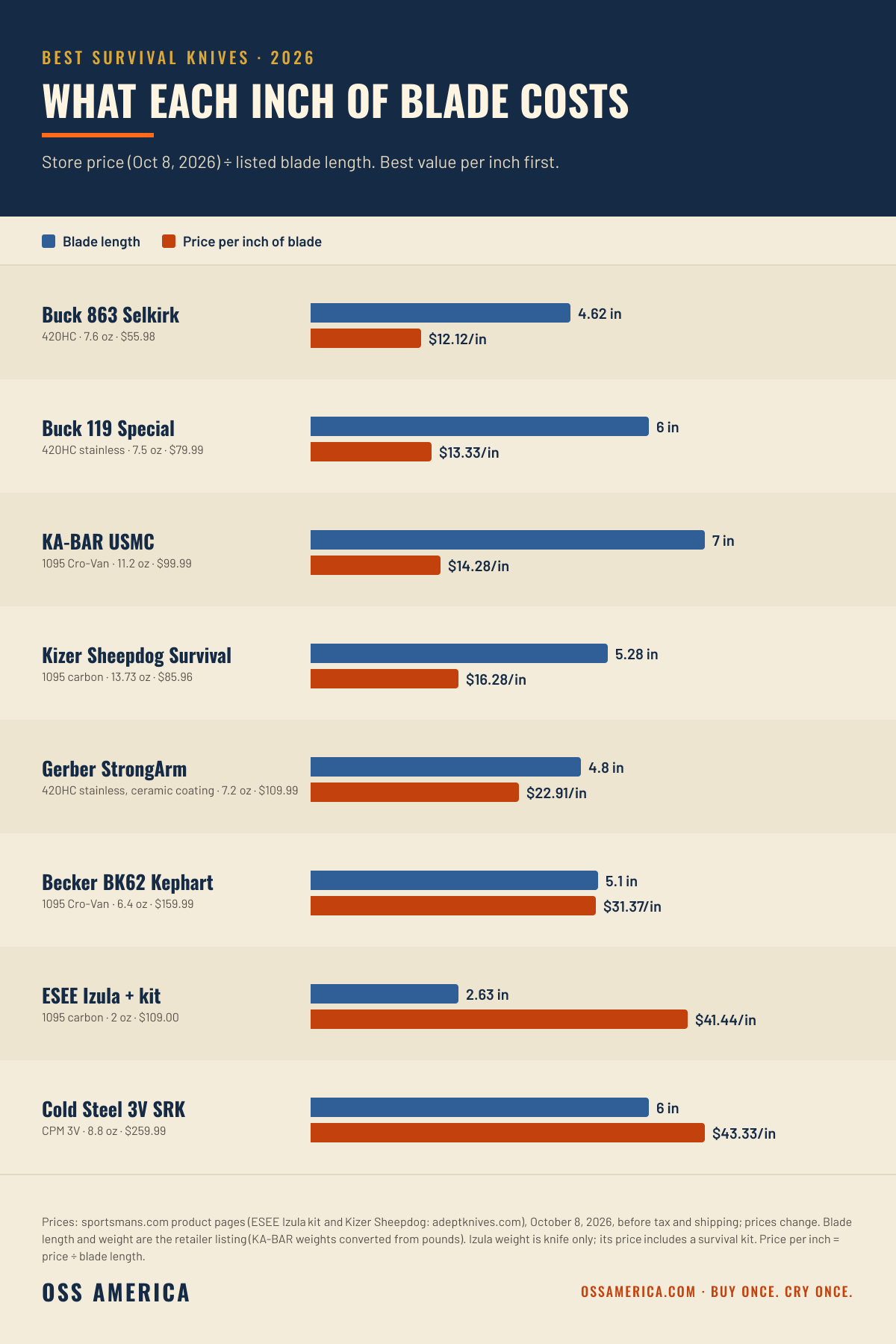
How to read the chart: the two Buck knives and the KA-BAR give you the most blade for the money, at roughly $12 to $14 per inch. The Gerber StrongArm costs more per inch because you're paying for that multi-mount sheath and grippy handle. The Cold Steel SRK and ESEE Izula sit at the top for different reasons: the SRK for its premium CPM 3V steel, the Izula because its price includes a fire-starting kit and its blade is tiny. Price per inch isn't everything, but it's a quick way to see what extra money buys.
Carbon or stainless: which steel for a survival knife?
- 420HC stainless (Gerber StrongArm, Buck 119, Buck Selkirk): resists rust well and is easy to resharpen at camp. It won't hold an edge as long as premium steels, so carry a sharpener.
- 1095 / 1095 Cro-Van carbon steel (KA-BAR USMC, Becker Kephart, ESEE Izula, Kizer Sheepdog): tough and easy to sharpen in the field. It will rust if you leave it wet, which is why several of these come with a black coating. Wipe it dry and oil it.
- CPM 3V (Cold Steel SRK): a premium powder-metal tool steel built for toughness. It costs more and takes more effort to sharpen.
The 8 best survival knives, ranked
Gerber StrongArm Fixed Blade (Coyote)
Best survival knife overall
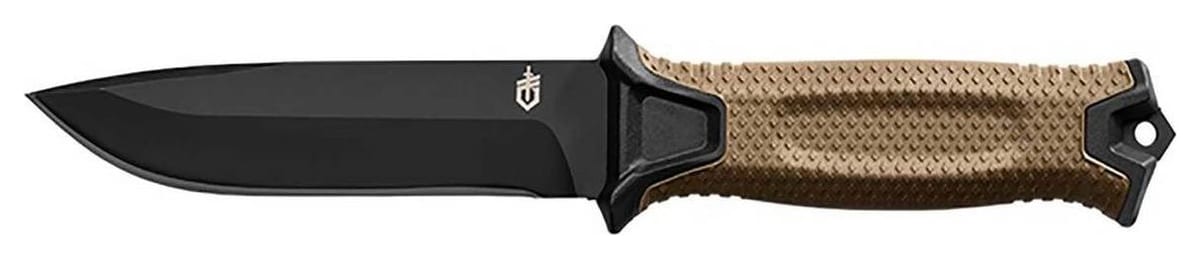
Sportsman's Warehouse: about $110 · Blade: 4.8 in 420HC · Weight: 7.2 oz
"Gerber" is one of the top brand searches tied to survival knives right now, and the StrongArm is the Gerber fixed blade most people mean. It's a full-tang knife with a 4.8-inch plain-edge drop-point blade in 420HC stainless steel, a ceramic blade coating and a rubberized, diamond-texture handle meant to hold on when your hands are wet or cold. The butt has a striking pommel.
The sheath is a big part of why it's popular. Sportsman's lists a MOLLE-compatible multi-mount system with nylon webbing for drop-leg carry, detachable belt hoops so you can wear it horizontally, and a snap-in MOLLE strap for a pack or vest. That flexibility matters for a knife that might live on a bug-out bag one month and on your belt during hunting season the next. It's made in the USA, and Gerber backs it with a limited lifetime warranty.
On October 8, 2026, Sportsman's had the Coyote version in stock for about $110, with a 4.5 average from 97 owner reviews, the most reviews of any knife on this list except the Buck Selkirk. The black version was the same price. A 4.8-inch blade is long enough to baton small firewood and process kindling, and short enough to stay controllable for camp chores and game. That middle-ground size, the sheath and a US-made build are why it's our top pick.
| Type | Fixed blade, full tang |
| Blade | 4.8 in 420HC stainless, drop point, plain edge, ceramic coating |
| Overall | 9.8 in |
| Weight | 7.2 oz (Sportsman's listing) |
| Handle | Rubberized diamond texture, striking pommel |
| Sheath | MOLLE multi-mount, drop-leg webbing, belt hoops |
| Made in | USA; limited lifetime warranty |
Pros
- + Versatile sheath: belt, drop-leg or MOLLE
- + Grippy handle for wet or gloved hands
- + Made in the USA
- + Large owner-review base (97 on Sportsman's)
Cons
- − 420HC needs sharpening more often than premium steels
- − 7.2 oz is heavier than a small bushcraft knife
- − Pricier at Sportsman's than the Buck options here
KA-BAR USMC Fighting/Utility Knife (1217)
Best full-size classic
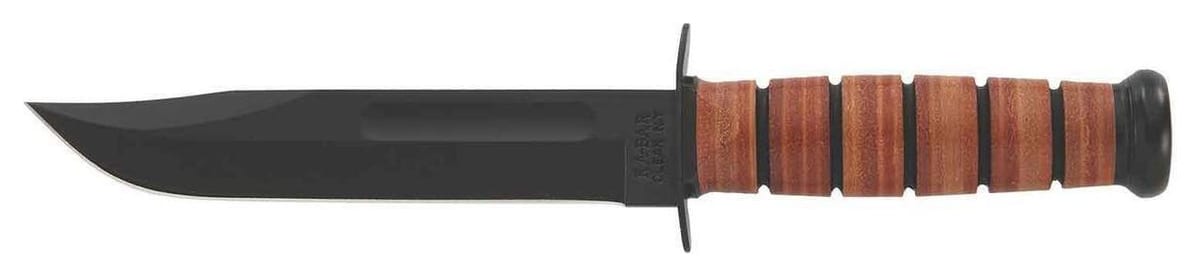
Sportsman's Warehouse: about $100 · Blade: 7 in 1095 Cro-Van · Weight: 0.7 lb (about 11.2 oz)
If you picture a "survival knife," there's a good chance you picture this one. KA-BAR's USMC knife was designed to serve troops in World War II, and it's still made in the USA with the same basic recipe: a 7-inch clip-point blade in 1095 Cro-Van carbon steel (56 to 58 HRC), a stacked-leather handle and a USMC stamp. Sportsman's lists an 11.8-inch overall length and a weight of 0.7 lb.
The long blade makes it the best chopper and batoning knife in the group short of the Cold Steel SRK, and 1095 Cro-Van is known for being tough and easy to sharpen in the field. The trade-offs are the ones you'd expect: carbon steel can rust if you don't keep it dry and oiled (the blade is coated black to help), and a stacked-leather grip needs some care if it gets soaked. Owner reviews on Sportsman's averaged 4.9 across 20 ratings, and it was about $100 on October 8.
| Type | Fixed blade, full size |
| Blade | 7 in 1095 Cro-Van, 56-58 HRC, clip point |
| Overall | 11.8 in |
| Weight | 0.7 lb (Sportsman's listing) |
| Handle | Stacked leather |
| Made in | USA |
Pros
- + Long 7-inch blade for chopping and batoning
- + Tough, easy-to-sharpen carbon steel
- + A proven design with decades of history
- + Made in the USA
Cons
- − Heavy at about 11 oz
- − Carbon steel needs oil to prevent rust
- − Leather handle needs care in wet climates
- − Too big for fine carving or game work
Buck 119 Special
Best Buck survival knife
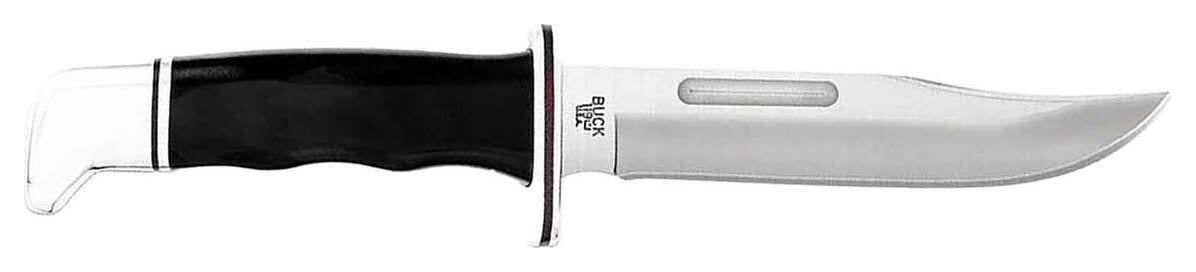
Sportsman's Warehouse: about $80 · Blade: 6 in 420HC · Weight: 7.5 oz
"Buck survival knife" broke out as a rising search this month, and Sportsman's itself files the 119 Special under "Survival." It's one of Buck's oldest designs: the listing traces it to the fixed blades Hoyt Buck made by hand for the military in 1942. Today it's a 6-inch clip-point blade in Buck's 420HC stainless, a black phenolic handle with aluminum guard and pommel, a 10.5-inch overall length and a leather sheath.
At 7.5 oz (Sportsman's listing), it's about the same weight as the Gerber StrongArm but gives you more blade for less money: about $80 on October 8, or $13.33 per inch of blade, second-best value in this guide. 420HC is stainless, so it shrugs off rust better than the carbon-steel knives here, and it's easy to bring back to sharp at camp. The fine clip point is better for detail cuts than prying. It had a perfect 5.0 average across 26 Sportsman's reviews and is made in the USA.
| Type | Fixed blade |
| Blade | 6 in 420HC stainless, clip point |
| Overall | 10.5 in |
| Weight | 7.5 oz (Sportsman's listing) |
| Handle | Phenolic with aluminum guard and pommel |
| Made in | USA |
Pros
- + Lots of blade for the price
- + Stainless steel resists rust
- + Classic design with a long track record
- + 5.0 average from 26 owner reviews
Cons
- − Fine clip point isn't built for prying
- − Smooth handle isn't as grippy as rubberized designs
- − Basic sheath compared with the Gerber's
Buck 863 Selkirk
Best budget survival knife (with fire starter)
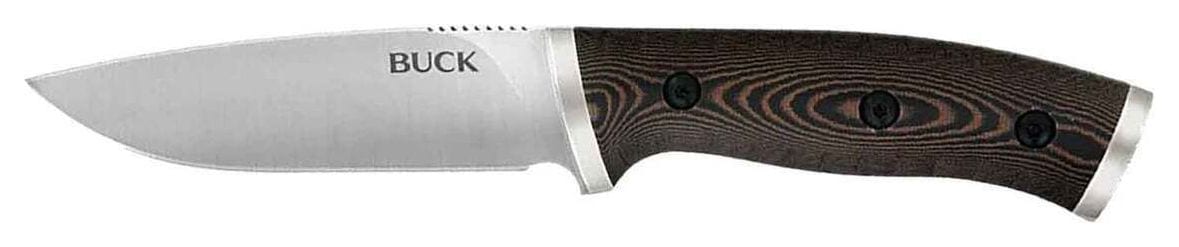
Sportsman's Warehouse: about $56 · Blade: 4.62 in 420HC · Weight: 7.6 oz
The Selkirk is Buck's purpose-built survival knife, and at about $56 on October 8 it was the cheapest knife in this guide and the best value per inch of blade ($12.12). It has a 4.62-inch drop-point blade in 420HC (58 HRC), a contoured Micarta handle and steel bolsters, and Buck says the rear bolster can serve as an improvised hammer.
The sheath is the selling point for preppers: it's a heavy-duty belt sheath that can be set up for horizontal or vertical carry, and it comes with a fire starter/whistle tool. That makes it a ready-made "knife plus fire" combo for a vehicle kit or a first bug-out bag. It's covered by Buck's lifetime warranty. With 224 reviews, it had by far the most owner feedback of any knife here, averaging 4.0, the lowest average on this list, so read a few recent reviews before you buy.
| Type | Fixed blade |
| Blade | 4.62 in 420HC, 58 HRC, drop point |
| Overall | 9.5 in |
| Weight | 7.6 oz (Sportsman's listing) |
| Handle | CNC-contoured Micarta, steel bolsters |
| Extras | Fire starter/whistle tool; horizontal or vertical sheath; lifetime warranty |
Pros
- + Lowest price and best value per inch here
- + Fire starter and whistle included
- + Sheath carries horizontal or vertical
- + Micarta handle grips well
Cons
- − 4.0 average is the lowest on this list
- − Heavier than the Gerber despite a shorter blade
- − 420HC needs more frequent sharpening
ESEE Izula with Survival Kit
Best compact survival knife kit
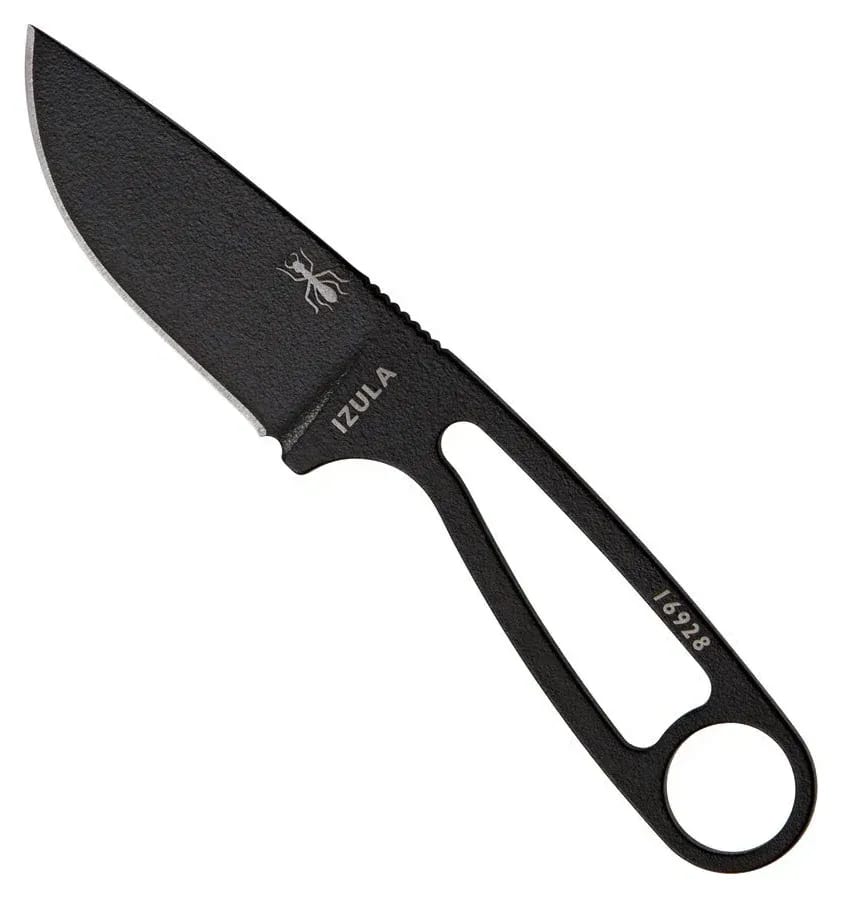
Adept Knives: about $109 · Blade: 2.63 in 1095 · Weight: 2 oz (knife only)
Not every survival knife has to be big. ESEE's Izula is a tiny, skeletonized full-tang fixed blade that weighs about 2 oz (knife only, per the Adept Knives listing), so it disappears on a neck cord, in a pocket or clipped to a pack strap. That means it's actually with you, which is the whole point of a survival knife.
This version is the complete kit: a black powder-coated 1095 carbon steel blade (2.63 inches, 55 to 57 HRC, 0.156 inch thick), a molded sheath and a survival kit with a ferro rod, emergency whistle, paracord, split rings, cord lock, snap hook and carry hardware. It's made in the USA. On October 8, Adept Knives had it in stock for about $109. Its price per inch of blade looks high in our chart, but that price includes the fire-starting kit. Use it as a backup or everyday-carry survival knife alongside a bigger blade, not as your only chopping tool.
| Type | Compact fixed blade, skeletonized full tang |
| Blade | 2.63 in 1095 carbon, 55-57 HRC, 0.156 in thick |
| Overall | 6.25 in |
| Weight | 2.0 oz knife only (Adept listing) |
| Kit | Ferro rod, whistle, paracord, split rings, cord lock, snap hook |
| Made in | USA |
Pros
- + About 2 oz: easy to carry every day
- + Fire-starting kit included
- + Neck, belt or pack carry
- + Made in the USA
Cons
- − Too small for chopping or batoning
- − Skeleton handle is thin without a paracord wrap
- − 1095 carbon steel can rust if neglected
Cold Steel SRK in CPM 3V
Premium pick: toughest steel
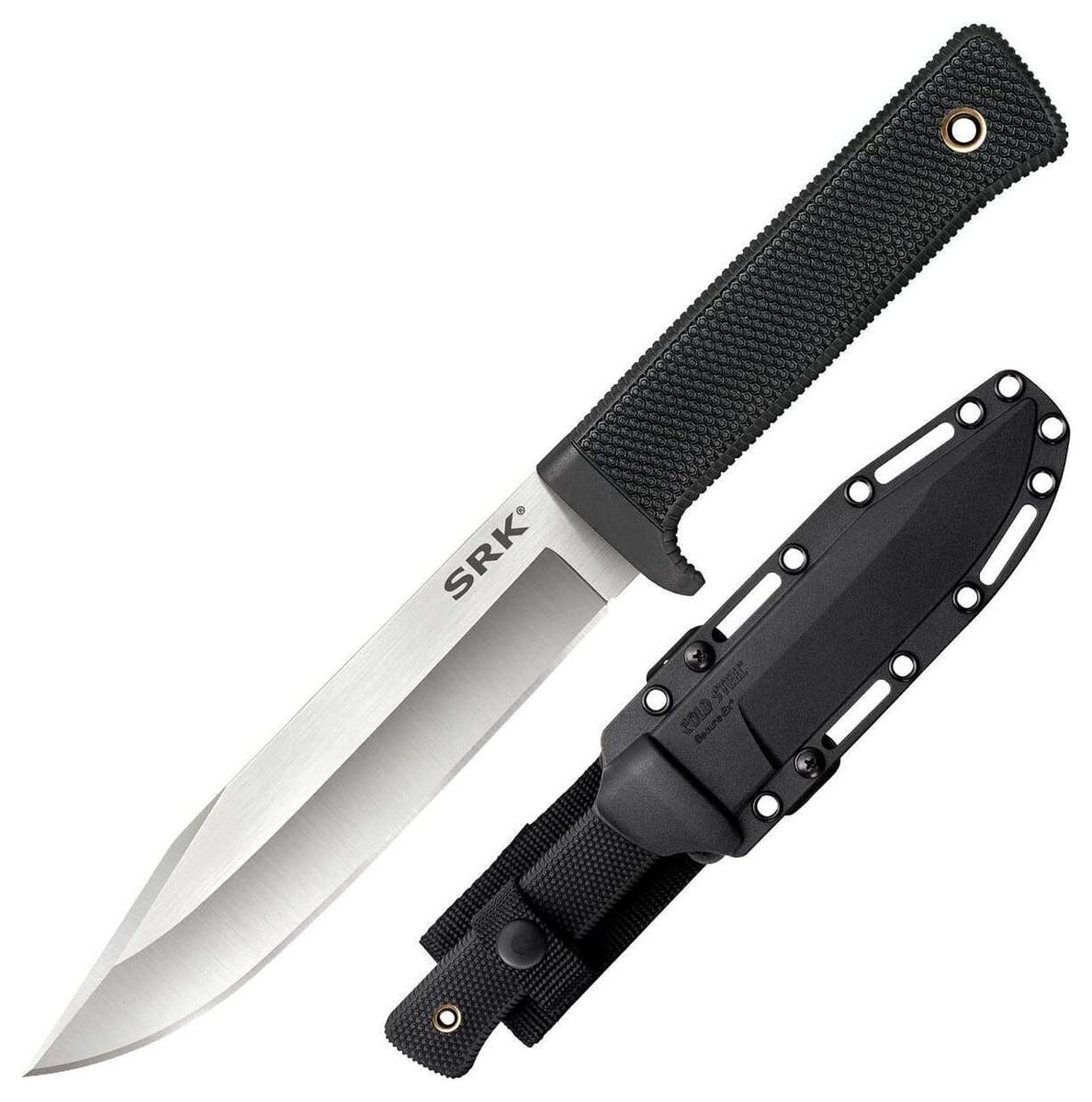
Sportsman's Warehouse: about $260 · Blade: 6 in CPM 3V · Weight: 8.8 oz
"Cold steel" is a top survival-knife search, and the SRK (Survival Rescue Knife) is the brand's survival flagship. Cold Steel says it was designed specifically for survival and rescue work and that it's popular with military and tactical law-enforcement users. This version has a 6-inch clip-point blade in CPM 3V, a powder-metallurgy tool steel known for its toughness, with a textured Kray-Ex handle and a Secure-Ex hard sheath.
Sportsman's lists it at 8.8 oz and 10.75 inches overall, which is barely heavier than the Gerber StrongArm despite the longer blade. It's the most expensive knife here at about $260 on October 8 ($43.33 per inch), with a 4.5 average from 10 reviews. You're paying for the steel; if you'll lean hard on a knife for batoning and heavy camp work and want it to hold up, this is the one to save for.
| Type | Fixed blade |
| Blade | 6 in CPM 3V, clip point |
| Overall | 10.75 in |
| Weight | 8.8 oz (Sportsman's listing) |
| Handle | Kray-Ex, textured |
| Sheath | Secure-Ex |
Pros
- + CPM 3V: a very tough premium steel
- + Light for a 6-inch blade
- + Grippy Kray-Ex handle
- + Hard sheath with secure retention
Cons
- − Most expensive knife here
- − Only 10 owner reviews on Sportsman's
- − CPM 3V takes more effort to sharpen than 420HC or 1095
KA-BAR Becker BK62 Kephart
Best bushcraft-style survival knife

Sportsman's Warehouse: about $160 · Blade: 5.1 in 1095 Cro-Van · Weight: 0.4 lb (about 6.4 oz)
If your idea of survival is woodcraft (carving, feather sticks, notching shelter poles), look at the Becker BK62 Kephart. KA-BAR says it's designed true to the original knife created by Horace Kephart, often called the father of modern bushcraft. It pairs a 5.1-inch drop-point blade in 1095 Cro-Van (56 to 58 HRC) with walnut handles, a 9.6-inch overall length and a sheath.
The straight, slim Kephart pattern is built for slicing and carving more than prying or chopping. At 0.4 lb (about 6.4 oz) per Sportsman's, it's the lightest full-size knife in this guide. It was about $160 on October 8; Sportsman's had no owner reviews posted for it yet, so you're buying the pattern and the Becker name rather than a big review record. As with any 1095 knife, keep it dry and oiled.
| Type | Fixed blade, Kephart pattern |
| Blade | 5.1 in 1095 Cro-Van, 56-58 HRC, drop point |
| Overall | 9.6 in |
| Weight | 0.4 lb (Sportsman's listing) |
| Handle | Walnut |
| Sheath | Included |
Pros
- + Classic bushcraft pattern for carving and slicing
- + Light for its size
- + Tough, easy-to-sharpen carbon steel
- + Good-looking walnut handle
Cons
- − No owner reviews on Sportsman's yet
- − Not a prying or heavy-chopping knife
- − Carbon steel and wood need care
Kizer Sheepdog Survival (1105A3)
Best heavy-duty value
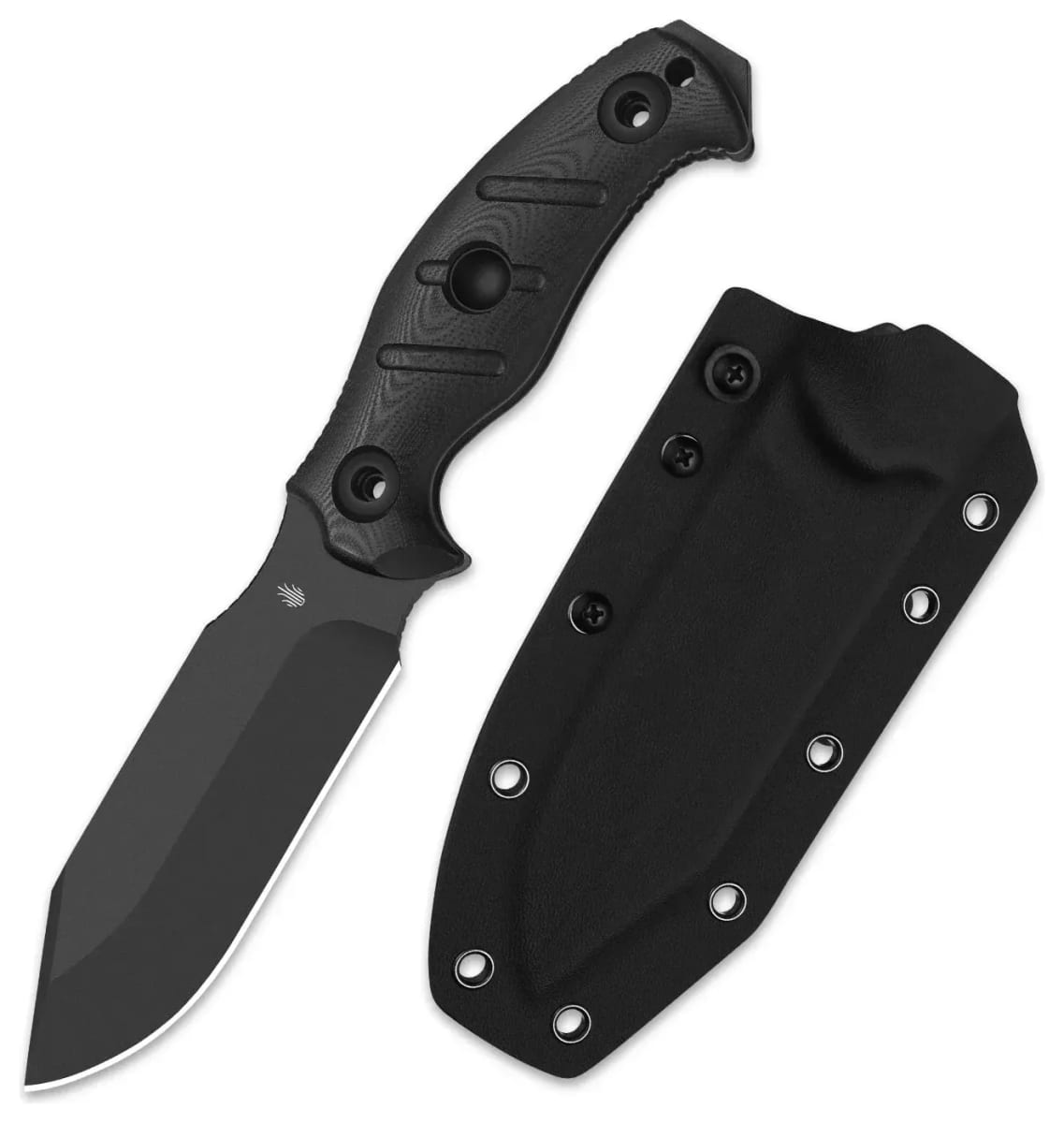
Adept Knives: about $86 · Blade: 5.28 in 1095 · Weight: 13.73 oz (listed)
The Kizer Sheepdog Survival is the beefiest knife on this list. Adept Knives lists a 5.28-inch clip-point blade in 1095 carbon steel (57 to 60 HRC) that's 0.217 inch (5.5 mm) thick with a flat grind and a black coating, a 5.32-inch black G10 handle, a 10.6-inch overall length and a fitted sheath. That thick stock is what you want for batoning and hard outdoor work.
It's also heavy: Adept lists 13.73 oz, the most of any knife here, so it's more of a pack or vehicle knife than a belt knife for all-day carry. On October 8 it was about $86 and in stock at Adept Knives ($16.28 per inch of blade). We couldn't find an owner-review record on the listing, so weigh that against the Buck, Gerber and KA-BAR picks.
| Type | Fixed blade, full size |
| Blade | 5.28 in 1095, 57-60 HRC, 0.217 in thick, flat grind |
| Overall | 10.6 in |
| Weight | 13.73 oz (Adept listing) |
| Handle | Black G10 |
| Sheath | Fitted sheath included |
Pros
- + Thick 5.5 mm blade for hard use
- + Grippy, durable G10 handle
- + Under $90
- + Tough carbon steel
Cons
- − Heaviest knife here
- − No owner reviews on the listing
- − 1095 needs oil to prevent rust
Which should you buy?
- You want one do-it-all survival knife: Gerber StrongArm.
- You want a long blade for chopping and batoning: KA-BAR USMC or, if you'll pay for premium steel, the Cold Steel 3V SRK.
- You want a classic stainless knife that won't rust easily: Buck 119 Special.
- You're building a first bug-out bag on a budget: Buck 863 Selkirk (fire starter included).
- You want a survival knife you'll carry every day: ESEE Izula with survival kit.
- You're into bushcraft and carving: Becker BK62 Kephart.
- You want the thickest, toughest blade for under $90: Kizer Sheepdog Survival.
What to look for in a survival knife
- Fixed blade, full tang: no hinge to fail, and the steel runs through the handle so it can take batoning and prying better than a folder.
- Blade length: 4 to 6 inches is the sweet spot for most people. Shorter knives are easier to control and carry; 6 to 7-inch blades chop and baton better but weigh more.
- Spine and point: a sturdy point and a thick spine handle prying and splitting. Fine points (like the Buck 119's clip point) are better for detail work.
- Grip: rubberized, Micarta, G10 or textured synthetic handles stay secure when wet or cold. Smooth wood and leather look great but need more care.
- Sheath: it should hold the knife securely and mount the way you'll carry it: belt, drop-leg, pack strap or neck. A sheath with a fire starter (Selkirk, Izula) is a bonus.
- Maintenance: any knife gets dull. Pack a field sharpener and, for carbon steel, a little oil.
Knife laws vary by state
Blade-length limits, fixed-blade carry rules and rules about where you can carry a knife differ from state to state and sometimes city to city. Owning a survival knife is legal in most places, but check your state and local laws before you carry one in public, concealed, or in a vehicle. This isn't legal advice.
Building out a kit? See our best bug-out bags and 15 essential survival gear picks. Want an everyday-carry knife instead? See our best EDC knives guide.
Frequently asked questions
What is the best survival knife?
For most people, the Gerber StrongArm: a full-tang, made-in-USA fixed blade with a 4.8-inch 420HC blade, a grippy rubberized handle and a sheath that mounts on a belt, drop-leg or MOLLE webbing. It was about $110 at Sportsman's Warehouse on October 8, 2026, with a 4.5 average from 97 reviews.
Is a fixed blade better than a folding knife for survival?
For a primary survival knife, yes. A full-tang fixed blade has no hinge or lock to fail, it's easier to clean, and it can take batoning and prying that would stress a folder. Many people carry a folder or multitool as a second tool.
What size survival knife is best?
A 4 to 6-inch blade covers most survival jobs: carving, food prep, game and splitting small wood. A 7-inch blade like the KA-BAR USMC chops better but is heavier. Tiny knives like the ESEE Izula are great backups but not good choppers.
What is the best Buck survival knife?
It depends on budget. The Buck 119 Special (about $80) gives you a 6-inch 420HC blade and is filed under "Survival" at Sportsman's. The Buck 863 Selkirk (about $56) is Buck's purpose-built survival knife and comes with a fire starter/whistle tool.
Is 1095 or 420HC better for a survival knife?
Both work. 1095 carbon steel is tough and easy to sharpen but rusts if neglected, so keep it oiled. 420HC stainless resists rust and is easy to sharpen but won't hold an edge as long. In wet climates or if you won't baby your knife, stainless is the easier choice.
Is the KA-BAR USMC a good survival knife?
It's one of the most famous. It has a 7-inch 1095 Cro-Van blade, is made in the USA, and averaged 4.9 across 20 Sportsman's reviews. It's heavy at about 11 oz and the leather handle needs care, so it's best for people who want a big chopping knife.
Do I need a survival knife with a fire starter?
It's a nice bonus, not a must. The Buck Selkirk and the ESEE Izula kit include one, which makes them ready-to-go for a vehicle or bug-out bag. Otherwise, carry a separate ferro rod and lighter.
Can I legally carry a survival knife?
It depends where you are. Knife laws vary by state and city, including blade-length limits and concealed-carry rules. Check your local laws before carrying a fixed blade in public.
The bottom line
Buy the Gerber StrongArm if you want one versatile, US-made survival knife with a sheath that goes anywhere. Pick the KA-BAR USMC for a big, classic chopper, the Buck 119 Special for a lot of stainless blade at a fair price, or the Buck 863 Selkirk if you're on a budget and want a fire starter in the box. Add an ESEE Izula as the knife that's always on you. Whatever you buy, keep it sharp, keep it dry, and know your local knife laws.
Get the free Blackout-Ready Home Checklist — join the OSS America newsletter for honest gear guides like this one, straight to your inbox.
Talk soon,
OSS AMERICA
God · Family · Country · Gear that earns its keep.
Advertisement
FTC Disclosure: OSS America contains affiliate links. We earn a commission from qualifying purchases at no extra cost to you. Every pick is research-based: specs, verified prices and owner reviews.
More reviews
 Top PickSurvival
Best Emergency Food Supply (2026): 8 Kits Ranked by Real Cost per Day
We ranked eight emergency food kits from Ready Hour, My Patriot Supply, Emergency Essentials and Survival Fresh by what one 2,000-calorie day really costs, plus protein, shelf life and storage.
 Top PickSurvival
Best First Aid Kits (2026): 8 Picks for Home, Truck, Camp and Dogs
MyMedic MyFAK and Recon, Adventure Medical Kits Mountain Explorer, Sportsman 300, Family and Trail Dog, and more: real October 2026 prices, contents, cost per piece and honest pros and cons.
 Top PickSurvival
Best Emergency Radios (2026): 7 Crank, Solar and Weather Radios Compared
Midland ER310, ER210 and ER310PRO, Kaito KA500, Ready Hour 4-in-1, FosPower A1 and Midland ER10VP: real October 2026 prices, battery size, power options and honest pros and cons.
 Top PickSurvival
Best Bug Out Bags (2026): Premade vs. Build Your Own
Premade go bags, 72-hour kits and bag components from Be Prepared, My Patriot Supply, Camping Survival and Survival Frog, compared on contents, food, weight and real October 2026 prices.
 Survival
My Patriot Supply vs 4Patriots (2026): Which Emergency Food Gives You More for Your Money?
My Patriot Supply vs 4Patriots, compared kit by kit on the number that matters: calories. Cost per 2,000-calorie day for every size from 72 hours to 1 year, what's inside, return policies, real reviews, and which to buy.
 Survival
 Frog Review (2026): Legit or Gimmick Gear? We Checked the Best-Sellers
An honest Survival Frog review: who's behind it, its 8 best-sellers with prices and ratings, which products are legit and which are gimmicks, the 12-month return policy (and its fine print), plus what the BBB and Trustpilot say.