
Why Every American Family Needs a One-Year Food Supply (Honest Math, Real Reasons — 2026)

Advertisement
March 12, 2020. Kroger. Six-forty-seven PM. The bread aisle was already gone. The meat case had two packs of chicken thighs and a lonely pork shoulder left. The pasta shelf was empty except for one box of penne someone had returned. And in the parking lot, a woman in a Toyota Camry sat with her forehead on the steering wheel, both hands still gripping it, staring at the empty back seat.
That was you, maybe. Or your wife. Or your mom.
The shelves came back in three weeks. But the memory didn't leave.
This is a post about the shelf in your basement that ensures that memory never comes back — and about the exact math of how much food it takes to make sure your family sees a normal dinner on the worst night of any year to come.
The five 90-day disruptions we've already lived through
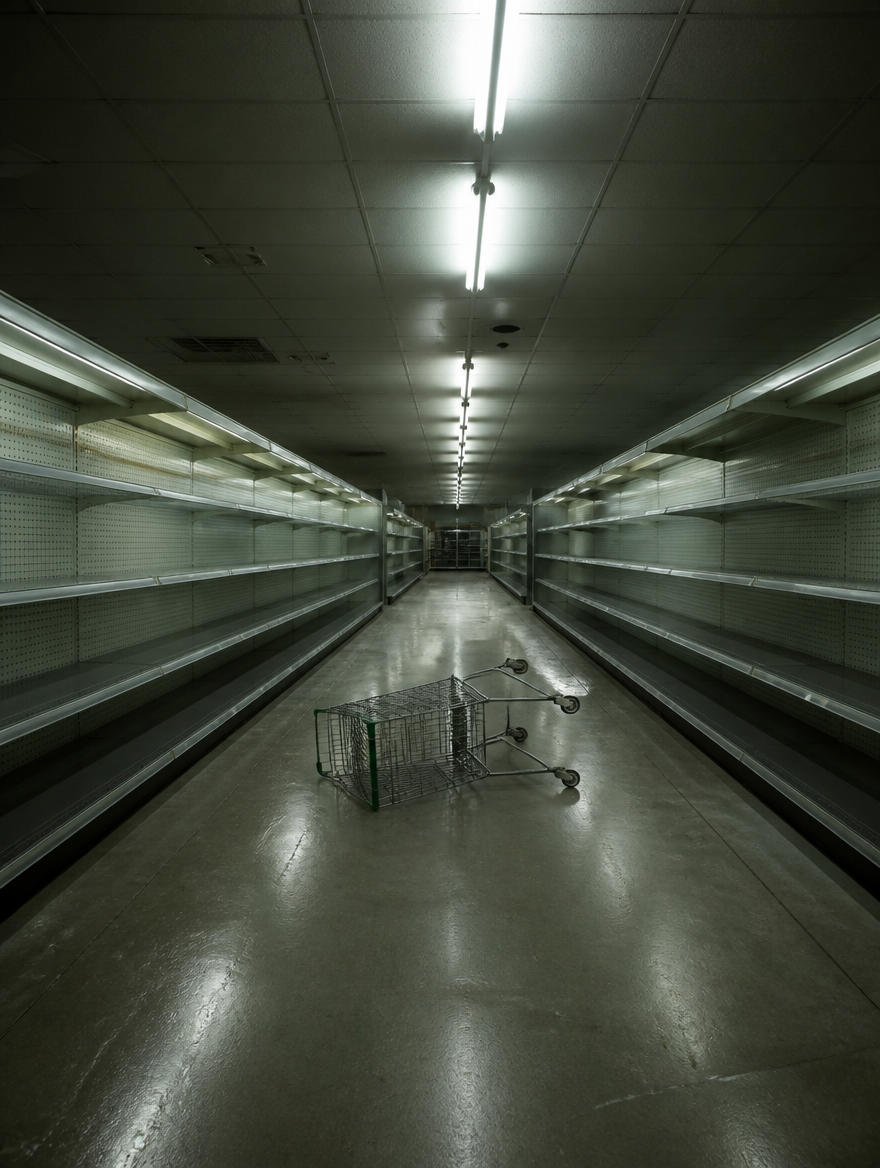
Nobody in America under sixty had experienced a real grocery shortage until the last five years. And then we lived through five of them, back to back.
March 2020 — COVID panic buying. Nationwide grocery panic ran six weeks. Meat processing plants shut down. Rice, flour, toilet paper, canned vegetables, and dry pasta went to zero in most metros within 72 hours of the first lockdown announcement. Supply chain didn't fully normalize until July.
May 2022 — Baby formula shortage. Forty-three percent of formula was out of stock nationwide after the Abbott recall + plant shutdown. Parents drove three, four states to find cans. Facebook groups sprang up trading formula like currency. It took six months to normalize. If your kid was six weeks old that May, you remember every hour of it.
May 2021 — Colonial Pipeline attack. A ransomware crew took down the pipeline that supplies 45% of the East Coast's fuel. Panic buying hit gas AND groceries across the Southeast within 72 hours because delivery trucks couldn't refuel. Some Georgia and North Carolina towns saw empty shelves in five days.
February 2024 — Kroger cyberattack. Regional Kroger stores emptied because inventory systems went down for five days. Ohio, Michigan, and Kentucky metros in particular. You could physically walk into the store — but the shelves couldn't restock because the ordering system was frozen.
September 2024 — Hurricane Helene. Appalachia food distribution collapsed for three weeks in North Carolina, Tennessee, and Georgia. Roads gone. Bridges gone. FEMA overwhelmed. Local grocery stores physically intact but with zero incoming trucks. Communities ate through their pantries in ten days.
Every one of those was less than one year ago in the memory of anyone reading this. None were "doomsday." None involved a foreign war or a coup. Every one was a 90-day disruption where a stocked pantry was the difference between calm and panic.
The people who had food certainty during those five events all say the same thing: "I didn't realize how much I was carrying until I put it down."
What food certainty actually means

Food certainty is not a bunker. It's not doomsday theology. It's not shame about being "one of those people."
It's this: you open your basement door, look at the shelf, and know — genuinely, in your gut, not as a talking point — that whatever hits next month, your kids' dinner isn't the thing you have to worry about.
You still buy groceries every week. You still cook fresh. You still enjoy Friday pizza night. But the shelf is there. It's the calmest room in the house. And it changes how you carry yourself in every other room.
The parents who have this describe it as sleeping differently. Not deeper — differently. The 3 AM parent-brain that turns over "what if" scenarios has one less thing to turn over.
The math of "one year" — honest version
Here's the truth that most emergency food companies won't tell you plainly, because it doesn't fit the marketing:
The My Patriot Supply 1-Year Kit contains 3,384 total servings across sealed, freezer-grade Mylar pouches inside four stackable food-grade buckets. At 1,500 calories per person per day — which is the survival-ration standard, not comfort-eating — one kit covers:
1 adult for 12 months
2 adults for 6 months
Family of 4 for 3 months
Family of 6 for 2 months
If your goal is a real 12-month reserve for your entire household, the honest sizing is:
Household of 2: 2 kits
Household of 4: 4 kits
Household of 6: 6 kits
That math isn't sexy. Companies would rather you think one purchase covers everyone forever. It doesn't. And you're not going to get calm sleep from a math trick — you're going to get it from a shelf that actually contains what you think it contains.
Here's why it still makes sense even with the honest math:
A single MPS 1-Year Kit is still the longest food-security purchase you can make in one line item. Building an equivalent food reserve yourself, at current grocery prices, with freeze-drying and Mylar sealing at home, would run $8,000 to $12,000 in raw goods, plus 200+ hours of preserving and packaging labor, plus $2,500 to $3,000 for a home freeze-drying machine, plus roughly 20 hours per batch of ongoing work. And your DIY food would still spoil in five years instead of the commercial kit's twenty-five.
You can buy that shelf. Or you can build it, at three times the cost and eighty times the effort. Both are honest paths. Most people who look at both math it out and buy.
Why the buy-once economics actually work
The MPS 1-Year Kit carries a 25-year shelf life on the sealed pouches. This isn't marketing puffery — it's a function of the freeze-drying process (moisture pulled below 4%), the nitrogen-flushed Mylar seal, and the oxygen absorbers packed inside each pouch. The company has kits from 2004 that they periodically open and eat as taste tests. They're still good.
What that shelf life means, in normal-person math:
You are buying insurance you never pay a premium on again. Your car insurance is $1,800 a year forever. Your home insurance is $2,400 a year forever. This is one purchase that covers you through 2049. Divide the price by 25 years and you're paying $10-$12 per month for the certainty that your family eats regardless of what happens to the grocery supply chain.
You are buying at peacetime prices, not panic prices. During COVID's peak, canned chicken in some regions went from $3.29 to $11.99 per can. Rice went from $8 to $30 per 20-lb bag on eBay. If you tried to build a one-year food reserve during an active disruption, at panic prices, you'd pay four to five times what you'd pay today.
You are buying against inflation. Freeze-dried emergency food is up roughly 4× since 2019, driven by grain, energy, and packaging input costs. Whatever this kit costs today, it will cost more next year. That's not a manipulation tactic — that's the same commodity trend that hits every dry good you buy.
Every other prep expense — a rifle, a generator, ammunition, a water filter — you buy once and you're done. Food is the only category where most Americans still pay monthly, in the form of grocery bills that go up every year and leave nothing on the shelf. The 1-Year Kit is the food equivalent of buying the generator instead of paying the electric bill forever.
what you actually get
People don't buy the kit for the food. They buy the kit for the change in how they sleep.
Deleted 3 AM anxiety. Every parent has a mental subroutine that runs "what if" scenarios in the middle of the night. Sick kid. Layoff. Car accident. Grocery panic. When the pantry contains a year of food for someone in the family, that last scenario stops running. It's a small silence. It's a real silence.
The neighbor equation flips. During any real disruption, your neighbors sort into two groups: the ones who show up at your door asking for help, and the ones who show up offering it. The kit puts you permanently in the second group. That's a change in how you relate to your street. Not because you become the sheriff — but because you carry yourself from a place of not needing anything.
Independence from the panic-price cycle. When the next grocery panic hits and eggs are $18 a dozen, you don't participate. You cook from your regular fridge, and if it's a longer disruption, you crack a bucket. The market can do whatever it does. Your kitchen is stable.
Faith without dependence. Every serious Christian family we know says the same thing about prep: we trust God, and we stock the pantry. Both. Never one instead of the other. The kit doesn't compete with faith — it removes an anxiety that gets in the way of faith. Proverbs 6:6-8 has been the standard on this for three thousand years.
Multigenerational. A 25-year shelf life means the buckets outlast most of the decisions you'll make this decade. Your kids will be raising their own families by the time the seals need to be revisited. You are literally putting food on your grandchildren's table with a purchase you make today.
The window is real — this is not manufactured urgency
We are not going to tell you the sky is falling. It isn't. This isn't a countdown clock and there is no "buy before midnight" pressure on this page.
But the availability window on emergency food kits is real, and it's documented, and if you've been kicking this decision down the road for two years, here is what you should know before you kick it another year:
March 2020 wait times hit 12-18 weeks. MPS pulled the 1-Year Kit off the site entirely for portions of April 2020 because they couldn't fill orders. Customers who had ordered in February got their kits in July. The kit page carried a "reservation only" flag through the summer.
2022 wait times hit 8 weeks. Not as bad as 2020, but bad enough that a customer buying during the crisis was buying to be ready for the NEXT crisis, not the current one.
Freeze-dried facility capacity is capped by industrial equipment. The Mylar sealers, nitrogen flush lines, and industrial freeze dryers that produce commercial emergency food take 6-9 months to source and install. When demand spikes, supply can't scale to meet it — the equipment doesn't exist. This is a structural constraint that will show up in every future disruption.
Every crisis pulls product mid-cycle. The rule is simple: you can order in peacetime, or you can order during a crisis. You can't do both. The people who ordered during 2020 waited months and paid more.
Prices are up roughly 4× since 2019. Grain, energy, and packaging inputs all went up. Kit prices reflect it. Whatever the kit costs today, it will cost more next year — not because of marketing, because of commodities.
None of that is a countdown clock. It's just the shape of the market you're buying into. The best time to have made this decision was five years ago. The second best is today.
What actually comes in the 1-Year Kit
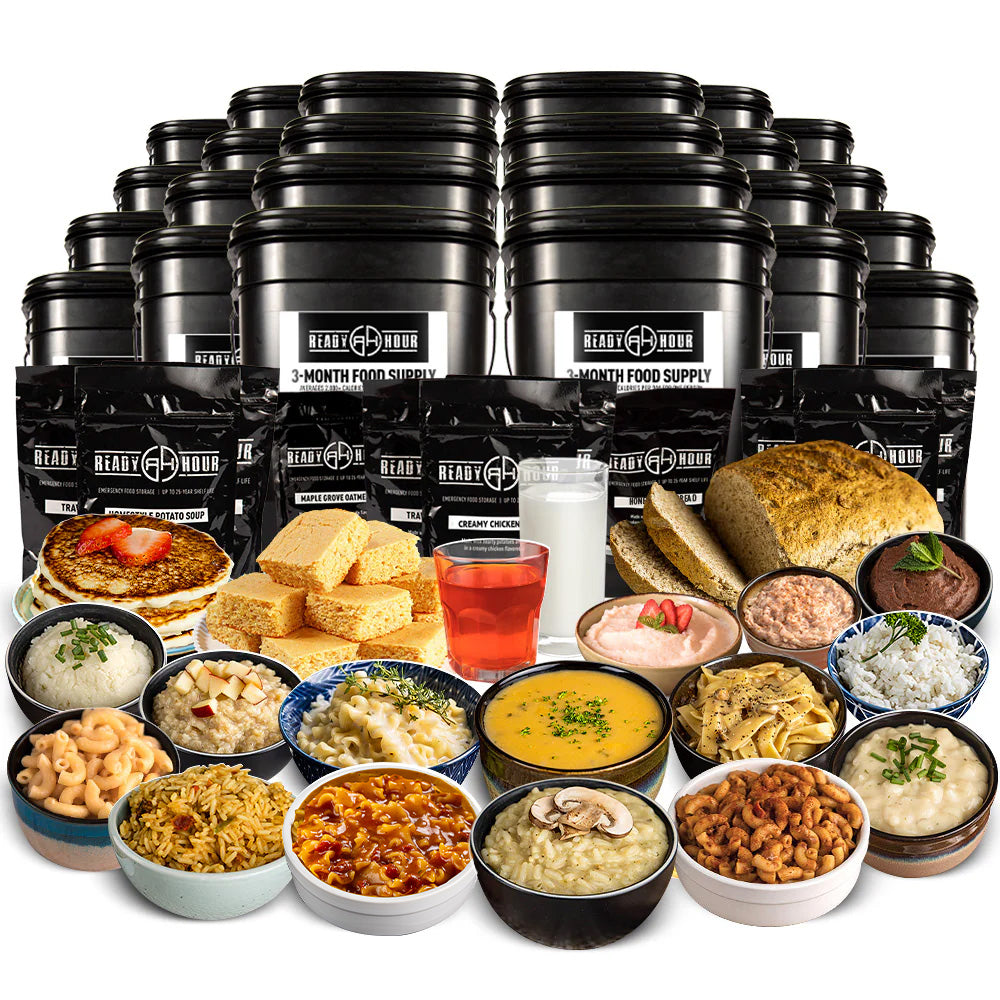
Four stackable, food-grade, water-resistant buckets. Inside each bucket, freezer-grade Mylar pouches individually sealed and nitrogen-flushed. Inside each pouch, freeze-dried and dehydrated meals with a 25-year shelf life.
The kit breaks down roughly like this:
Breakfast entrées — Maple grove oatmeal, granola with milk, powdered whole eggs, blueberry pancakes. Enough for one adult to have a real breakfast every morning for a year.
Lunch and dinner entrées — Chili mac, cheesy broccoli rice, pasta primavera, creamy stroganoff, southwest style beans and rice, potato soup, hearty tortilla soup. Fifteen distinct entrée types to prevent taste fatigue.
Sides — Mashed potatoes, dehydrated vegetables, gravies, sauces.
Snacks and drinks — Milk, whey protein, fruit drink powder. Water flavoring matters more than you think during a disruption — plain water for weeks kills morale faster than the food itself.
Preparation on every pouch: add hot water, wait ~15 minutes. That's it. No specialized cooking, no rehydration process, no soaking overnight. If you can boil water on a camp stove, you can feed your family from this kit.
The four buckets stack into a footprint roughly the size of a two-drawer filing cabinet. Under a basement stair, in a closet corner, in a garage — most homes have space they didn't realize was space until they measured.
Check current pricing and kit availability at My Patriot Supply →
Honest alternatives
We are not going to tell you MPS is the only path. There are four legitimate ways to build food certainty, and each one is right for a different type of person.
Costco / Sam's Club stockpile. Cheaper per calorie. Excellent if you rotate discipline. Downsides: 2-year practical shelf life on canned goods, no packaging redundancy against moisture or pests, and it takes physical space equivalent to 3-4 pallets to match one MPS kit. Right for the family with a big pantry, big freezer, and the discipline to eat and restock on a rolling basis.
DIY freeze-drying. Harvest Right medium freeze dryer runs about $2,795. You'll process 6-8 lbs per batch, batches run 20-30 hours, and you'll need Mylar bags, oxygen absorbers, and an impulse sealer on top. Best-case DIY shelf life is 5-10 years (not the commercial 25). Right for the family that will actually use the machine long-term for garden preservation, not just prep — because otherwise it's a $2,795 paperweight after six months.
Grocery-store rotation. Buy an extra of everything each shop, first-in-first-out the pantry, always have 30-60 days on hand. Zero capital cost, infinite time cost, and it wastes food if you don't rotate perfectly. Right for the household that shops weekly and has a spouse who lives for spreadsheets. Fails hard against any disruption longer than 30 days.
LDS bishop's storehouse. If you're Latter-day Saints, you already know about this. It's the best deal in emergency food in America. Not available to non-members. Worth noting for completeness.
My Patriot Supply 1-Year Kit. Highest upfront cost, zero ongoing effort, longest shelf life on the market, real disaster performance track record from the last five years of American disruptions. Right for the family that wants to make one decision, write one check, and move on with their life.
Pick the one that fits your household. Don't let the perfect be the enemy of the done. The worst answer is the one where you kick the decision down the road for another year while five more disruptions roll through.
Frequently asked
Does the food actually taste good?
Better than most people expect. Not as good as a home-cooked meal on a Tuesday, better than most military MREs and college dorm food. MPS sends free sample pouches with orders so you can taste before committing to eating from the kit. Take them up on that.
Is it healthy?
It's survival calories, not fitness food. Reasonable macros (protein-forward on the entrées, complex carbs on the sides, real vegetables in most pouches). Sodium is higher than a cooked-from-scratch diet because sodium preserves. If you have blood pressure issues, factor that in. If you're feeding kids for 90 days during a crisis, you'll take the sodium and be grateful.
Where do I store 4 buckets?
The four buckets stack into a footprint of roughly 24" × 18" × 40" tall. Under a basement stair. In the back corner of a hall closet. In a garage cabinet. In a mudroom bench. Most homes have space they haven't measured. Kits are food-grade sealed against pests, humidity-resistant to standard basement conditions, and stackable if you buy multiple.
What if I move?
They're four buckets. They go in the moving truck. Total weight is roughly 100 lbs per kit — one bucket is manageable by one adult. This is not a permanent installation.
What about my kids who won't eat pasta?
The kit has enough variety (breakfast, lunch, dinner entrées, sides, snacks) that even picky kids find several pouches they'll eat. But be realistic: during a real 90-day disruption, "picky" resets. Kids who wouldn't eat mashed potatoes on a Tuesday will eat them on day fourteen of a supply chain freeze.
Can I try it before buying the whole kit?
Yes. MPS sells single sample pouches and 72-hour kits for under $100 so you can taste-test the food before committing to the full kit. Recommended.
What's the return policy?
365-day return window on unopened kits. That's an unusually long window for a food product and reflects the company's confidence in the product.
How long does it take to prepare?
Every pouch is boil-water-and-wait. Roughly 12-20 minutes from cold water to hot meal. Camp stove, propane burner, wood fire, or kitchen stovetop all work. The only requirement is heat + potable water.
The quiet close
The best time to have bought this was five years ago. The second best is today.
Nobody's holding a gun to your head. There's no countdown clock, no fake scarcity, no "act now" button that flashes. This is a purchase you either make once and forget about for 25 years, or don't make and hope every future disruption comes back to normal in three weeks like the last five did.
If it fits your household, the honest math is on this page. Multiply kits by household size. Multiply the shelf-life discount against the price. Compare to the cost of doing nothing during the next 90-day disruption.
Then decide.
Check current pricing and kit availability at My Patriot Supply →
God · Family · Country
Advertisement
FTC Disclosure: OSS America contains affiliate links. We earn a commission from qualifying purchases at no extra cost to you — we only point you at gear we'd stake our own trip on.
More field tests
 Field-TestedSurvival
Best Machetes for the Outdoors
Eleven machetes that actually sell, ranked by steel, tang and reach - from a $23 pack blade to a full-tang Gerber Bolo. Counting down from #11 to #1.
 Buy Once, Cry OnceSurvival
4Patriots 30-Day Preparedness Trifecta: 3 Products for Off-Grid Survival (2026)
Three 4Patriots products cover food, backup food, and off-grid power for 30 days of survival — the trio that turns a household from unprepared to insurance-policy ready.
 Survival
15 Products and Tips to Protect Your House Against Whatever Comes to You
Fifteen verified products and the tips that make them work: locks, cameras, flood control, backup power, food storage, and which gun actually belongs in a house.
 Survival
10 Non-Firearm Home Defense Weapons on Amazon (2026)
10 legal, non-firearm home defense weapons sold on Amazon right now. Ranked #10 to #1 with state-by-state legal notes — from a $37 pepper gel to a $399 CO2 launcher.
 Field-TestedSurvival
Top 15 Essential Survival Gear & Gadgets for American Households 2026
The 15 pieces of survival gear the OSS crew stands behind for American households in 2026 — ranked #15 → #1 from a $25 water filter to a $1,500 solar generator. Real gear, honest brands, buy once, cry once.
 Field-TestedSurvival
11 Best-Selling Shotguns for Home Defense (Ranked #11 to #1)
Eleven pump-action and semi-auto shotguns Americans are actually buying to defend their homes — ranked #11 to #1, with real dealer stock and honest picks from Mossberg 590, Beretta 1301, Kel-Tec KSG, and more.