
.50 BMG Rifles — Buy While You Can: Every Model Still Legal + Shipping in America (2026)

Advertisement
The .50 BMG has never been a common civilian purchase. It was never meant to be. Designed by John Browning in 1918 as anti-materiel ammunition for the M2 machine gun — the same gun still mounted on American armor and helicopters more than a century later — it was built to disable equipment and engage threats at a mile out. When Ronnie Barrett brought his shoulder-fired M82 rifle to market in 1982, he did what everyone said was impossible: he made a .50 BMG platform that a single soldier or civilian could actually carry, aim, and fire from a bench or a bipod. The M82/M107 has served in every major American conflict since. And for the last 40 years, American civilians have been able to buy the exact same platform out of the box.
That window is closing. California banned new civilian .50 BMG sales in 2005. Connecticut, Illinois, and New York have proposed similar restrictions at state level. Federal ".50 Caliber Sniper Rifle Reduction Act" bills have been introduced by U.S. senators in 2008, 2013, 2019, and 2023 — every one of them killed in committee, but each one closer to the finish line than the last. Some states have started with ammunition restrictions instead of the rifles themselves — California already requires proof-of-legal-ownership documentation to buy .50 BMG rounds. The regulatory pattern is clear: this is a caliber the political class wants off civilian shelves. If you've ever wanted to own one, "someday" is the wrong plan. Existing owners have always been grandfathered under every restriction that's passed — but new sales end the day the law does.
This is the complete field guide to civilian .50 BMG rifles in America — what they're for, why they're regulated, and every currently-shipping model you can still buy today from a major U.S. retailer. Prices, sources, and product URLs all verified live at the time of writing.
🏆 The Quick Winners (Skip the Whole Guide)
Best entry-level .50 BMG (buy this first): HM Defense HM50B2 Gen2 Bolt-Action — around $5,000, American-made, four Cerakote color options, single-shot bolt gun
Best precision / ELR competition rifle: Zastava Arms Black Arrow M93 Bolt-Action — around $9,500, 33" barrel, five-round magazine, purpose-built long-range platform
Best semi-auto — the American benchmark: Barrett M107A1 Semi-Auto — around $14,200, the platform the U.S. military uses, the round every serious ELR shooter respects
Best collector piece: Barrett M107A1 America 250 Series Anniversary Edition — around $17,000, American 1776 Flag Cerakote, limited production, the piece you buy to hand down
How We Screened These Rifles
Editorial rank — not a sales chart. Every rifle listed here is (a) chambered in .50 BMG, (b) currently listed and stocked at Sportsman's Warehouse as of this writing (we link to Guns.com where it lists the same rifle), and (c) either an established platform with real service history OR a serious purpose-built competitor to the established brands. We didn't include vaporware SKUs, discontinued rifles, or overseas platforms with no established U.S. dealer network. Prices reflect Sportsman's Warehouse listings at the time of research and will move; check the retailer for current pricing.
A note on availability: .50 BMG rifles are Federally-regulated firearms and must ship to an FFL (Federal Firearms License holder) in your state, not to your home. The retailer arranges the FFL transfer at checkout. Delivery timelines are longer than standard rifles — expect 2-4 weeks from order to pickup at your FFL. Some states (California is the main one) prohibit new .50 BMG sales entirely — if you're a California resident, none of these are legally purchasable regardless of where they ship from.
📜 The History of .50 BMG — Why This Round Exists
The .50 BMG (Browning Machine Gun, 12.7×99mm NATO) was designed by John Moses Browning in 1918 in response to a specific problem: World War I had introduced armored vehicles and low-flying aircraft to the battlefield, and existing rifle cartridges couldn't stop them. Browning scaled up his .30-caliber machine gun design, chambering it for a new cartridge — effectively a larger, longer version of the .30-06 case, throwing a 660-750 grain projectile at 2,900 fps. The result was the M2 Browning machine gun, adopted by the U.S. military in 1933. The M2 has been in continuous American service for over 90 years — the longest continuous-service military weapon in U.S. history.
For 65 years, .50 BMG was a machine-gun-only cartridge. Then in 1982, Tennessee engineer Ronnie Barrett brought a prototype shoulder-fired rifle chambered in .50 BMG to the SHOT Show — the M82. The industry laughed. The M82 was heavy, expensive, complicated, and — critically — a full-power .50 BMG shoulder-fired rifle was supposed to be impossible without breaking the shooter's collarbone. Barrett had solved the recoil problem with a recoiling-barrel design and an aggressive muzzle brake. The rifle worked. The Swedish military bought some. The U.S. military eventually adopted it as the M82A1 in 1990, then upgraded to the M107 in 2002 and the M107A1 in 2011. It's been in every American conflict since Desert Storm.
Civilian .50 BMG rifle sales began the same year Barrett brought the M82 to market. For 40+ years, American civilians have been able to buy the exact same rifle the U.S. Marine scout snipers carry. That access is what the current regulatory pressure targets.
🎯 What Civilians Actually Use .50 BMG For
The public perception of civilian .50 BMG ownership doesn't match the reality. Here's what these rifles are actually being used for by their owners:
Extreme Long-Range (ELR) precision shooting
This is the #1 civilian use, by a wide margin. The .50 BMG's ballistics let a shooter hit man-sized targets reliably at 1,500-2,500 yards, with confirmed hits well past 4,000 yards (2.3 miles). There's a growing competition circuit — King of 2 Miles (KO2M), NRL Hunter, and regional ELR matches — where competitors put their gear against precision-rifle targets at extreme distance. If someone owns one and actually shoots it, most of the time this is what they're doing.
Feral hog + predator eradication on large ranches
Texas, Oklahoma, and the American Southeast have a wild hog problem that costs American agriculture an estimated $2.5 billion a year, according to USDA. Ranchers with 10,000+ acre operations use .50 BMG for helicopter-based or hilltop hog eradication at 500-1,000 yards, where standard hunting rifles run out of practical range. This is a real practical use, not theater — ask any Texas rancher managing a hog problem.
Steel-target destruction + recreational shooting
Private ranges with 500-1,000-yard bays where owners shoot old car bodies, appliances, and steel gongs. Pure fun-shooting — the .50 BMG makes a 3/8" AR500 steel plate ring like a bell at 1,000 yards, and reduces a car door to Swiss cheese at 300 yards. If you've ever watched a "50 Cal Sunday" video, this is what you were watching.
Long-range hunting (limited, ethical debate)
Legal in some Western states for elk, bison, and dangerous game where laws specifically permit; more common on African plains-game safaris (Cape buffalo, elephant in some countries). Banned in most Eastern hunting seasons. Ethically debated — the caliber is overpowered for most North American game, and pass-through shots can travel dangerously far past the target. Serious hunters who use .50 BMG do it responsibly on massive private land with verified long-range backstops.
Precision-rifle collecting + engineering appreciation
Some buyers love the Barrett M82/M107 the way car people love a Ferrari — the platform is iconic, the engineering is landmark, the service history is real. You don't NEED one to be a serious rifle owner. You WANT one because it represents something that changed a category. Collectors keep them in the safe next to other landmark American firearms.
Prepper / TEOTWAWKI stockpile
Some buyers see .50 BMG as the ultimate barrier-defeat rifle for worst-case-scenario planning — the capability to disable vehicles, penetrate cover at distance, and interdict threats past the range of standard rifles. Overkill for realistic defensive scenarios, but part of the mindset for the serious-prep community. Whether you agree with the premise or not, it's a documented buyer segment.
Veteran + commemorative purchases
Former M2 Browning gunners, Marine scout snipers, and Army designated marksmen who used the M107 in service and want to own the platform they carried. This is often an emotional purchase as much as a practical one — the M107A1 is a piece of American military history a veteran can own outright.
What it's NOT used for: home defense (comically wrong caliber for indoor use — a .50 BMG through a home wall exits the neighborhood, not the neighboring room), casual range shooting (ammo cost + noise + backstop requirements make it impractical), or vermin control below hog-sized game.
⏰ The Regulatory Timeline — Why "Buy While You Can" Isn't Hyperbole
The pressure to restrict civilian .50 BMG ownership is not hypothetical. Here's the documented timeline:
2005 — California — the "Fifty Caliber BMG Regulation Act" (SB50) became law. New sales, transfers, and possession of .50 BMG rifles by California residents were prohibited. Existing owners were grandfathered but required to register.
2008 — U.S. Congress — Senator Dianne Feinstein introduced the ".50 Caliber Sniper Rifle Reduction Act" (S.1331), which would have banned civilian .50 BMG sales federally. Died in committee.
2013 — U.S. Congress — reintroduced version of Feinstein's bill (S.150). Died in committee.
2019 — U.S. Congress — reintroduced as H.R.5602. Died in committee.
2019 — Washington D.C. — DC's existing "high-capacity firearm" restrictions were interpreted to include .50 BMG rifles. Practical civilian ownership is prohibited in the District.
2023 — U.S. Congress — reintroduced as H.R.698. Died in committee, but companion bills at state level in Connecticut, Illinois, and New York gained momentum.
Ongoing — California ammunition restrictions — California residents purchasing .50 BMG ammunition must provide proof of legal-owner status; out-of-state sales prohibited without additional documentation. This ammo-first restriction is the pattern other states are watching.
The trajectory is unmistakable: every federal .50 BMG restriction bill that has been introduced has died in committee, but the pressure has been consistent for two decades and appears to be intensifying. State-level restrictions are already in force in California and D.C., with active legislation in three additional states. Every restriction that has passed has grandfathered existing owners — new sales end on the day the law does.
This is not fear-mongering. If you've been thinking about owning one, the honest financial and legal calculus favors buying now over waiting.
💰 The Ammunition Reality — What You'll Actually Spend
Owning the rifle is step one. Feeding it is the ongoing commitment most first-time buyers underestimate.
Military-surplus ball ammunition: $3.50-$5.00 per round when in stock (Sportsman's, Ammunition Depot, Palmetto State Armory rotate inventory). Adequate for range shooting and practice.
Match-grade ammunition (Hornady A-MAX, Hornady ELD Match, Nosler Custom): $6.50-$10.00 per round. Required for ELR competition and precision work past 1,000 yards.
API (Armor-Piercing Incendiary) and specialty rounds: $12-$25 per round when legally available. Some specialty rounds are restricted in certain states.
Practical training session cost: A 50-round range session runs $175-$500 depending on ammunition grade. Zeroing a new scope + confirming DOPE at multiple distances is often a 100-round day = $350-$1,000.
Ammo availability: .50 BMG is not stocked at big-box sporting-goods stores year-round. Sportsman's Warehouse, Ammunition Depot, MidwayUSA, and specialty retailers (Sportsman's Guide, Palmetto State Armory) are your reliable sources.
Buy the ammo when you buy the rifle — at minimum a case of ball (100 rounds) for break-in and initial zero + a case of match-grade (100 rounds) for the actual capability. That's a $1,000-$1,500 ammunition investment on top of the rifle cost. Anyone selling you a .50 BMG rifle and telling you "you can pick up ammo whenever" is misleading you — inventory is inconsistent and prices have only gone up over the last decade.
🔧 Before You Buy — Five Things Every .50 BMG Owner Must Know
1. It has to ship to a Federal Firearms License (FFL) holder
You cannot ship a .50 BMG rifle to your home. The retailer handles FFL arrangement at checkout — you'll select a receiving FFL near you (usually a local gun shop that charges $25-$75 for the transfer). The transfer includes the standard NICS background check. Expect 2-4 weeks from order to pickup at your FFL.
2. You need a range that can actually handle it
Standard indoor ranges will refuse .50 BMG (backstop can't handle it and the muzzle blast is dangerous to adjacent shooters). Most outdoor commercial ranges cap at .308 or .338 Lapua. You'll need access to a private property with 500+ yards of safe backstop, or a specialty long-range facility (K&M Precision Rifle Training in TN, NRA Whittington Center in NM, FTW Ranch in TX, Rifles Only in TX are common destinations for serious .50 BMG shooters). Confirm range access BEFORE you buy the rifle, not after.
3. Optics cost as much as a good rifle
A .50 BMG rifle without a serious optic is a paperweight. Minimum credible glass: a 5-25x or 7-35x precision scope with elevation adjustment to 30+ MRAD (Nightforce ATACR, Vortex Razor HD Gen III, Schmidt & Bender PMII, Kahles K525i). Budget $2,500-$5,000 for scope + mount + rings. On the Barrett M107A1 specifically, you'll want a mount rated for the recoiling-barrel system — cheap rings will loosen and lose zero.
4. Storage is a real consideration
A .50 BMG rifle in a Pelican case is 50+ pounds and 5+ feet long. It doesn't fit in a standard rifle safe. Plan for a dedicated long-gun safe (Liberty, Fort Knox, Browning Pro Series) sized for the specific rifle. Ammunition storage adds weight — a 100-round case of .50 BMG is 30+ pounds and needs dry, temperature-stable storage.
5. Muzzle brake + hearing protection are non-negotiable
All modern .50 BMG civilian rifles ship with aggressive muzzle brakes — they have to, because unbraked .50 BMG recoil is genuinely dangerous. The trade-off: the muzzle blast is deafening and creates a significant concussion zone. Double hearing protection (foam plugs + electronic muffs) is mandatory. Anyone standing within 20 feet of the muzzle needs the same protection. Suppressors for .50 BMG exist but require NFA registration + serious wait times.
🎯 The 5 Currently-Shipping .50 BMG Rifles
Every rifle below was verified in stock at Sportsman's Warehouse at the time of writing; where Guns.com lists the same rifle, the link goes there. Ranked by price (entry to flagship).
#5 — HM Defense HM50B2 Gen2 Bolt-Action (29.25" barrel, Cerakote)
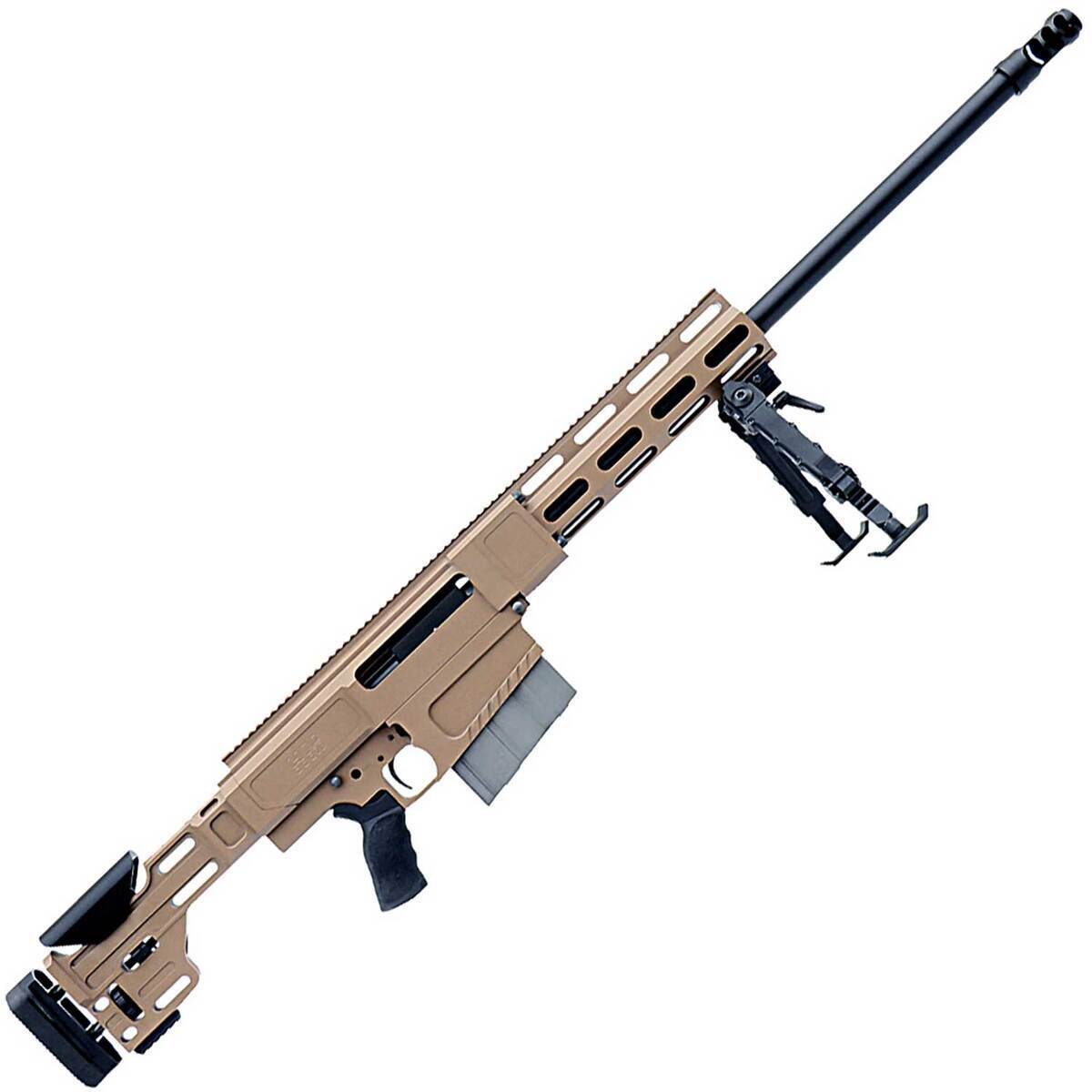
~$4,999 · The entry-level American bolt-action .50 BMG · Single-shot bolt-action · 29.25" free-floated barrel · aggressive dual-chamber muzzle brake · monolithic aluminum receiver · four Cerakote color options (Flat Dark Earth, OD Green, Black, Tungsten)
Best for: First-time .50 BMG buyer, ELR beginner, precision hobbyist at a proven-brand price point
HM Defense is an American manufacturer (Pennsylvania) that built the HM50B2 Gen2 as an accessible entry into serious .50 BMG ownership. Single-shot bolt-action platform means simpler action (fewer parts to maintain, more inherent accuracy) at roughly a third of the price of the semi-auto Barrett flagship. Monolithic aluminum receiver keeps weight manageable at 20 lbs — still heavy, but portable for a range trip. Four Cerakote colorways let you match the rifle to your kit. If you want to own a .50 BMG and don't need the semi-auto capability, this is where the honest first-purchase conversation starts.
#4 — HM Defense HM50MAX Bolt-Action (29.25" barrel, Tan)
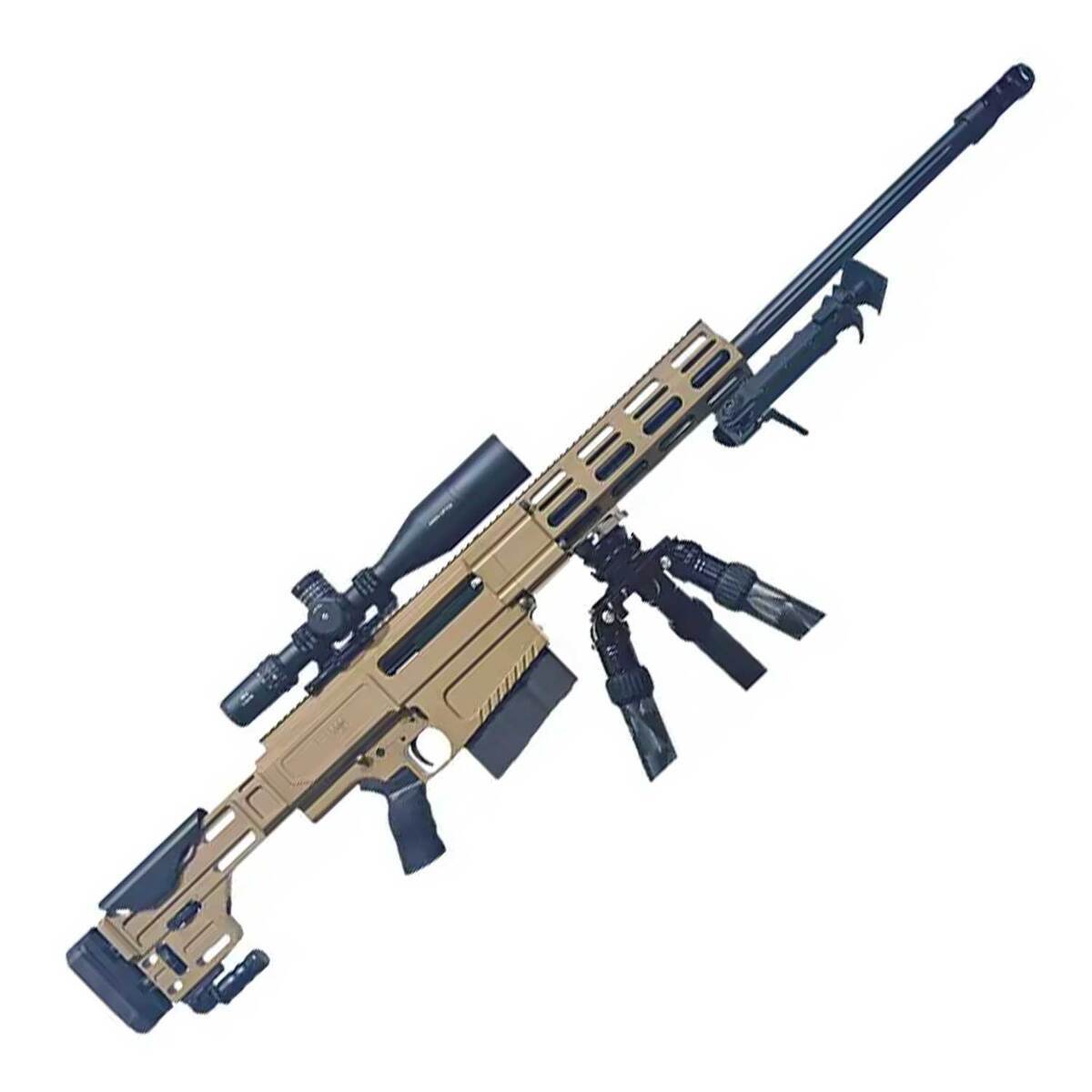
~$5,999 · The enhanced-precision bolt-action from HM Defense · Single-shot bolt-action · 29.25" match-grade barrel · enhanced trigger group · upgraded Cerakote finish · Tan colorway
Best for: Precision shooters who want tighter tolerances than the base HM50B2 offers
HM Defense's step-up model — same bolt-action platform as the HM50B2 Gen2 but with a match-grade barrel and enhanced trigger group that tighten the accuracy envelope for ELR work. Roughly $1,000 more than the base rifle, buying you meaningfully tighter groups at 1,000+ yards. The right pick for the shooter who knows they're going to shoot the rifle seriously — not just own it. Same FFL requirements, same range considerations as the base HM50B2.
#3 — Zastava Arms Black Arrow M93 Bolt-Action (33" barrel)
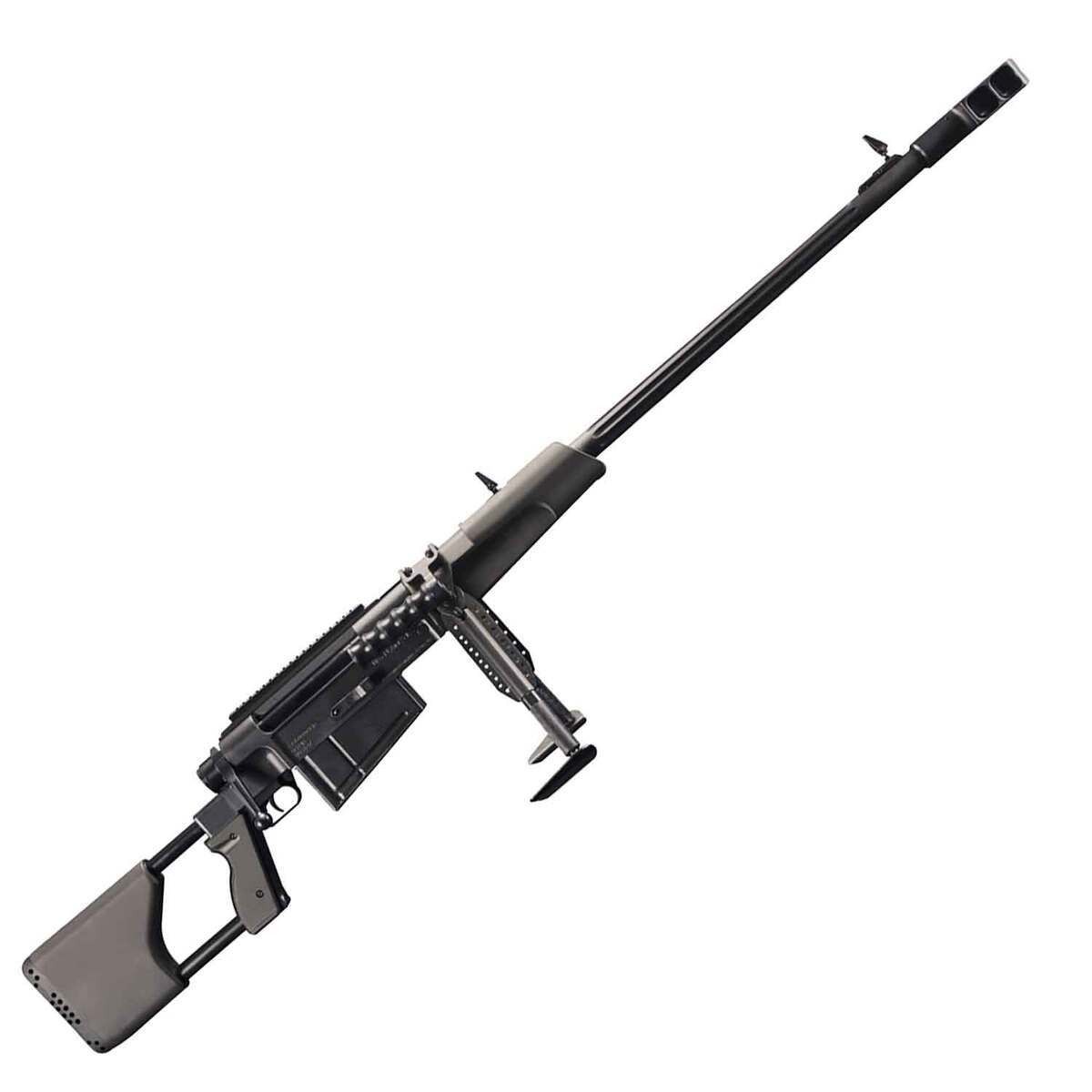
~$9,499 · The purpose-built long-range precision platform · Bolt-action · 5-round detachable magazine · 33" barrel (longest in this guide — maximum sight radius + velocity) · thumbhole tactical stock · integrated Picatinny optics rail · Serbian-manufactured
Best for: Serious ELR competition, precision shooters who want a magazine-fed bolt-action platform
Zastava's Black Arrow is the platform serious European ELR competitors have been buying for two decades — a purpose-built long-range .50 BMG designed from a clean sheet as a precision platform rather than adapted from a military rifle. The 33" barrel is the longest in this guide, maximizing both muzzle velocity and sight radius for iron sights. The 5-round detachable magazine (unique in this guide — most .50 BMGs are single-shot) enables follow-up shots without breaking position. Zastava's Serbian manufacturing has a strong reputation for precision-rifle build quality at prices below American premium brands. The right pick for the shooter who plans to actually compete or hunt at extreme distances.
#2 — Barrett M107A1 Semi-Automatic (29" barrel, Tungsten Gray Cerakote)
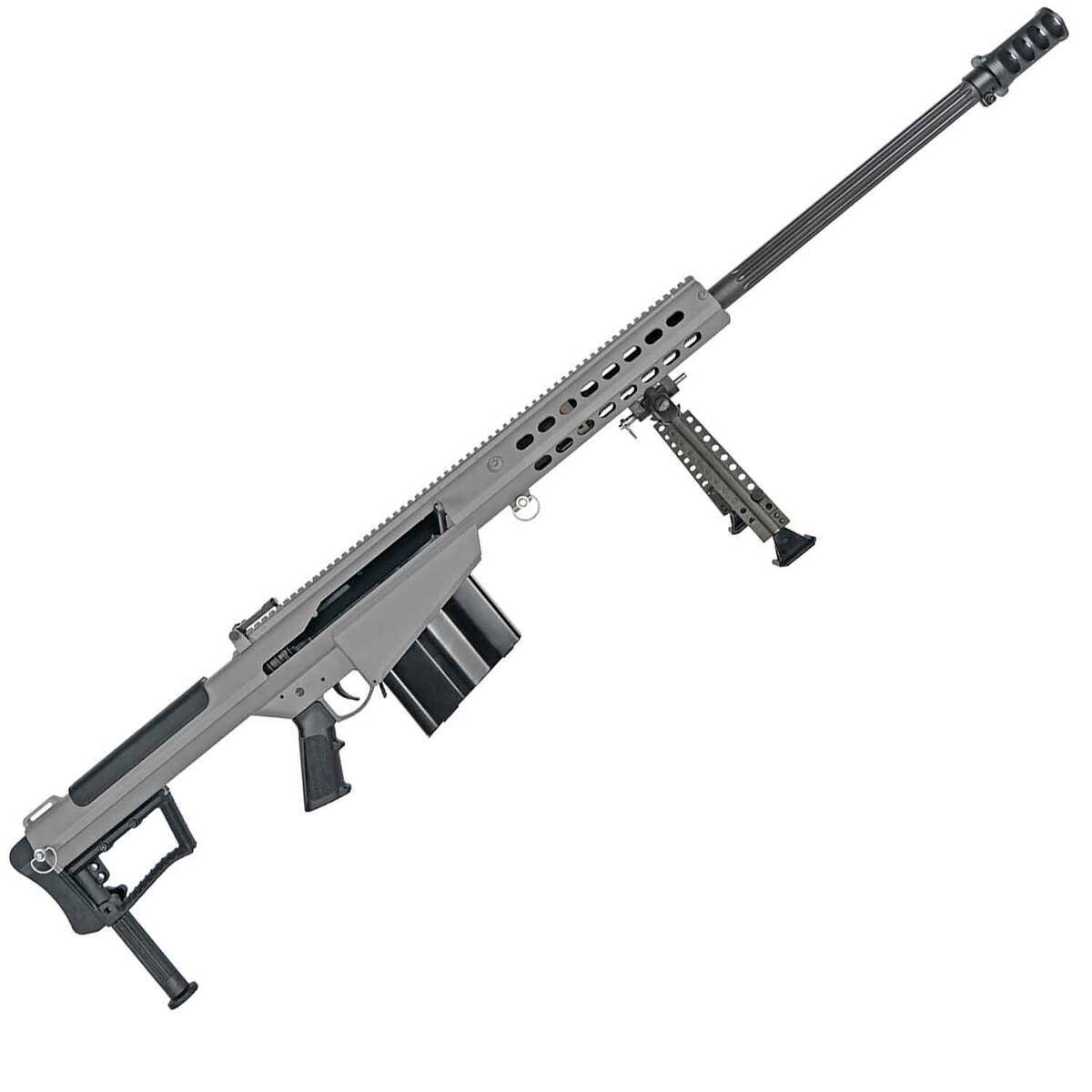
~$14,186 · The American benchmark — the rifle the U.S. military uses · Semi-automatic (short recoil operated) · 10-round detachable magazine · 29" fluted barrel · titanium tapered muzzle brake · Cerakote finish (multiple colors available) · integrated 27 MOA optics rail · adopted by U.S. military as M107A1 in 2011
Best for: The buyer who wants the actual American service rifle, semi-auto capability, and the strongest resale value in the category
The Barrett M107A1 is the platform. Every other .50 BMG rifle in this guide exists in the market Barrett created 40 years ago. The M107A1 is the direct-issue rifle currently in service with the U.S. Marine Corps, Army designated marksman program, and dozens of allied militaries worldwide. Semi-automatic operation with 10-round magazine capacity — meaningful in a competition context and irreplaceable in a hog-eradication context where multiple targets present in seconds. Titanium tapered muzzle brake reduces felt recoil to roughly that of a 12-gauge shotgun — impressive engineering. Available in multiple Cerakote colors (Flat Dark Earth, Tungsten Gray at this price point; specialty colors and configurations run higher). The rifle you buy if you want the definitive American .50 BMG platform.
#1 — Barrett M107A1 America 250 Series Anniversary Edition (American 1776 Flag Custom Cerakote)
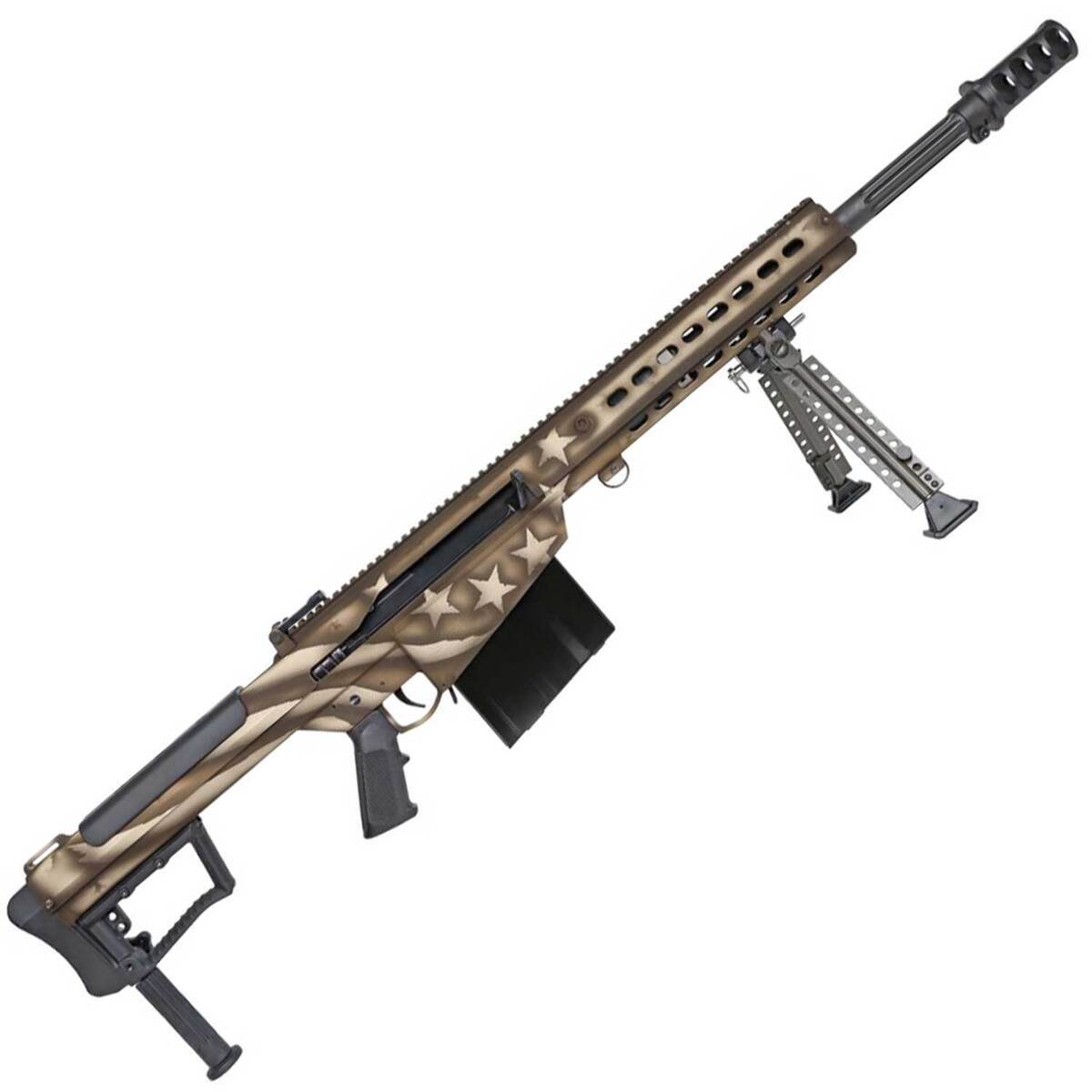
~$16,999 · The commemorative Barrett — the piece you buy to hand down · Semi-automatic (short recoil operated) · 20" barrel · custom American 1776 Flag Cerakote finish · limited-production anniversary run commemorating America's 250th (2026) · 10-round detachable magazine · full Barrett M107A1 mechanical platform
Best for: The buyer who wants the flagship American .50 BMG platform in a commemorative configuration — a hand-down piece, not just a range rifle
Barrett's limited-production anniversary edition of the M107A1, released for America's 250th anniversary in 2026. Full-power semi-automatic .50 BMG in the same mechanical package as the standard M107A1, dressed in a custom American 1776 Flag Cerakote finish that turns the rifle into a piece of American history you can shoot. Limited production runs of Barrett flagships historically appreciate — the original M82A1 examples from the 1980s now trade for multiples of their original price. If you're going to buy one rifle to hand down to a son or daughter, this is the strongest candidate in the guide. Owning a Barrett M107A1 is significant; owning THE Barrett America 250 Anniversary is generational.
Buying a rifle online from Guns.com
You pay online, Guns.com ships the rifle to the licensed dealer (FFL) you choose, and you pick it up with a valid ID after the dealer runs the required background check. Some listings can't ship to certain states, so check the listing first. Our Is Guns.com legit? guide walks through fees, shipping and the whole process step by step.
The Bottom Line — Which Rifle Do You Actually Buy?
Five rifles across a $12,000 price spread. Here's the honest decision tree:
If this is your first .50 BMG and you're not sure how much you'll actually shoot it: HM Defense HM50B2 Gen2 at $5,000. American-made, four color options, single-shot bolt-action keeps the mechanics simple. Adequate for range shooting, ELR practice, and casual ownership. If you get serious later, resale value is real (used HM50B2s hold value well because the entry-level tier has consistent demand).
If you know you're going to compete in ELR or shoot at extreme distances seriously: Zastava Black Arrow M93 at $9,500. Purpose-built long-range precision platform, 33" barrel maximizes velocity and precision, 5-round magazine enables follow-up shots. This is a serious tool for a serious hobby.
If you want the definitive American semi-auto platform + real resale value: Barrett M107A1 at $14,200. The American service rifle, semi-auto with 10-round mag, the strongest brand in the category. Barrett resale value has been rock-solid for 40 years.
If you're buying one rifle to own for life and hand down: Barrett M107A1 America 250 Anniversary Edition at $17,000. Limited-production commemorative in custom American 1776 Flag Cerakote. Historical significance + Barrett flagship platform + limited-production scarcity = generational purchase. The one rifle in this guide that IS as much a collector item as a shooter.
Any of these five is a legitimate buy. All of them are chambered for the same round the U.S. military has fielded for over 90 years. None of them is a "starter caliber" — the .50 BMG is a specialty commitment across the board. The question is not whether it's practical (it isn't, and it doesn't need to be) — the question is whether the door is going to be open five years from now. The regulatory timeline says: don't count on it.
Legal + Safety Disclaimer
Civilian ownership of .50 BMG rifles is legal under U.S. federal law and in most U.S. states, subject to standard federal firearms law and background-check requirements. California prohibits new civilian .50 BMG rifle sales (existing owners grandfathered under Roberti-Roos Assault Weapons Control Act extension, 2005). Washington D.C. effectively prohibits civilian .50 BMG ownership under the District's high-capacity firearm restrictions. Connecticut, Illinois, and New York have active proposed legislation restricting .50 BMG ownership at the state level — check current state law before purchasing. All .50 BMG rifles must ship to an FFL (Federal Firearms License) holder in your state, not to your home address; the retailer handles the FFL transfer arrangement at checkout. Use of any firearm is governed by state-specific self-defense, hunting, and use-of-force law — consult a firearms attorney in your jurisdiction if you have questions about legal use.
OSS America believes in the individual right to bear arms as enshrined in the Second Amendment, and in the American tradition of responsible firearm ownership. Train regularly with your firearm. Store firearms and ammunition responsibly. Verify all state and local laws before purchase. And most importantly — verify the rifle you own actually shoots to your expected zero before you ever trust it in a competition or hunt.
Advertisement
FTC Disclosure: OSS America contains affiliate links. We earn a commission from qualifying purchases at no extra cost to you. Every pick is research-based: specs, verified prices and owner reviews.
More reviews
 Top PickShooting
Best 10mm Pistols (2026): 8 Picks From $600 to Colt
Glock 20, M&P 10mm, SIG P320-XTEN, Springfield XD-M Elite, FN 510 and three 10mm 1911s compared on capacity, weight, optics and real October 2026 prices.
 Top PickShooting
Best Revolvers (2026): 8 Picks for Carry, Home, Hunting and .22
Ruger GP100, S&W 686 Plus, SP101, LCR, Taurus 856, Colt Python, Super Redhawk and Wrangler compared on caliber, weight, capacity and real October 2026 prices.
 Top PickShooting
Best 300 Blackout Ammo (2026): 8 Supersonic and Subsonic Loads
Federal Fusion MSR, Hornady Sub-X, Deer Season XP, Barnes, Hornady BLACK, S&B subsonic, Magtech and Wolf: real October 2026 prices, cost per round, and supersonic vs subsonic explained.
 Top PickShooting
Best Glock Holsters (2026): 8 Picks for the Glock 19, 43X and 17
Alien Gear, CrossBreed, G-Code, Safariland, Galco, Blackhawk and Sticky: eight Glock holsters for IWB, OWB, light-bearing, leather and duty carry, with exact model fit and real October 2026 prices.
 Top PickShooting
Prime Big Deal Days 2026: 37 Best Outdoor, Hunting & Shooting Deals
We checked about 1,700 Amazon deals and kept the 37 best for hunters, shooters, campers and preppers: Streamlight, Bushnell, Howard Leight, Coleman, LifeStraw, Leatherman, EcoFlow and more, with verified prices.
 Top PickShooting
Best 9mm Ammo (2026): 8 Loads for Range, Bulk and Self-Defense
Blazer Brass, PMC Bronze, Winchester USA, Federal HST, Speer Gold Dot and more: real October 2026 prices, cost per round by the box and by the case, and honest owner-review pros and cons.