
The 7 Types of Shotgun Ammo Every American Home Defender Should Understand — And the 3 Best Loads in Each (2026)

Advertisement
The shotgun is the most-owned home defense firearm in America — and for good reason. Nothing else at the price point delivers the same terminal effect on a violent intruder at across-the-room distances. But the shotgun is only half the equation. What comes out the barrel matters more than the barrel itself. A twelve-gauge loaded with the wrong shell can either over-penetrate through three walls into a neighbor's bedroom, or under-penetrate and fail to stop the threat entirely. Both outcomes are catastrophic.
The problem: walk into any sporting goods store and the shotgun ammo aisle is a wall of red, green, and yellow boxes with unfamiliar terminology — 00 buck, #4 buck, sabot slug, reduced recoil, magnum, "Flight Control," PDX1. Most first-time buyers grab whatever's on sale and hope for the best. That's a defensive mistake. Different loads exist for different roles, and picking the right one for YOUR home — apartment vs. house, small shooter vs. big shooter, dedicated shotgun vs. crossover hunting gun — is the single biggest decision you'll make after buying the firearm itself.
This is the complete field guide: the 7 categories of defensive shotgun ammo, what each one is for, when to pick it, and the 3 best loads in each category we'd actually stack in the ready-box.
🏆 The Quick Winners (Skip the Whole Guide)
Best all-around home defense load: Federal Personal Defense 9-Pellet 00 Buck (PD13200) — the reduced-recoil 9-pellet load that's controllable, credible, and stocked
Best for smaller shooters + fast follow-ups: Rio Royal Buck Low Recoil (RBLR129) — 9 pellets at 1,200 fps, cheapest per-round in the guide
Best pattern discipline (the flagship): Federal Premium FLITECONTROL 9-Pellet Copper-Plated 00 (PFC15400) — the tightest defensive pattern on the market, period
Best hybrid load: Winchester PDX1 Defender (S12PDX1) — 1 oz slug + 3 pellets of 00 buck in one shell, the multi-threat answer
Best barrier / long-range defense pick: Federal TruBall Rifled Slug (PB127RS) — sub-3-inch groups at 50 yards from a smoothbore
How We Screened These 21
Editorial rank — not a sales chart. Every load listed here is one we'd load in our own home shotgun, put on a family member's nightstand gun, or hand to a first-time defensive shotgun owner. This is a research-based list, not a hands-on test. Selection drew on published sources: law-enforcement adoption, manufacturers' published specs and patterning claims, independent gel tests measured against the FBI's 12-to-18-inch penetration standard, and each maker's track record. If a load didn't hold up on those points, it didn't make the list — no matter how well it markets. This is defensive ammo, not hunting ammo. The stakes are different.
A note on where to buy: Amazon does not sell ammunition, and defensive shotgun ammo rotates through inventory faster than any other segment. We've linked every product to a live product page at either Ammunition Depot or Sportsman's Warehouse — the two retailers with the deepest live inventory across the categories in this guide. Every product below was verified in stock at the time of writing; prices reflect the retailer's listing at that moment. Ammo pricing swings weekly — the honest recommendation is always "buy from whichever site has it in stock right now."
Counting down from Category 1 (foundational) to Category 7 (specialty) — everything above Category 4 is what belongs in the ready-box; Categories 5-7 are the specialty picks you add once the basics are covered.
📚 Ammunition 101 — What You're Actually Buying
Before we get to categories, a fast primer on what a shotgun shell actually is — because most defensive-shotgun buyers have never had this explained clearly, and every category below assumes you understand this baseline. Skip this section if you already know what a wad does; read it if you don't.
Shell anatomy — the five parts that matter
Every modern shotgun shell has five components, and each one affects how the load performs at the muzzle:
Hull — the plastic tube that holds everything together. Length is measured in inches (2.75", 3", 3.5"). A 3" magnum hull is not interchangeable with a 2.75" chamber — you must match shell length to what your barrel is stamped for (usually printed on the barrel itself).
Base / head — the brass or plated-steel cup at the rear that houses the primer. "High-brass" and "low-brass" refer to how far the brass extends up the hull; high-brass is stronger and typically found on higher-pressure defensive/magnum loads.
Primer — the small explosive cap in the center of the base that ignites the powder when the firing pin strikes it. Nearly all modern shotgun shells use Boxer primers (single central flash hole) that are reloadable.
Powder — the propellant that burns to launch the projectile(s). Two important variables here: (a) charge weight, which determines velocity and recoil; and (b) formulation, where "low-flash" powders burn cleaner and dramatically reduce muzzle flash — critical for indoor nighttime encounters where standard powder can blind the shooter for 10-15 seconds.
Wad — the plastic cup between the powder and the projectile(s). This is the single most important part of a defensive shotgun shell. A traditional wad separates from the pellet stack immediately after leaving the muzzle, letting pellets spread wildly. Engineered defensive wads (Federal FliteControl, Hornady Versatite, Winchester Grex) stay attached to the shot column for an extra several feet, holding the pattern into a tight cluster at defensive distances. This is why a $2.00 shell patterns dramatically better than a $0.60 shell out of the same barrel.
Gauge — why 12-gauge is the American standard
Shotgun bore diameter is measured in "gauge" — a historical metric where lower numbers mean bigger bores. 12-gauge (about 0.729" internal diameter) is the dominant defensive/hunting gauge in the U.S. because it hits the sweet spot between payload capacity and manageable recoil for average-sized adults. 20-gauge is smaller (about 0.615") and delivers roughly 65-70% of the payload with roughly half the recoil — a legitimate choice for smaller shooters or younger family members, though defensive-load selection is thinner than 12-gauge. .410 bore is the smallest common size; it's not recommended for adult home defense (payload is too light to reliably stop determined threats), though .410 defensive loads have their advocates.
Payload types — buckshot, slugs, and (a warning on) birdshot
Buckshot is a payload of several large-diameter lead pellets. "00 buck" (pronounced "double-aught") is the defensive standard — .33-caliber pellets, roughly the diameter of a 9mm handgun bullet, delivered 8-15 per shell. "#1 buck" is slightly smaller (.30-caliber, 16 pellets). "#4 buck" is smaller still (.24-caliber, 24-34 pellets) and is what Category 7 of this guide covers.
Slugs are single large projectiles — a one-ounce (438-grain) lead cylinder. Foster-type slugs have external "rifling" cast into the outside of the slug (which doesn't actually stabilize like true rifling but does help minimize damage to a smoothbore barrel). Sabot slugs are smaller-diameter slugs wrapped in a plastic sleeve, designed specifically for shotguns with rifled barrels — do NOT fire sabot slugs from a smoothbore.
Birdshot (#7.5, #8, #9) is what most people think of as "shotgun ammo" — tiny pellets designed for shooting birds in flight. Birdshot is NOT recommended for home defense by any credible defensive-shooting authority. In ballistic gel tests, birdshot generally falls well short of the FBI's 12-inch minimum penetration standard — meaning it can wound an attacker without stopping them. The persistent myth that "birdshot is safer for indoor use" gets people killed. If wall over-penetration is your concern, use #4 buckshot (Category 7), not birdshot.
Muzzle velocity — what the numbers mean
Every ammo box lists muzzle velocity in feet-per-second (fps). Standard-power defensive buckshot runs 1,300-1,400 fps. Reduced-recoil defensive buckshot runs 1,100-1,200 fps. Magnum buckshot runs 1,200-1,600 fps (higher velocity + heavier payload = punishing recoil). Rifled slugs run 1,500-1,700 fps. As a rough rule: every 100 fps of muzzle velocity increase adds meaningfully to felt recoil AND to terminal energy on target — reduced-recoil loads trade a small amount of terminal energy for dramatically better follow-up-shot control.
Pellet plating — what "copper-plated" and "nickel-plated" mean
Bare-lead pellets can deform against each other in the shot cup as the load accelerates down the barrel, and deformed pellets fly erratically (opening the pattern). Electroplating each pellet with a thin layer of copper or nickel prevents deformation, keeping the pattern tight. Plated pellets also resist corrosion during long-term storage in a magazine tube — important for a home-defense shotgun that may sit loaded for years. Category 3 of this guide covers plated defensive loads specifically.
🎯 Category 1 — Standard 00 Buckshot (The Home Defense Baseline)
What it is: A 2.75-inch 12-gauge shell loaded with eight or nine .33-caliber lead pellets (each pellet is roughly the diameter of a 9mm bullet). At home-defense distance — 3 to 10 yards inside a house — those pellets travel as a tight cluster, hit a threat as a single devastating payload, and end the fight faster than any handgun round.
Why it matters: This is what "shotgun for home defense" actually means. Every serious defensive shotgun course teaches on 00 buck. Every law-enforcement patrol shotgun rides with it in the tube. It's the load defensive shotgun manufacturers pattern their guns to shoot well. If you own a home-defense shotgun and don't have at least one box of standard 00 buck on the shelf, you're not equipped yet.
When to pick it: Full-size home with drywall interior walls (most American houses). The pellet cluster stays tight enough at across-the-house distances to hit the threat and — critically — NOT spread through walls into neighboring rooms the way a shotgun's reputation suggests. Modern buckshot patterns much tighter than the 1970s movie mythology gives it credit for.
Trade-off: Recoil is significant. A full-power 12-gauge 00 buck load hits your shoulder harder than a magnum rifle round. If you're small-framed or new to shotguns, skip to Category 2 (Reduced Recoil) before you buy a case.
Federal Premium Personal Defense 12 Gauge 2.75" 9 Pellet 00 Buckshot (PD13200)

~$3.20/round · The Federal defensive flagship · 9 pellets of 00 buck · Personal Defense line · muzzle velocity 1,145 fps · 2.75" shell · low-flash, low-recoil · $15.99 per 5-round box
Best for: Any 18-20" cylinder or improved-cylinder home-defense shotgun
Federal's civilian-line Personal Defense buckshot in 9-pellet 00 — the load that put Federal on every defensive shotgun shortlist. Slightly reduced velocity vs. hunting loads (1,145 fps) means significantly less shove into the shoulder without sacrificing terminal effect at defensive distance. If you can only stock one box for your home shotgun, this is the honest first pick.
Where to buy: Buy at Ammunition Depot →
Winchester Defender 12 Gauge 2-3/4" 00 Buck 9-Pellet (SB1200PD)
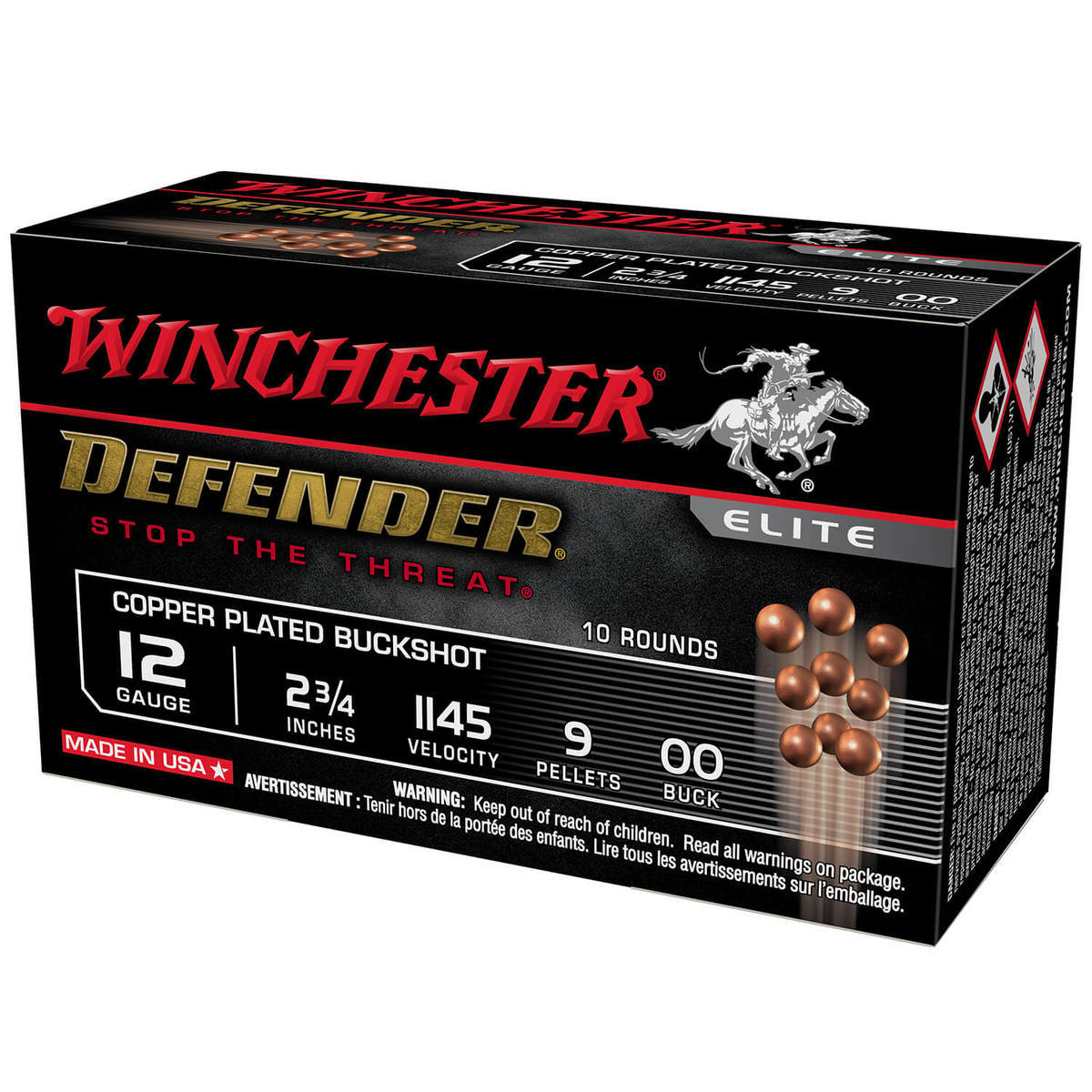
~$2.30/round · The value-tier defensive standard · 9 pellets of 00 buck · buffered shot cup · muzzle velocity 1,145 fps · 2.75" shell · 10-round box · $22.99 per 10-round box
Best for: Budget-conscious buyer who wants credible defensive performance without premium pricing
Winchester's dedicated defensive line — not the cheaper Super-X buckshot they sell alongside it for deer season. Defender uses a buffered shot cup that holds the pellet stack disciplined through the choke. The 10-round box at Sportsman's Warehouse pricing lets you actually practice with your defensive ammo — which matters more than any specification advantage. Second-best pattern discipline in the category after Federal FliteControl.
Where to buy: Buy at Sportsman's Warehouse →
Hornady Black 12 Gauge 2-3/4" 8 Pellet 00 Buckshot (86249)

~$2.60/round · Full-power tactical-line defense · 8 pellets of 00 buck · Versatite wad technology · muzzle velocity 1,600 fps · 2.75" shell · Hornady Black defensive line · $25.99 per 10-round box
Best for: Buyers who want a full-power, engineered-for-defense load
Hornady Black is the tactical-line spin on their Critical Defense DNA — full 1,600 fps velocity with the Versatite wad that keeps 8-pellet patterns tight through home-defense distances. Faster than Federal's Personal Defense line and harder-hitting per pellet as a result. Trade-off: more recoil, so pick this over Cat 2 only if you're comfortable managing the extra shove.
Where to buy: Buy at Ammunition Depot →
🎯 Category 2 — Reduced-Recoil 00 Buckshot (Fast Follow-Ups + Smaller Shooters)
What it is: Same 8- or 9-pellet .33-caliber payload as standard 00 buck, but loaded with 15-25% less powder so muzzle velocity drops from ~1,300 fps down to ~1,150 fps. Recoil impulse to the shooter drops by roughly a third. The pattern stays essentially the same at defensive distances.
Why it matters: Recoil is the enemy of the second shot. A defensive shotgun encounter is rarely one-and-done — most defensive shotgun instructors teach a controlled pair as the standard response. If your first shot punishes your shoulder so hard that your muzzle is 45 degrees off-target for the second one, you've handicapped yourself at the worst possible moment. Reduced-recoil loads bring the follow-up shot back down to a fraction of a second.
When to pick it: ANY of these apply — smaller-framed shooter (spouse, adult child), first-time shotgun owner, defensive shotgun without a proper recoil pad, close-quarters home where multiple shots may be needed. Also the honest pick for anyone over 60 or with a shoulder injury.
Trade-off: Slightly less terminal energy per pellet (the pellets still hit hard, just with a bit less velocity behind them). At home-defense distances the difference is not meaningful; at 25+ yards it starts to matter, but you shouldn't be defending yourself at 25 yards inside a house anyway.
Hornady American Gunner Reduced Recoil 12 Gauge 2.75" 8 Pellet 00 Buckshot (86274)

~$2.30/round · The reduced-recoil defensive standard · 8 pellets of 00 buck · Hornady American Gunner Reduced Recoil line · muzzle velocity ~1,155 fps · 2.75" shell · $22.99 per 10-round box
Best for: Any shooter who wants Hornady defensive performance with ~30% less recoil
Hornady's dedicated reduced-recoil defensive line — same 8-pellet 00 buck payload, dropped down to ~1,155 fps for controllable follow-up shots. American Gunner is Hornady's practical-price defensive/practice line and this specific SKU is the honest pick for anyone building out a family defensive shotgun without punishing recoil on second and third shots.
Where to buy: Buy at Ammunition Depot →
Rio Royal Buck Low Recoil 12 Gauge 2.75" 9 Pellet 00 Buck (RBLR129)

~$1.20/round · Best budget reduced-recoil load · 9 pellets of 00 buck · Rio Royal Buck Low Recoil · muzzle velocity 1,200 fps · 2.75" shell · Spanish-manufactured · $5.99 per 5-round box
Best for: The value-focused buyer building out multiple family defensive shotguns
Rio Ammunition is Spain's largest ammunition manufacturer and their Royal Buck line brings genuinely low per-round pricing to a segment usually dominated by premium American loads. The Low Recoil version at 1,200 fps and 9 pellets is a real defensive round — not a hunting adaptation — and at this price you can afford to actually practice with the defensive ammo instead of buying training substitutes.
Where to buy: Buy at Ammunition Depot →
Federal Premium Personal Defense Force X2 12 Gauge 2.75" 9 Pellet 00 Buckshot (PD12FX200)

~$3.60/round · The next-generation reduced-recoil pick · 9 pellets of copper-plated 00 buck · Federal Force X2 splitting pellets · muzzle velocity 1,245 fps · 2.75" shell · $35.99 per 10-round box
Best for: Defenders who want maximum terminal effect from a controllable-recoil load
Federal's Force X2 is a genuine engineering innovation — copper-plated 00 pellets designed to split into two separate wound-channel-creating projectiles on soft-tissue impact. Effectively doubles the on-target projectile count from a single trigger pull. Reduced 1,245 fps velocity keeps recoil manageable. Most technically interesting defensive load in the category by a wide margin.
Where to buy: Buy at Ammunition Depot →
🎯 Category 3 — Nickel/Copper-Plated 00 Buckshot (Corrosion-Resistant + Pattern Discipline)
What it is: Buckshot pellets electroplated with a thin layer of nickel or copper. The plating serves two purposes: it prevents pellet-to-pellet deformation as the shot column travels down the barrel (deformed pellets fly erratically and open the pattern), and it protects the pellets from long-term corrosion in humid storage conditions.
Why it matters: Defensive ammo often sits in a magazine tube for months or years before it's ever fired. Bare-lead pellets can develop a fine oxidation layer that changes how they release from the shot cup — enough to open a defensive-tight pattern by two to three inches. Plated pellets stay dimensionally consistent, which means the pattern the load prints today is the same pattern it prints two years from now. The tighter the pattern discipline, the higher the odds every pellet lands on the threat and none go past the threat into a wall.
When to pick it: Coastal / high-humidity climates. Long-term storage in a home defense shotgun. Any deployment where the ammo will sit loaded for extended periods without being cycled. Also the honest pick for a bedroom-nightstand shotgun.
Trade-off: Roughly 15-25% higher price per round vs. bare-lead equivalents. If you shoot through a case a year of defensive practice ammo, that price adder adds up — most shooters use plated ammo for the actual defensive load and bare-lead for range practice.
Federal Premium 12 Gauge 2.75" FLITECONTROL 9 Pellet Copper-Plated 00 Buckshot (PFC15400)

~$4.00/round · The pattern-discipline flagship · 9 pellets of copper-plated 00 buck · Federal FLITECONTROL wad · muzzle velocity 1,325 fps · 2.75" shell · nickel-plated base · $19.99 per 5-round box
Best for: The one load if you can only own one defensive shotgun load, period
The load that changed defensive shotgun ammunition. Federal's FLITECONTROL wad stays attached to the shot column for an extra several feet past the muzzle, holding the copper-plated 9-pellet pattern into a fist-sized cluster at 15 yards — dramatically tighter than any conventional wad. Copper plating prevents pellet deformation and long-term corrosion in storage. This is the load defensive shotgun manufacturers pattern their guns to shoot well.
Where to buy: Buy at Ammunition Depot →
Winchester Double X 12 Gauge 2.75" 9 Pellet 00 Buck Copper-Plated (SB1200)

~$5.20/round · The high-velocity plated hard-buck · 9 pellets of copper-plated hardened 00 buck · Winchester Double X buffering · muzzle velocity 1,450 fps · 2.75" shell · $25.99 per 5-round box
Best for: Defenders who want maximum per-pellet penetration
Winchester's Double X is the premium copper-plated variant of the Super-X line — hardened lead pellets with copper plating and buffering compound between them, driven at a full 1,450 fps. Highest per-pellet energy in the plated category. Recoil is noticeable but the terminal-effect payoff is real. If you specifically want penetration through heavy barriers or thick clothing on a threat, this is the pick over the tighter-patterning FliteControl.
Where to buy: Buy at Ammunition Depot →
Federal Premium 12 Gauge 2.75" 1-1/8 oz 9 Pellet Copper-Plated 00 Buck (P15400)

~$3.80/round · Federal Premium plated without the FliteControl premium · 9 pellets of copper-plated 00 buck · Federal Premium buffered wad · muzzle velocity 1,325 fps · 2.75" shell · $18.99 per 5-round box
Best for: Federal buyers who want copper plating at a lower per-round cost
The direct stablemate of the flagship PFC15400 — same 9-pellet copper-plated payload, same 1,325 fps velocity, without the FliteControl wad. Pattern spreads a bit wider at 15+ yards (larger than a fist, still hand-sized), but per-round cost drops meaningfully. Best pick for the shooter who wants Federal's plated buck quality but doesn't need extended-range pattern discipline for their specific home layout.
Where to buy: Buy at Ammunition Depot →
🎯 Category 4 — Magnum 00 Buckshot (Maximum Terminal Payload)
What it is: A 3-inch (or 3.5-inch) 12-gauge shell loaded with 12 to 15 pellets of 00 buck — 50% to 65% more pellets than a standard 2.75-inch shell — driven at higher velocities (1,400-1,600 fps). Sometimes marketed as "magnum" or "3-inch" or "high-brass" buckshot.
Why it matters: Every additional pellet in the payload is another chance to hit vital anatomy and stop the threat faster. A 15-pellet magnum load delivers nearly TWICE the projectile count of a standard 8-pellet load in the same trigger pull. For extreme defensive scenarios — multiple threats, aggressive dog attack, home invasion by multiple assailants — the extra payload is a real advantage.
When to pick it: Rural home / farm defense (where threats may be at longer distance, multiple attackers, or include large predators). Shotguns chambered for 3" or 3.5" shells with quality recoil pads. Experienced shooters who've mastered standard 12-gauge recoil.
Trade-off: Recoil is punishing. A full-house 3-inch magnum load hits your shoulder harder than most modern military rifles. Muzzle rise is significant. Second-shot recovery time roughly doubles vs. a standard 2.75-inch load. NOT recommended for smaller shooters or first-time buyers. Also — importantly — 3-inch magnum shells over-penetrate interior walls at rates the 2.75-inch loads don't. Not the pick for apartment or townhouse defense.
Winchester Super-X 12 Gauge 3" 15 Pellet 00 Buck (Magnum, Value Pack) (XB12300VP)

~$2.63/round · The magnum baseline, value 15-pack · 15 pellets of buffered 00 buck · Winchester Super-X Magnum · muzzle velocity 1,210 fps · 3" magnum shell · 15-round value pack · $39.49 per 15-round box
Best for: Rural defense, farm or ranch home protection, any 3" chamber shotgun
Winchester Super-X Magnum in the 15-round value pack — 15 pellets of buffered 00 buck per shell in a 3-inch magnum casing. Nearly twice the projectile mass on target vs. a standard 2.75-inch 8-pellet load. Not the tightest pattern in the world but at defensive distances the pattern is still fist-sized, with 15 pellets in that fist instead of eight. The 15-round value pack drops per-round pricing to standard-buck territory.
Where to buy: Buy at Ammunition Depot →
Federal Power-Shok 12 Gauge 3" 1-7/8 oz 15 Pellet Magnum 00 Buck (F13100)

~$2.80/round · The Federal magnum answer · 15 pellets of 00 buck · Federal Power-Shok Magnum · 1-7/8 oz payload · muzzle velocity 1,210 fps · 3" magnum shell · $13.99 per 5-round box
Best for: Federal-preferring shooters, deer camp gun that doubles as home defense
Federal's magnum answer to the Winchester Super-X — same 15-pellet 00 buck payload at 1,210 fps, in a 3-inch magnum casing. Federal's wad geometry produces slightly tighter patterns than the Winchester in side-by-side testing at extended distances. Best pick if you already run Federal in the rest of your defensive rotation and want the whole ecosystem to match.
Where to buy: Buy at Ammunition Depot →
Federal Premium 12 Gauge 3" 1-7/8 oz 15 Pellet Copper-Plated 00 Buck (P15800)
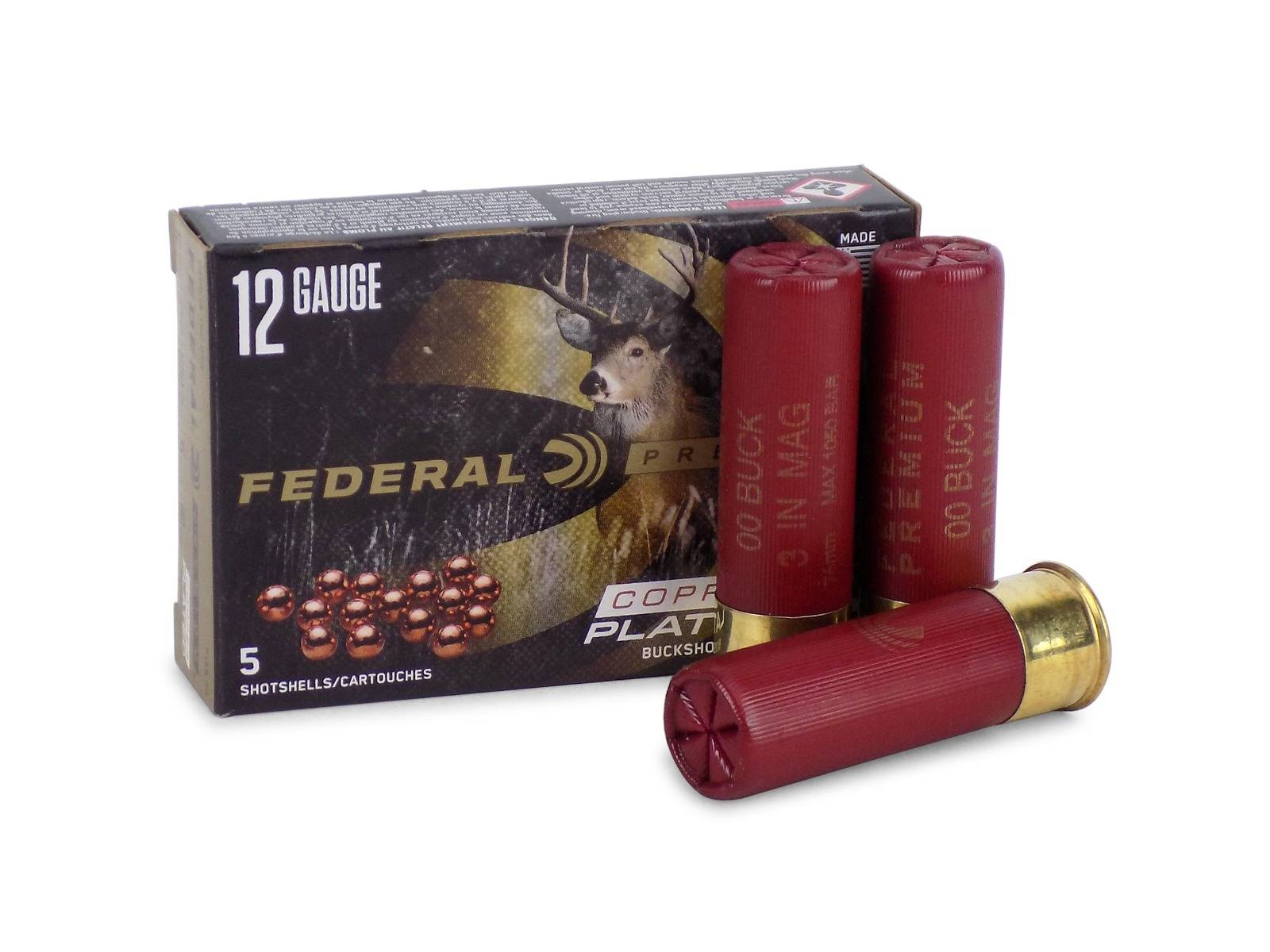
~$4.80/round · The reduced-recoil magnum · 15 pellets of copper-plated 00 buck · Federal Premium buffered · muzzle velocity 1,100 fps · 3" magnum shell · $23.99 per 5-round box
Best for: Rural defense with 15-pellet payload but managed recoil
Federal Premium's copper-plated magnum variant, dropped down to 1,100 fps for reduced recoil while keeping the full 15-pellet payload. Copper plating prevents pellet deformation for a tighter cluster than the bare-lead Power-Shok magnum. The math is unique — 15 pellets of plated buck at reduced-recoil velocity is a genuinely rare combination in the market, and this SKU delivers it in a single shell.
Where to buy: Buy at Ammunition Depot →
🎯 Category 5 — Rifled Slugs (Single-Projectile Precision + Barrier Defeat)
What it is: A single one-ounce (438-grain) lead projectile fired from a smoothbore shotgun barrel. The "rifling" cast into the outside of the slug itself gives it modest stabilization in flight (though it doesn't actually spin the projectile the way a rifle barrel does — the rifling is largely cosmetic on modern slugs). The result: one massive, slow-moving projectile that punches through barriers a buckshot payload wouldn't defeat.
Why it matters: Buckshot loses effectiveness fast beyond 20-25 yards — pellets spread, energy per pellet drops, and terminal effect diminishes. A rifled slug punches out to 50-75 yards with real accuracy and delivers roughly 2,000 foot-pounds of energy on target — more than a .44 Magnum revolver. For rural properties, defense against large animals (bear, aggressive dog), or scenarios where a threat may be behind a wooden door or interior wall, a slug is the single most authoritative shotgun projectile you can fire.
When to pick it: Rural / farm defense with longer possible engagement distances. Bear country carry gun. Truck gun for anti-vehicle capability (a slug through a windshield or engine block ends the encounter). Also — critically — the ONE load capable of defeating a car door or interior partition wall a buckshot load might not.
Trade-off: Massive over-penetration through interior residential walls. A one-ounce slug at 1,600 fps will punch through five to seven layers of drywall and keep going — this is NOT an apartment or duplex load. Recoil is severe. Range at which a defensive shooter can reliably place a slug is significantly shorter than a rifle at the same distance (25-yard groups from a smoothbore slug gun are usually 4-6 inches).
Federal Premium 12 Gauge 2.75" 1 oz TruBall Rifled Slug HP (PB127RS)

~$2.00/round · The accuracy benchmark · 1 oz TruBall rifled slug · Federal Premium TruBall HP · muzzle velocity 1,600 fps · 2.75" shell · $9.99 per 5-round box
Best for: Any smoothbore home defense shotgun; the "one slug" pick
Federal's TruBall system centers the slug precisely in the shot cup with a plastic ball between the wad and slug base, dramatically reducing yaw at the muzzle. Independent testing shows TruBall producing sub-3-inch groups at 50 yards from an 18.5-inch cylinder-bore barrel — roughly half the group size of legacy Foster-style slugs. If you're keeping one slug in your defensive shotgun rotation, this is the load that goes where you point it.
Where to buy: Buy at Ammunition Depot →
Remington Slugger 12 Gauge 2.75" 1 oz Rifled Slug (20300)

~$3.40/round · The classic American slug · 1 oz Foster-type rifled slug · Remington Slugger · muzzle velocity 1,560 fps · 2.75" shell · $16.99 per 5-round box
Best for: The value pick, deer camp / defensive crossover, iron-sight shotguns
Remington Slugger is the deer-camp shotgun slug an entire generation of American hunters learned on — classic Foster design with a hollow base that lets the slug deform slightly through the choke, allowing use in shotguns with slight constriction. Not as pattern-consistent as Federal TruBall, but proven adequate accuracy out to 40 yards for the shooter who wants honest terminal performance without the boutique-slug price tag.
Where to buy: Buy at Ammunition Depot →
Federal Power-Shok 12 Gauge 2-3/4" 1 oz Rifled Slug (F127RS)
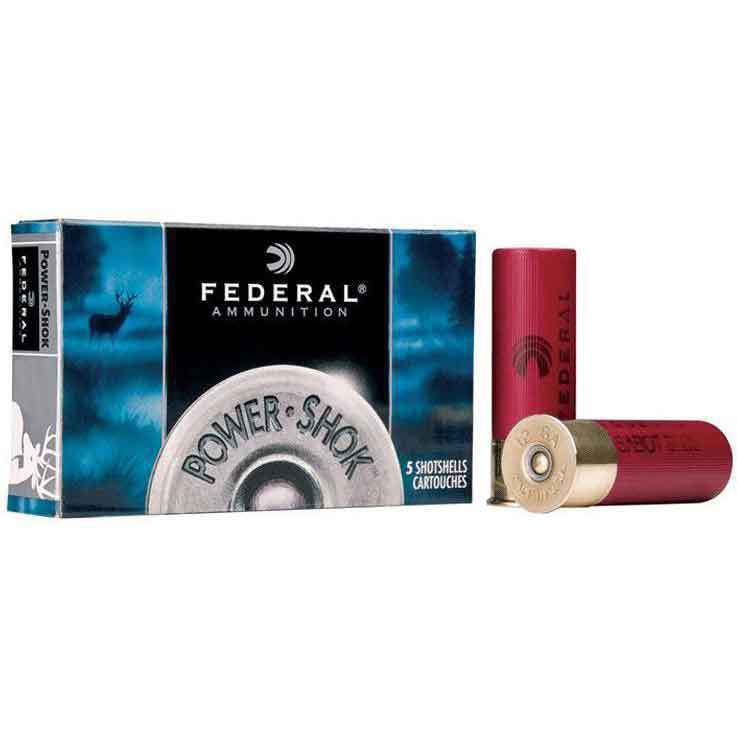
~$1.60/round · Best value slug · 1 oz soft-lead Foster rifled slug · Federal Power-Shok · muzzle velocity 1,610 fps · 2.75" shell · $7.99 per 5-round box on Guns.com (checked Sept 26, 2026)
Best for: The budget pick if you're already shopping Sportsman's for the rest of your defensive kit
Federal's practical Power-Shok Foster-style rifled slug — 1 oz soft lead, 1,610 fps out of a smoothbore. Adequate defensive accuracy inside 30 yards from an 18-inch cylinder-bore. Not as tight as TruBall, but roughly half the per-round cost, and the 5-round box sells at hunting-ammo prices. The honest pick if you want a case of slugs on the shelf for training + defensive rotation.
Where to buy: Buy on Guns.com →
🎯 Category 6 — Combo Loads (Segmenting Slug + Buckshot)
What it is: A specialty defensive shell that combines multiple projectile types in one payload — typically a small slug (roughly a half-ounce) at the front of the shot column with a small pellet payload behind it (three to six pellets of 00 buck). The design intent: multi-threat capability in one trigger pull.
Why it matters: The theoretical advantage is real — one shell delivers both the barrier-penetration of a slug AND the multiple-projectile spread of buckshot. If your threat scenario is uncertain (a moving assailant behind partial cover, a threat that may or may not be armored), a combo load hedges you against both extremes without the operator needing to swap ammunition mid-fight.
When to pick it: Home defense scenarios with unknown/mixed threats. Truck gun for hunters who might face bear, dog, or human threat with no time to choose. Anyone who wants ONE load in the tube that covers the most possible defensive situations.
Trade-off: Compromised at both ends — the slug is smaller and less accurate than a dedicated slug, the pellet payload is smaller and less devastating than a dedicated buck load. Also — the fewer players in this category means fewer choices. Winchester's PDX1 is the market leader by a wide margin; Federal's Personal Defense combo and a handful of specialty offerings round out the field.
Winchester PDX1 12 Gauge 2-3/4" 1 oz Segmenting Slug (S12PDX1S)

~$2.85/round · The segmenting-slug specialty load · 1 oz segmenting slug that separates into 3 projectiles on impact · Winchester PDX1 · muzzle velocity 1,600 fps · 2.75" shell · $28.49 per 10-round box
Best for: The specialty buyer wanting maximum wound-channel effect from a single-projectile shell
The segmenting-slug variant of Winchester's PDX1 line — a 1-oz slug engineered to separate into three distinct wound-channel projectiles on soft-tissue impact. Behaves like three individual slugs after target penetration, creating a wound cavity structure closer to a modern hollow-point pistol round than a traditional slug. Priced at the top of the defensive-shotgun ammo market for a reason.
Where to buy: Buy at Ammunition Depot →
Winchester PDX1 Defender 12 Gauge 2-3/4" 1 oz Slug + 3 Pellet 00 Buck Combo (S12PDX1)

~$2.60/round · The category-defining slug + buck combo · 1 oz plated slug + 3 pellets of buffered 00 buck · Winchester PDX1 Defender · muzzle velocity 1,150 fps · 2.75" shell · low-recoil formulation · $25.99 per 10-round box
Best for: The buyer who wants ONE defensive shell that covers slug + buck in one trigger pull
The load Winchester built specifically to define this category — a full 1-oz slug at the front of the wad column, followed by three pellets of Grex-buffered 00 buck. Fire one shell and you deliver a 1-oz slug (roughly 2,000 ft-lbs) PLUS three .33-caliber pellets in the same trigger pull. Tuned to a reduced 1,150 fps velocity for controllable recoil. The go-to shell for shooters who don't want to think about ammo selection in a crisis.
Where to buy: Buy at Sportsman's Warehouse →
The third combo-load slot — an editorial note
Category 6 traditionally rounds out with a third option, but a full sweep of Ammunition Depot and Sportsman's Warehouse turned up only two defensive combo/segmenting loads currently in stock: Winchester's PDX1 segmenting slug (Cat 6 #1) and Winchester's PDX1 Defender slug + buck combo (Cat 6 #2). The combo-load market is thin — Winchester functionally owns it, and the third-tier options that historically filled this slot (Federal Personal Defense Buck & Ball, discontinued specialty combos) are no longer shipping to consumer retailers. Rather than fill the slot with a hunting-load adaptation that doesn't belong in a defensive ready-box, we're calling this what it is: a two-product category. The two picks above cover the full defensive combo-load use case between them.
🎯 Category 7 — Small-Shot Defense Loads (Apartment / Close-Quarters Consideration)
What it is: A 2.75-inch 12-gauge shell loaded with smaller-diameter shot than 00 buck — either #1 buck (16 pellets of .30-caliber shot), #4 buck (27 pellets of .24-caliber shot), or #4 birdshot (~135 pellets of .13-caliber shot). Smaller projectiles individually, dramatically higher total pellet count.
Why it matters: The single biggest concern in apartment / condo / duplex home defense is over-penetration — a load that stops the threat but continues through walls into a neighbor's living space is a legal, moral, and civil-liability nightmare. Smaller-shot defense loads trade individual pellet stopping power for dramatically reduced wall-penetration risk. #4 buck penetrates roughly HALF as many interior walls as 00 buck at defensive distances.
When to pick it: Apartment / condo / townhouse where wall over-penetration is a genuine risk to neighbors. Small children in adjacent rooms. Elderly residents next door. Anyone whose defensive scenario places non-combatants directly on the "beyond the target" line.
Trade-off: Real and controversial. Defensive shooting community is genuinely split on whether smaller-shot loads deliver enough terminal effect to reliably stop a determined attacker. In gel tests, #4 buckshot typically lands right around the FBI's 12-inch minimum. Anything smaller than #4 buck (i.e. traditional birdshot) generally falls short of it and is NOT recommended for defensive use by any credible defensive-shooting instructor. Choose smaller shot only when the over-penetration risk to third parties genuinely outweighs the reduced terminal-effect risk to yourself.
Hornady Varmint Express 12 Gauge 2.75" 24 Pellet #4 Buckshot (86243)

~$1.80/round · The high-payload apartment defense pick · 24 pellets of #4 buckshot (.24 caliber each) · Hornady Varmint Express · muzzle velocity 1,350 fps · 2.75" shell · $17.99 per 10-round box
Best for: Apartment / condo / townhouse defense where wall over-penetration threatens neighbors
Hornady's Varmint Express #4 buckshot line was designed for coyote and predator hunting but has crossed over into defensive use for exactly the reason this category exists — 24 pellets of .24-caliber shot at 1,350 fps deliver credible terminal effect while penetrating fewer interior walls than 00 buck. If your defensive scenario places non-combatants directly downrange of any shot that doesn't stop in the target, this is the pick.
Where to buy: Buy at Ammunition Depot →
Federal Premium 12 Gauge 2-3/4" 27 Pellet #4 Buckshot (F1274B)

~$3.60/round · The premium apartment defense pick · 27 pellets of #4 buckshot · Federal Premium heavy buck · muzzle velocity 1,450 fps · 2.75" shell · $17.99 per 5-round box
Best for: The Federal-loyalist apartment defender who wants premium pattern discipline
Federal Premium's heavy 27-pellet #4 buckshot load — three more pellets than the Hornady Varmint Express and Federal's proven pattern discipline holding them all in a fist-sized cluster at defensive distance. Higher per-round cost than the Hornady pick, but if you already run Federal in your defensive rotation this is the correct Category 7 answer to keep the ecosystem consistent.
Where to buy: Buy at Ammunition Depot →
Federal Power-Shok 12 Gauge 3" 41 Pellet #4 Buck Buckshot (F1304B)

~$2.80/round · The 3-inch magnum #4 buck · 41 pellets of #4 buck · Federal Power-Shok Magnum with Triple Plus wad · muzzle velocity 1,210 fps · 3" magnum shell · $13.99 per 5-round box
Best for: 3" chamber shotguns in apartment/urban defense where you want maximum payload with reduced-penetration shot size
Federal Power-Shok's 3-inch magnum #4 buck — 41 pellets of .24-caliber shot in a single trigger pull, with the Triple Plus wad system holding the pattern surprisingly tight for a magnum load. Delivers a payload count that no 2.75-inch shell can match, while retaining #4 buckshot's reduced wall-penetration characteristic. Best pick for defenders with 3" chamber shotguns who want the apartment-safe shot size scaled up to magnum payload.
Where to buy: Buy at Sportsman's Warehouse →
🛡️ Before You Buy — Six Things Every Defensive Shotgun Owner Must Know
Picking a load off this list is step one. These six items are the difference between owning defensive ammo and being actually equipped to defend yourself with it.
1. Pattern-test your specific gun before you trust the load
Every shotgun patterns differently — even two guns from the same manufacturer, same model, same production year will throw different patterns with the same shell. The single most important defensive-shotgun task is putting a paper target at 5, 10, and 15 yards, firing three shells from each distance, and measuring the pellet spread. What you're looking for: a tight cluster (fist-sized or smaller at 10 yards) with every pellet on target at every defensive distance in your home. If a load throws pellets outside your target at 10 yards, it doesn't belong in your defensive gun — no matter what the review says. Buy a 25-round practice case, pattern it in YOUR gun, then buy the defensive stock in bulk once you've verified it works.
2. Recoil management — train up, don't punch above your weight
A full-power 12-gauge 00 buck load hits your shoulder with about 35-40 foot-pounds of recoil energy — more than a magnum rifle round. If you or a household member can't shoot a full-power defensive load with control (muzzle stays on target, second shot recovers in under 1.5 seconds), drop down to Category 2 (reduced-recoil) or step down to 20-gauge. Recoil-induced flinch is the #1 cause of missed defensive shots. There is no honor in shooting a load you can't manage — a controlled reduced-recoil hit stops the threat; a full-power miss does not. Training progression matters: start with low-power target loads (1,100 fps birdshot for pattern practice, not defense), work up to reduced-recoil buckshot, then to full-power buckshot only when you can control the reduced-recoil version cold.
3. Ammo storage + rotation — keep it dry, keep it fresh
Modern shotgun ammunition has a functional shelf life measured in decades when stored properly, but "properly" means dry conditions between 40°F and 85°F. A hot garage or a humid basement can degrade primers and warp hulls over 2-3 years. Storage rules: (a) keep ammo in its original box, not loose in a can; (b) if you live in a coastal or humid climate, use plated-pellet loads (Category 3) for the ammo that stays in the magazine tube long-term; (c) rotate your defensive stock every 2-3 years — shoot the old rounds at the range for pattern verification, replace with a fresh case. Ammo that's been cycling through the magazine tube for 5+ years should be tested before you trust your life to it.
4. Legal considerations — check your state before you buy
Federal law places no restrictions on shotgun ammunition purchase for personal use, but several states impose additional rules:
- California, New York, Massachusetts, New Jersey, Illinois — additional documentation, background checks, or FFL delivery required for out-of-state ammo purchases. Ammunition Depot and MidwayUSA both list current shipping restrictions on their product pages; check before ordering.
- Magazine capacity limits in certain jurisdictions apply to shotguns as well — verify your state's rules on tube-magazine capacity if you're in a restricted state.
- Use of force in self-defense is governed by state-specific law, and some jurisdictions have prosecuted defensive shootings based on ammunition selection (e.g. "the shooter chose an aggressive load, showing pre-meditation"). Talk to a firearms attorney in your state if you have questions about how ammunition choice interacts with local self-defense doctrine.
General rule: proven, industry-standard defensive loads (Federal FliteControl, Hornady Critical Defense, Winchester Defender, Winchester PDX1) are used by law enforcement nationwide — using them for your own defense is the same practical + legal choice the professionals make.
5. Barrel and choke — match the ammo to the gun
Defensive shotguns typically have an 18-20" barrel with either a "cylinder bore" (no choke constriction) or "improved cylinder" choke. Every load in this guide is designed to perform in that setup. If your shotgun has a modified or full choke, patterns will run tighter than the reviews describe — beneficial for buckshot at range but can cause slug accuracy problems in some barrels. Do NOT fire slugs through a full choke without checking your barrel's slug rating. Sabot slugs are only for rifled barrels; foster/rifled slugs are for smoothbores. Barrel length under 18" is federally regulated (short-barrel shotgun requires NFA registration) — don't shorten your barrel unless you understand what you're doing legally.
6. Cycle reliability — does your gun actually feed this shell?
Semi-automatic shotguns (Beretta 1301, Benelli M4, Mossberg 940 Pro Tactical, Remington 1100/1187) can be finicky about ammunition — a specific gun may cycle full-power loads reliably but choke on reduced-recoil loads because the gas system isn't getting enough pressure. Before committing to a defensive load in a semi-auto, put at least 100 rounds through YOUR specific gun to verify reliable cycling. Pump-action shotguns (Mossberg 500/590, Remington 870, Benelli Nova) will cycle anything you feed them because you're manually working the action — but this doesn't excuse the pattern-test step. Every gun + load combination needs verification before it goes on defensive duty.
The Bottom Line — Which Load Do YOU Actually Buy?
Twenty-plus loads across seven categories is a lot to process. The honest recommendation is that most American home defenders need two loads in the rotation — one primary defensive load, one situational alternate — not seven. Here's the decision tree:
House, 1-2 story, drywall interior, standard adult shooter: Federal Premium FLITECONTROL 9-Pellet Copper-Plated 00 (PFC15400). Primary defensive load in the tube. One box lasts years in a home defense role. If recoil is a concern for anyone in the household, swap to the Hornady American Gunner Reduced Recoil (86274) — same defensive discipline, ~30% less shove.
Apartment / condo / townhouse with shared walls: Federal Premium 27-Pellet #4 Buckshot (F1274B). Meaningfully reduced wall over-penetration risk to neighbors, while still delivering credible defensive terminal effect. Do NOT drop to birdshot — it fails penetration and won't stop a determined attacker.
Rural / farm / ranch defense (longer distances, larger threats possible): Federal TruBall Rifled Slug (PB127RS) OR Winchester PDX1 Defender combo (S12PDX1). Slug for pure stopping power at extended distance; PDX1 for the hedge scenario.
Best cheap starter box for first-time defensive shotgun owners: Rio Royal Buck Low Recoil (RBLR129). Genuinely low per-round pricing lets you actually practice with defensive ammo instead of training substitutes. Buy two 5-round boxes to pattern-test your gun, one 25-round box for the ready shelf.
Buy one primary load, buy enough to actually practice with it (minimum 25 rounds through YOUR specific shotgun before it goes into the ready-box — every shotgun patterns differently), and pattern-test it at 5, 10, and 15 yards from a bench so you know what your defensive weapon actually delivers. The shell you HAVEN'T patterned in your own gun is a guess. The one you have patterned is a plan.
Ordering from Guns.com
Guns.com sells ammunition as well as firearms. Ammo ships to your door where your state allows it; guns go to the licensed dealer (FFL) you choose for the background check and pickup. Our Is Guns.com legit? guide walks through fees, shipping and the whole process step by step.
❓ Frequently Asked Questions
What's the difference between 00 buck and #4 buck?
00 buck uses .33-caliber pellets (roughly 9mm-diameter), 8-15 per shell depending on length. #4 buck uses smaller .24-caliber pellets, 24-34 per shell. 00 buck delivers more energy per pellet — the FBI-standard defensive load. #4 buck delivers more pellets with less per-pellet energy, and importantly penetrates roughly HALF as many interior walls as 00 buck. Choose 00 buck for standard home defense; choose #4 buck when wall over-penetration into neighboring apartments or bedrooms is a genuine concern.
Is birdshot enough for home defense?
No. Every credible defensive-shooting authority (law-enforcement trainers and defensive-shotgun instructors) recommends AGAINST birdshot for defense. Birdshot generally falls short of the FBI's 12-inch minimum penetration standard in gel tests — it can wound an attacker painfully without stopping them, which is the worst possible defensive outcome. The persistent myth that "birdshot is safer indoors" is wrong on both counts: it doesn't stop threats reliably, AND it can still over-penetrate drywall in dense clusters. If wall over-penetration is your concern, use #4 buckshot (Category 7), not birdshot.
Can I use hunting ammo for home defense?
You can, but you shouldn't if you have a choice. Hunting-line buckshot (Federal Power-Shok, Winchester Super-X, Remington Express) is optimized for deer at 25-40 yards from a modified-choke barrel — meaning the wad releases pellets quickly for a spread pattern. Defensive-line buckshot (Federal FliteControl, Hornady Critical Defense, Winchester Defender/Ranger) uses engineered wads that hold pellets in a tight cluster at 5-15 yards from a cylinder-bore barrel — the exact opposite optimization. The defensive-line loads cost $0.30-$0.80 more per round and pattern dramatically tighter at home-defense distances. Worth every penny.
What does "reduced recoil" actually mean?
Reduced-recoil defensive loads run muzzle velocity around 1,100-1,200 fps instead of the standard 1,300-1,400 fps. That drop is achieved by using less powder — same pellet count, same pellet size, roughly 25-30% less recoil impulse to the shooter's shoulder. Terminal effect at home-defense distances is essentially identical to full-power loads (all pellets still hit hard enough to stop threats). What you lose: a small amount of effective range past 20 yards, where the reduced-velocity pellets shed energy faster. What you gain: dramatically faster follow-up shots, less flinch, and the ability for smaller or newer shooters to actually control the gun.
How many rounds should I keep loaded in the tube?
Match your local law + your shotgun's capacity. Most pump and semi-auto defensive shotguns hold 5-9 rounds in the magazine tube plus one in the chamber. Loaded-tube storage for months or years is fine for modern spring designs (they don't take a "set" and lose tension the way older springs did). Some defensive shooters leave the chamber empty and rack the action only if needed (the mechanical sound is a deterrent + a safety layer with children in the home); others keep one in the chamber for immediate use. Either is a legitimate choice; the wrong choice is having ammo but no plan.
What's the difference between LE (law enforcement) and civilian ammo?
Some manufacturers (Federal, Winchester) sell parallel LE and civilian lines of the same cartridge — Federal LE133 is the LE-marked version of the same shell civilians can buy as Federal PFC15400 (FliteControl 9-pellet 00 buck). The physical product is often identical; the differences are packaging, distribution channel, and bulk pricing. LE-marked ammo is not "more powerful" or restricted from civilian ownership in most states — it's just sold through different channels. When a civilian retailer stocks LE ammo, it's the same load the police carry.
Do I need a specific barrel length or choke for defensive ammo?
Defensive shotguns typically run 18-20" barrels with cylinder or improved-cylinder chokes — every load in this guide is designed for that setup. Barrels shorter than 18" are federally regulated (require NFA short-barrel-shotgun registration). Longer hunting barrels (26-28") will still shoot defensive loads fine but are less maneuverable in tight home hallways. Choke matters more for slugs than buckshot: never fire a slug through a full choke without checking your barrel's slug rating, and sabot slugs REQUIRE a rifled barrel.
Can I mix different ammo types in the same magazine tube?
Technically yes, tactically maybe. Some defensive shooters load "slug-buck-slug-buck" alternating patterns to have both barrier-penetration and spread-pattern options. The problem: under stress, you can't remember which is coming next, and you can't visually verify what's chambered. Most defensive-shotgun instructors recommend one ammunition type in the tube. If you want slug + buck flexibility in a single trigger pull, use a combo load (Category 6 — Winchester PDX1) instead of mixing.
What's a "sabot slug" and how is it different from a rifled slug?
A traditional rifled slug (or "Foster slug") is a full-diameter one-ounce lead slug with external ribs cast into it — designed to be fired from a smoothbore barrel. A sabot slug is a smaller-diameter slug wrapped in a plastic sleeve ("sabot"), designed specifically for shotguns with rifled barrels. Sabot slugs deliver rifle-like accuracy out to 100+ yards in rifled-barrel shotguns; they are dangerously inaccurate through smoothbores. Match the slug to the barrel: smoothbore = rifled slug (Cat 5 of this guide); rifled barrel = sabot slug.
Does gauge matter for defense — is 20-gauge enough?
12-gauge is the American defensive standard because it delivers the widest ammunition selection at reasonable recoil for average-sized shooters. 20-gauge is a legitimate defensive choice, especially for smaller shooters — a 20-gauge 3" magnum with 20-pellet #3 buck or a 20-gauge 2.75" with 20-pellet #2 or 9-pellet #3 buck delivers meaningful terminal effect with roughly 40-50% less recoil than a 12-gauge. Defensive-load selection is thinner in 20-gauge but growing (Federal Personal Defense, Hornady Critical Defense, and Winchester PDX1 all offer 20-gauge variants). .410 bore is NOT recommended for adult home defense — payload is too light to reliably stop determined threats.
How often should I replace my defensive ammunition?
Modern shotgun ammo stored in original packaging in dry, moderate-temperature conditions has a functional shelf life of decades. Rotate the ammo in your magazine tube (which sees repeated loading/unloading cycles + potential humidity exposure) every 2-3 years — shoot the old rounds at the range for pattern verification, replace with fresh stock. Ammo in sealed cans in a climate-controlled space can sit for 10+ years without meaningful degradation. If you find corrosion, greening on the brass, or hulls that have deformed, discard those specific rounds.
What's the ONE load I should buy if I'm just starting out?
If you have never bought defensive shotgun ammo before and don't want to overthink it: buy a 5-round box of Federal Premium FLITECONTROL 9-Pellet Copper-Plated 00 Buckshot (PFC15400), pattern-test it in your gun at 5-10-15 yards, and if the pattern is tight (fist-sized at 10 yards), buy a 25-round case for defensive stock. This is the load defensive-shotgun professionals use as their benchmark. It won't be wrong for your gun.
Legal + Safety Disclaimer
Defensive shotgun ammunition is legal to own in all 50 U.S. states as of publication, subject to standard federal and state firearms law. Some jurisdictions restrict certain magazine capacities or shell types — check your local law before purchasing. Shipping ammunition to some states (CA, NJ, NY, MA, IL) requires additional documentation or is restricted to FFL delivery. Use of any firearm in self-defense is governed by state-specific self-defense law; consult a firearms attorney in your jurisdiction if you have questions about legal use of force. Ammunition Depot, MidwayUSA, Palmetto State Armory, and other reputable retailers all publish current shipping restrictions on their sites — check before ordering.
OSS America believes in the individual right to self-defense and the American tradition of responsible firearm ownership. Train regularly with your defensive firearm. Store your ammunition and firearms responsibly. And most importantly — pattern-test any defensive load in your own gun before you ever trust it with your life.
Related: Is Ammunition Depot legit?
Advertisement
FTC Disclosure: OSS America contains affiliate links. We earn a commission from qualifying purchases at no extra cost to you. Every pick is research-based: specs, verified prices and owner reviews.
More reviews
 Top PickShooting
Best 10mm Pistols (2026): 8 Picks From $600 to Colt
Glock 20, M&P 10mm, SIG P320-XTEN, Springfield XD-M Elite, FN 510 and three 10mm 1911s compared on capacity, weight, optics and real October 2026 prices.
 Top PickShooting
Best Revolvers (2026): 8 Picks for Carry, Home, Hunting and .22
Ruger GP100, S&W 686 Plus, SP101, LCR, Taurus 856, Colt Python, Super Redhawk and Wrangler compared on caliber, weight, capacity and real October 2026 prices.
 Top PickShooting
Best 300 Blackout Ammo (2026): 8 Supersonic and Subsonic Loads
Federal Fusion MSR, Hornady Sub-X, Deer Season XP, Barnes, Hornady BLACK, S&B subsonic, Magtech and Wolf: real October 2026 prices, cost per round, and supersonic vs subsonic explained.
 Top PickShooting
Best Glock Holsters (2026): 8 Picks for the Glock 19, 43X and 17
Alien Gear, CrossBreed, G-Code, Safariland, Galco, Blackhawk and Sticky: eight Glock holsters for IWB, OWB, light-bearing, leather and duty carry, with exact model fit and real October 2026 prices.
 Top PickShooting
Prime Big Deal Days 2026: 37 Best Outdoor, Hunting & Shooting Deals
We checked about 1,700 Amazon deals and kept the 37 best for hunters, shooters, campers and preppers: Streamlight, Bushnell, Howard Leight, Coleman, LifeStraw, Leatherman, EcoFlow and more, with verified prices.
 Top PickShooting
Best 9mm Ammo (2026): 8 Loads for Range, Bulk and Self-Defense
Blazer Brass, PMC Bronze, Winchester USA, Federal HST, Speer Gold Dot and more: real October 2026 prices, cost per round by the box and by the case, and honest owner-review pros and cons.