
14 Best-Selling Home Power Products of 2026 (Not a Ranking)

Advertisement
This is not a ranking. Nobody won. What follows is fourteen of the best-selling home power products on the market right now, with what each one actually does — the watts, the hours, the fuel, the install, the honest limits. We are not telling you which is best, because "best" depends on whether you live on a well, whether your outages last four hours or four days, and whether you have a legal place to put a machine that burns fuel.
These fourteen are not competitors in a bracket. Several are not even the same category of object — a 7.5-pound lithium box that charges a laptop and a permanently installed 28-kilowatt standby generator are both on this list, and comparing them would be useless to you. What they share is that a lot of Americans are buying them for the same reason: the grid went down, or they watched it go down somewhere else and did the math on their own house.
Read what each one offers. Match it against your house, your budget, and your tolerance for maintenance. The decision is yours — we are just putting the facts on the table.
⚡ Find Your Lane (Skip to What Fits)
You want it automatic and never want to think about it: Generac 28kW Whole Home Standby — installed, detects the outage, transfers on its own.
You need serious watts and fuel flexibility: GENMAX 17,000W Tri-Fuel, AIVOLT 11,500W Tri-Fuel, or DuroMax XP15000HX+.
You want silent backup with no fuel and no exhaust: Jackery 5000 Plus, Jackery HomePower 3600 Plus, or BLUETTI Elite 300.
You want the fridge running and phones charged, nothing more: Anker SOLIX S2000, EcoFlow DELTA 2 Max, or Jackery 1000 v2.
You want something you can carry with one hand: Jackery Explorer 300 — 7.5 pounds, and honest about being a small unit.
How These 14 Were Picked
Sales, not opinion. Every product here is a current best seller in home and portable power. We looked at what people are actually buying, not at a wish list.
Specs from the listing, not from memory. Every watt, watt-hour, runtime and cycle rating below came off the manufacturer's published specification for that exact model.
Limits stated out loud. Where a unit will not do something — no parallel connection, no 240V, panels in a separate box, professional install required — we say so instead of burying it.
Full disclosure: every link below is an affiliate link. You pay the same price. This post costs you nothing.
🏭 #14 → #10 — Whole-Home Class
These five are sized to carry a house, not a countertop. Two burn fuel, two are batteries big enough to act like generators, and one is bolted to a pad and wired into your panel. The common thread is capability measured in whole rooms and whole days.
#14 — GENMAX 17,000W Peak Tri-Fuel Inverter Generator
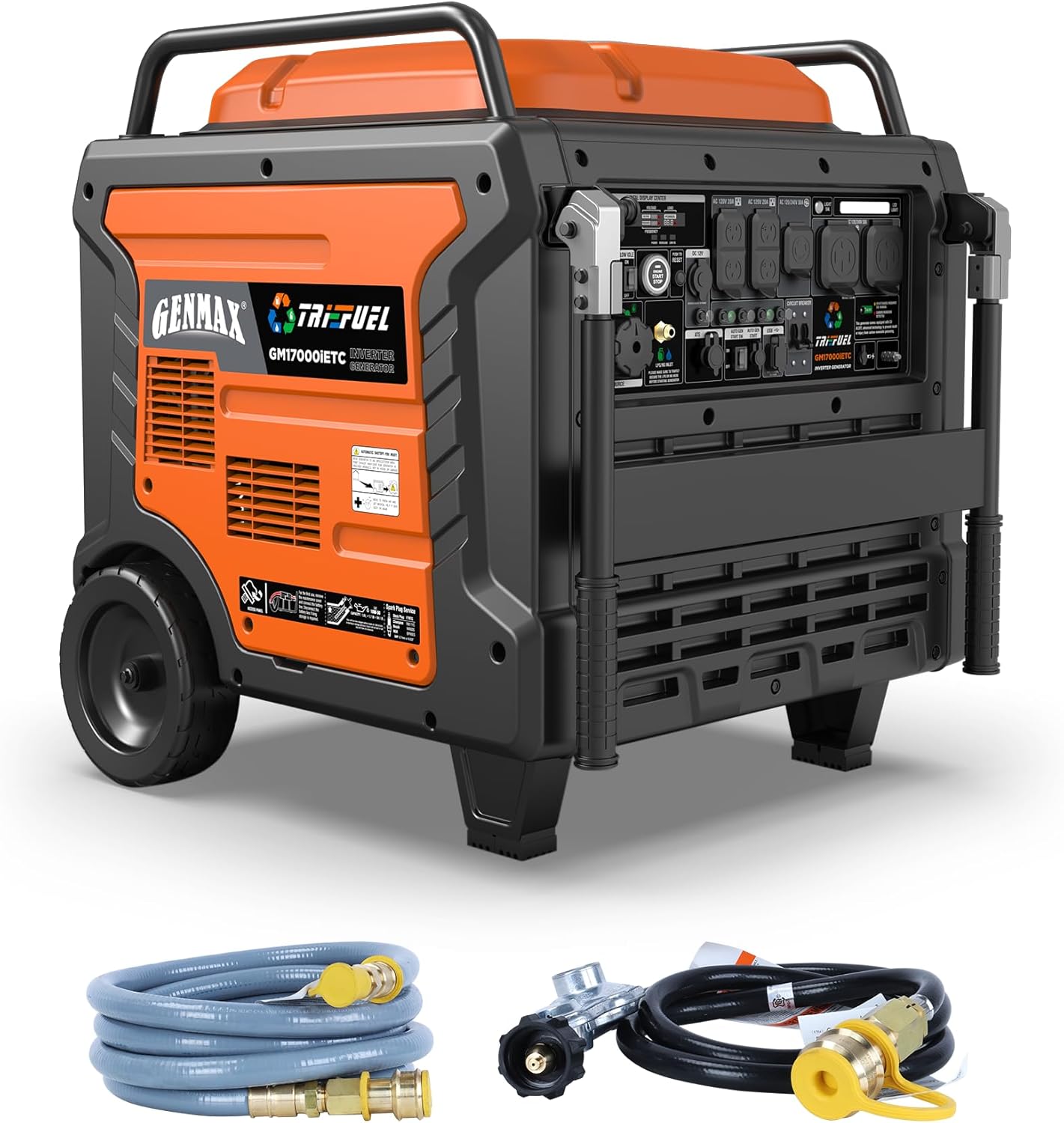
$5,000 · 17,000W starting / 13,500W running · Gas, propane or natural gas · Pure sine wave ≤3% THD · Dual 50A outlets · 2-wire auto start/stop · CO auto-shutdown · EPA/CARB
Best for: Running the whole house on whatever fuel you can actually get during a long outage
Tri-fuel is the entire argument. Gasoline disappears first in a regional outage because stations need power to pump it; propane sits in a yard tank indefinitely; natural gas flows as long as the line holds pressure. Inverter technology holds harmonic distortion at or below 3%, so the furnace board and well pump controller are not fed dirty power, and the 2-wire auto start/stop lets it talk to a transfer switch and start itself when the grid drops. Commercial V-twin rated for 1,000-plus hours, three-year warranty. It is still a combustion engine — it lives outside, well away from windows, and the CO shutdown sensor is a backstop for a placement mistake, not a license to make one.
#13 — Jackery Solar Generator 5000 Plus with Extra Battery

$2,609 · 10kWh total (5,040Wh base plus expansion battery) · 7,200W rated / 14,400W surge · 120V and 240V · Expandable to 60kWh · Up to 4,000W solar input, ~2-hour recharge · LiFePO4 with ChargeShield 2.0
Best for: Whole-home battery backup that includes 240V — the well pump, the dryer, the central air
The number that matters is not the capacity, it is the 240V. Most battery systems stop at 120V, which is the difference between keeping a refrigerator cold and running the appliances that decide whether your house is livable — Jackery rates this one to start a five-ton AC or run a water heater. Paired with the 60A Smart Transfer Switch it feeds up to twelve circuits at 120V or six at 240V, so you choose circuits instead of dragging cords through the house. The honest trade against fuel: no noise, no exhaust, no carbon monoxide, and it can live in a garage — but you are bounded by stored kilowatt-hours and how fast the sun replaces them.
#12 — DuroMax XP15000HX+ Dual Fuel EFI Portable Generator

$1,999 · 15,000W peak / 12,000W running · Dual fuel, gas and propane · Electronic fuel injection · Electric, remote and recoil start · Up to 17.9 hrs at 25% load on gas · CO Alert shutdown · GFCI · AVR
Best for: The most running watts per dollar here, if you do not need inverter-clean power
Twelve thousand running watts for two thousand dollars is the cheapest path to serious capacity here, and the reason is simple: this is a conventional generator, not an inverter. Power quality comes from an AVR rather than an inverter stage — fine for pumps, heaters, compressors, lights and tools, so be deliberate about sensitive electronics. The electronic fuel injection is the upgrade that matters most in a backup role, because there is no carburetor bowl to gum up while it sits nine months between outages, and cold starts are far more reliable. Three ways to start it, including a recoil pull for a dead battery, and up to 17.9 hours at quarter load on gasoline.
#11 — EcoFlow DELTA Pro 3.6kWh with 2× 400W Solar Panels

$2,859 · 3,600Wh LFP · 800W of panel included (2× 400W) · 22.4% conversion · Full solar recharge ~11 hrs on one panel, 3.5 hrs on three · IP68 panels, 35.3 lbs each · 15 outlets · App over WiFi or Bluetooth
Best for: A large battery that ships with enough panel to genuinely refill it off-grid, day after day
Most solar generator bundles include a token panel that takes two days to fill the battery. This one ships with 800 watts of it. At 22.4% conversion a single 400W panel brings the DELTA Pro from empty to full in about eleven hours, and three panels drop that to roughly 3.5 — which separates a battery you can live on from one you drain once and then stare at. The panels fold into a carry case at 35.3 pounds each and carry an IP68 rating, so leaving them out in weather is a non-event. Note before ordering: station and panels ship in separate packages and may arrive on different days.
#10 — Generac 28kW Whole Home Generator with Transfer Switch
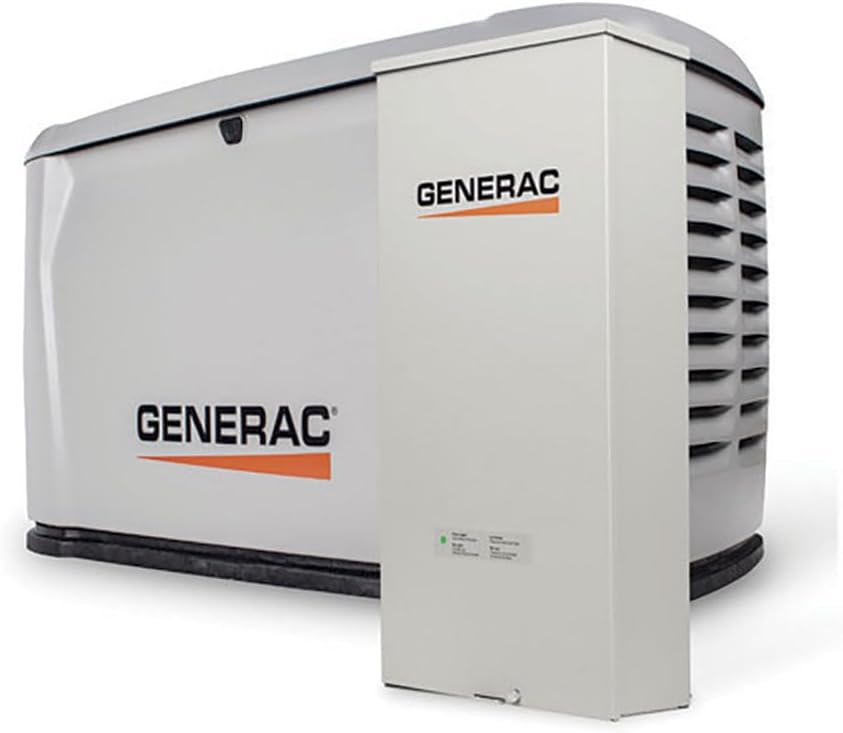
$8,387 · 28kW home standby · Transfer switch included · Built-in cellular with Mobile Link · Automatic outage detection and transfer · Electronic fuel and ignition control · Oil level sensors · 5-year limited warranty
Best for: Never touching anything — the house switches over on its own while you are asleep or away
This is the only permanently installed machine here, and a different philosophy from everything else on the list: you do not go outside, pull a cord, or run extension cords. It detects the outage and transfers the house automatically, usually before you finish noticing the lights flickered. The cellular link is smarter than it sounds — Mobile Link reports status over the cell network rather than your home WiFi, which is down during exactly the event you care about, though premium features need a subscription. Budget honestly: the purchase price is not the project price, because this needs a licensed electrician, a gas line, a permit and a pad.
🔋 #09 → #05 — Serious Backup Without the Install
The middle of this list is where most households actually land. Every unit here can carry real appliances through a multi-day outage, and none requires an electrician, a permit or a concrete pad. You roll it out, you plug in, it works.
#09 — Jackery Explorer 2000 v2 Portable Power Station (2-Pack)

$1,983 · Two units, 2,042Wh each · 2,200W AC and 3 AC ports per unit · 39.5 lbs each · 0–80% in 66 minutes on AC · Solar in ~6 hrs with 400W · Silent charging under 30dB · LiFePO4 rated 10 years
Best for: Two independent 2kWh units — one stays on the fridge, one goes wherever you go
Read the limitation first, because Jackery states it plainly and it changes the math: the Explorer 2000 v2 does not support parallel connection of two units. You are not buying 4kWh of combined output — you are buying two separate 2,042Wh machines that work independently, which is either the drawback or the entire point depending on your situation. One stays home on the refrigerator and router while the other goes to the jobsite, the camper, or your parents' house. At 39.5 pounds each they are 41% lighter and 34% smaller than typical 2kWh LiFePO4 stations, and go zero to 80% in 66 minutes.
#08 — AIVOLT 11,500W Tri Fuel Inverter Generator
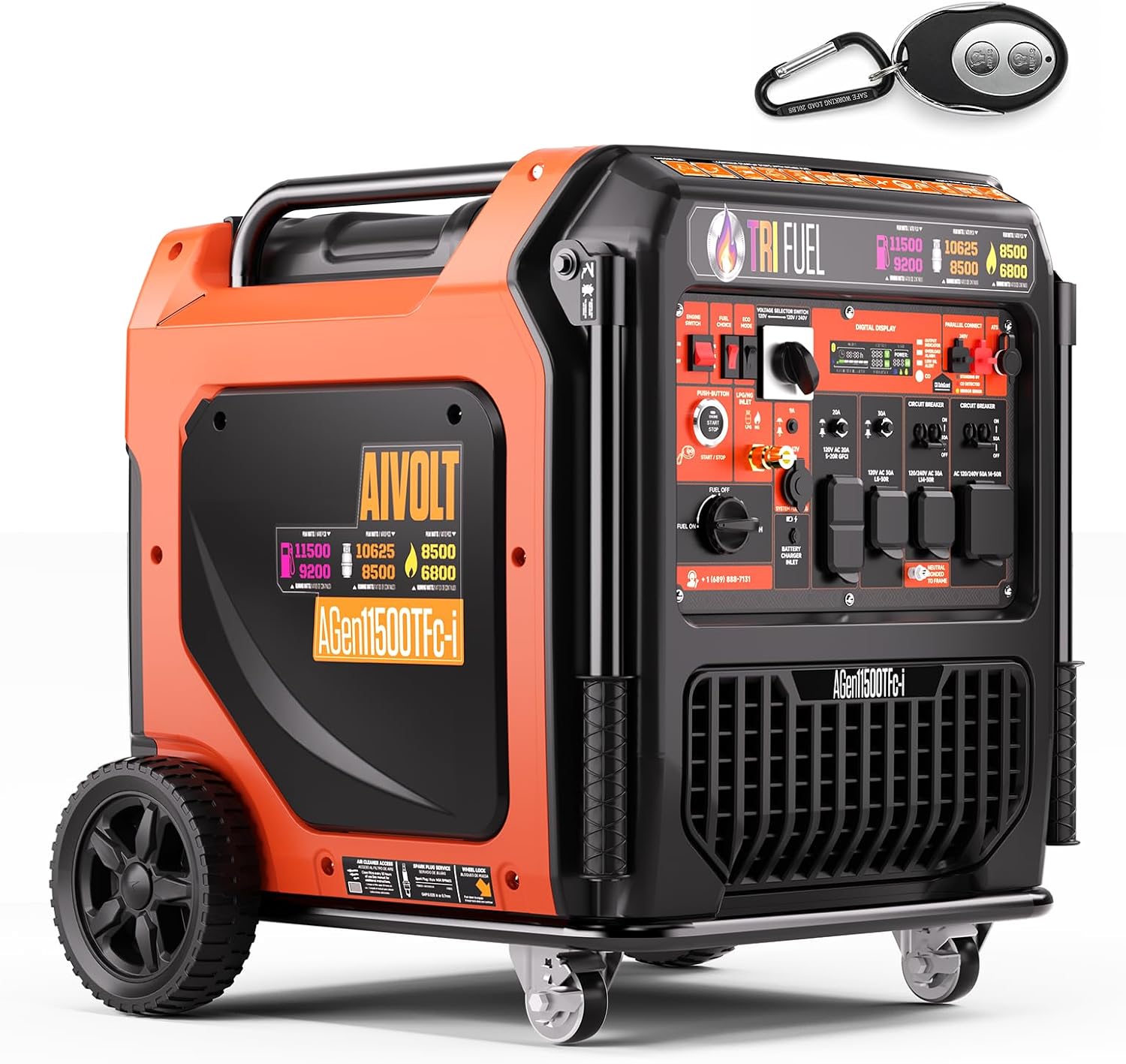
$2,500 · 11,500 / 9,200W on gas · 10,600 / 8,500 on propane · 8,500 / 6,800 on natural gas · 7.1-gal tank, up to 16 hrs at 25% · ~64 dBA at 23 ft · Dual 30A plus 50A plus 20A GFCI · ~216 lbs · Remote start · 2-year warranty
Best for: Tri-fuel whole-home or big-rig RV power that one person can still roll out alone
The enclosed inverter design is what makes this livable in a neighborhood — about 64 decibels at 23 feet is quieter than conversation, which matters when the thing runs for three days on a street where everyone can hear it. The outlet panel is built for real transfers rather than extension cords: a 50A outlet that ties directly to a large RV or a home panel through an ATS, plus dual 30A for running several heavy loads at once. At roughly 216 pounds it is about 31 pounds lighter than comparable units, with heavy wheels, a telescoping handle, and a remote fob so you are not walking outside at two in the morning. Engine oil is not included, so buy it alongside.
#07 — Jackery HomePower 3600 Plus with 2× 200W Solar Panels

$2,459 · 3,584Wh LFP · 3,600W output, 7,200W in parallel · 120V and 240V in parallel · Expandable to 21kWh per unit, 43kWh multi-unit · 0–100% in 2 hrs hybrid AC+DC · 6,000 cycles, 10-year lifespan · Cells tested at 302°F
Best for: Backup that scales later without throwing away what you bought first
Expandability is the reason to choose this one. You start at 3,584Wh — enough, Jackery says, to run a three-person household on essential loads for over two weeks — and the same unit grows to 21kWh, or 43kWh if you add more units. Put in parallel it delivers 7,200W and picks up 240V, bringing pumps, heaters and dryers into range, and paired with the MTS it is plug-and-play with no electrician. The safety engineering is unusually specific: high-temperature ceramic membrane cells tested at 302°F against thermal runaway, rated to keep working at -4°F, with 6,000 cycles and a ten-year lifespan. Panels ship separately.
#06 — EcoFlow DELTA 2 Max Solar Generator with 220W Panel

$1,399 · 2,048Wh LFP · 2,400W output, 3,400W with X-Boost · 0–80% in 43 min combining 1,000W solar with AC, or 1.1 hrs on AC alone · Expandable 2kWh to 6kWh · 3,000 cycles to 80% · 15 outlets · From 30 dB · 5-year service
Best for: The fastest refill in this group, and the cheapest entry into 2kWh
Forty-three minutes to 80% is the headline and it is real, but read how it is achieved — it requires combining up to 1,000W of solar with AC simultaneously; on AC alone you are at 80% in 1.1 hours, still quick. Recharge speed matters more than people expect, because during a rolling outage the grid returns in windows, and a unit that banks most of its capacity in a ninety-minute window is worth more than a larger one that cannot. Output is 2,400W across fifteen outlets, rising to 3,400W with X-Boost, and capacity triples from 2kWh to 6kWh with up to two extra plug-and-play batteries.
#05 — BLUETTI Elite 300 with 500W Solar Panel

$2,049 · 3,014Wh LFP · 2,400W output, 4,800W surge · Dedicated TT-30 RV outlet plus 12V/30A DC port · 500W panel included, 0–100% in ~7–10 hrs · Roughly 59% smaller than traditional 3kWh stations
Best for: RV owners who want to plug the rig in directly, with no adapter chain
The TT-30 outlet earns this a place on any RV owner's list: your travel trailer's 30-amp shore cord plugs straight into the station — no dogbone adapter, no pigtail, no improvised chain of connectors getting warm under load. There is also a dedicated 12V/30A DC port for the RV refrigerator. Beyond the RV case, 3,014Wh at 2,400W covers refrigerators, routers, lights, televisions and CPAP machines through a multi-day outage, with 4,800W of surge headroom to start resistive loads like an electric kettle. Frost & Sullivan recognized it as the world's smallest 3kWh portable power station, roughly 59% smaller than traditional units — which decides whether it lives in a closet or the garage.
🎒 #04 → #01 — Grab-and-Go
The last four are the ones people actually buy first. They are honest about their limits, they cost a fraction of the whole-home units, and every one ships with solar panels — which is what turns a battery into something you can live on rather than something you drain once.
#04 — Jackery Solar Generator 300 with SolarSaga 100W Light

$529 · 292Wh LiFePO4 · 300W rated / 600W peak surge · 7.5 lbs · 2 AC outlets, 100W USB-C PD, 2 USB-A, 120W car port · 80% in ~2.8 hrs on the included 100W panel · 4,000+ cycles to 70%, 11+ year service life
Best for: The one you actually carry — phones, laptops and lights, not appliances
Seven and a half pounds, 17% lighter than the industry average at this capacity, and the only unit here you can put in a pack without thinking about it. Be clear-eyed about the ceiling: 300W rated with 600W peak covers laptops, drones, cameras, lights and low-draw medical devices — it does not run a refrigerator or a space heater, and any listing implying otherwise is selling you something. Within that envelope it is excellent, with LiFePO4 cells rated for over 4,000 cycles before falling to 70% capacity, more than eleven years of service. One note straight from Jackery: the Explorer 300 is not compatible with the 100W Air panel, so do not substitute.
#03 — Jackery Solar Generator 1000 v2 with 2× 200W Panels

$1,069 · 1,070Wh LFP · 1,500W AC, 3,000W surge · 23.8 lbs with foldable handle · 400W of solar included, 0–80% in 3 hrs · 4,000+ cycles at 70%, 10+ years · 2 USB-C (one 100W PD), USB-A, car port, 3 pure sine wave AC outlets · 5-year coverage
Best for: The crossover point — fridge-capable, still light enough to carry in one hand
Fifteen hundred watts with a 3,000W surge is the threshold where a portable station stops being a device charger and becomes useful in an outage: enough for a full-size refrigerator, a window AC, or an electric cooking pot — not all at once, but any one of them, which is usually the real question. It does that at 23.8 pounds with a folding handle, genuinely one-hand portable. Two 200W panels are included for 400W of input, taking it to 80% in three hours. The app is more useful than most, with a one-hour emergency charge for when you see the storm coming and a 30dB quiet mode for overnight.
#02 — Anker SOLIX S2000 with 200W Bifacial Solar Panel

$1,259 · 2,010Wh LFP using 314Ah cells · 1,500W continuous / 3,000W peak · Up to 35-hour fridge backup · 6W idle draw · 10,000 cycles, 15-year lifespan · 35.7 lbs, 8.2 × 11.1 × 12.7 in · 6 recharge methods · Up to 400W solar
Best for: The longest service life here, and the least energy wasted while it sits doing nothing
Two specifications separate this from everything else on the list. The first is 10,000 charge cycles and a 15-year lifespan, roughly double what most LFP stations here claim, achieved with large-format 314Ah cells. The second is the 6W idle draw — the number nobody reads and everybody should, because idle draw decides how much charge is actually left when you pull the unit out of a closet three months after you last touched it. Anker rates it to run 20% longer than other 2kWh systems and hold a refrigerator for 35 hours, and the bifacial panel collects reflected light off snow, concrete or water from its back face.
#01 — EcoFlow DELTA 2 with 2× 220W Portable Solar Panels
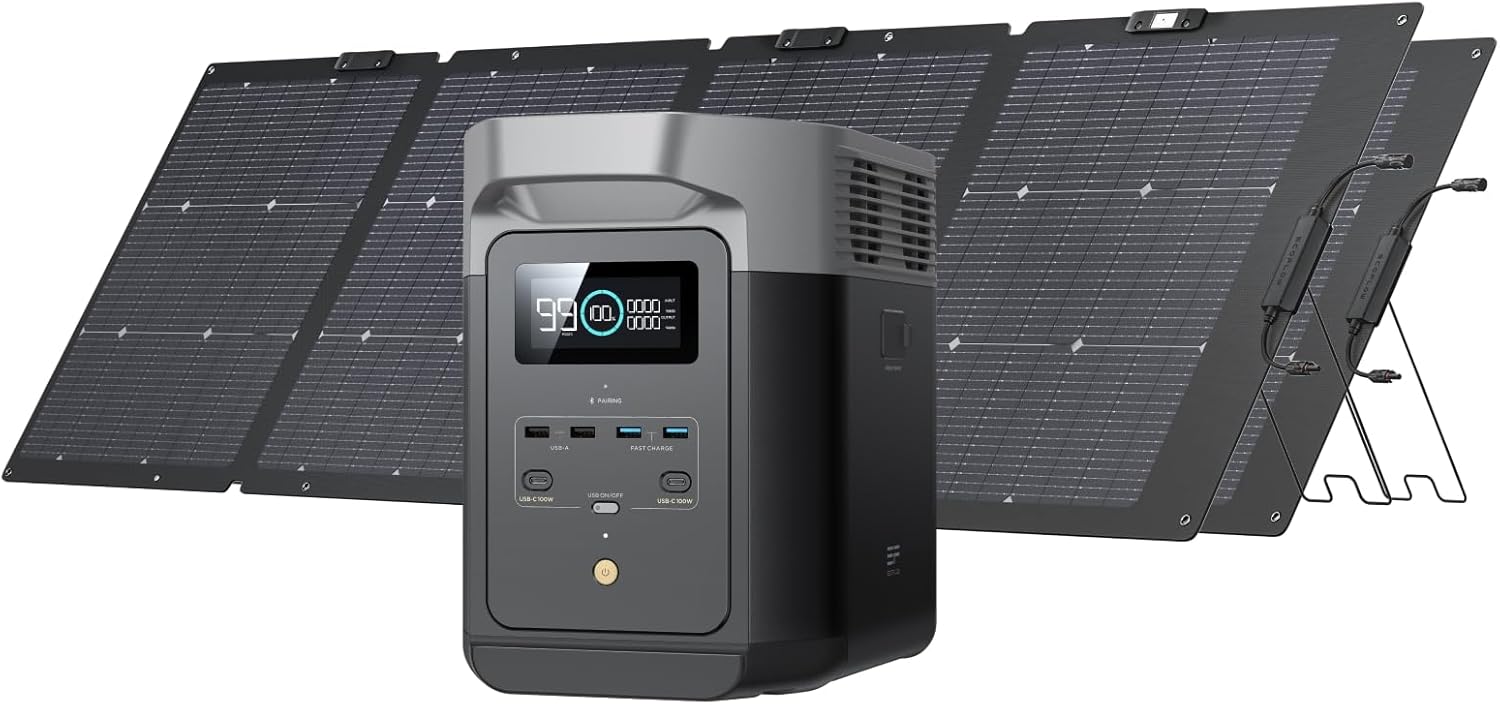
$1,681 · 1,024Wh LFP · 1,800W AC output, higher with X-Boost · 440W of solar included (2× 220W) · Fast charging · 120V
Best for: The most proven 1kWh platform in the category, bundled with enough panel to keep it fed
The DELTA 2 is the volume seller of this entire category, and volume matters more than it sounds — it means a deep pool of real-world reliability data, wide accessory availability, and firmware that has been through many revisions rather than one. The core spec is 1,024Wh of LFP capacity with 1,800W of AC output, and X-Boost pushes higher for resistive appliances that would exceed the inverter. What this bundle adds is 440 watts of solar, and that is the part worth paying for: a 1kWh battery alone is a one-night device, while the same battery with 440W behind it refills daily and becomes something you can run a long outage on.
🧭 Four Questions That Decide It for You
1. Fuel or battery? A fuel generator runs as long as you can feed it, which is the only way to survive an outage measured in weeks — but it lives outside, makes noise, needs oil changes, and produces carbon monoxide that kills people every storm season. A battery station is silent, emission-free, safe indoors and asks nothing of you, but when the stored kilowatt-hours are gone you wait for the sun. Outages of four to twenty-four hours favor batteries; multi-day winter outages with no sun favor fuel.
2. What does the thing you must run actually pull? Look up the running watts of your refrigerator, well pump and furnace blower, then find the starting watts — commonly two to three times higher for anything with a motor. The unit has to cover the surge, not the average, or it trips the moment the compressor kicks on.
3. Do you need 240V? Well pumps, electric dryers, electric water heaters and most central air are 240V, and most portable power stations deliver only 120V. Here, the Jackery 5000 Plus and the HomePower 3600 Plus in parallel provide 240V, as do the fuel generators and the Generac. If you are on a well, this question is the whole decision.
4. How does energy get back in? A battery with no meaningful solar input is a large single-use device. Look at included panel wattage, not just battery capacity, and check whether the panels are in the box or sold separately — several bundles here ship them in a second package.
❓ FAQ
How many watt-hours do I need to run a refrigerator? A modern full-size refrigerator draws 100 to 200 watts running, but it cycles on and off, so real consumption usually lands between 1 and 2 kWh per day. A 2kWh station like the Anker S2000 or DELTA 2 Max will generally carry a fridge a day to a day and a half — Anker rates the S2000 at 35 hours. Add solar and that becomes indefinite in decent weather.
What is the difference between starting watts and running watts? Running watts is steady-state draw. Starting watts, or surge, is the spike an electric motor demands in the first fraction of a second as it spins up — commonly two to three times running. A fridge that runs at 150 watts may surge to 600. Size for the surge or the unit shuts down when the compressor cycles.
Can I run a portable power station indoors? Yes. Battery stations produce no exhaust and no carbon monoxide, which is exactly why people pay a premium for them. Fuel generators must never be run indoors, in a garage, in a breezeway or near an open window — CO poisoning from generators kills people during every major outage. The CO shutdown sensors on several units here are a backup for a mistake, not permission to make one.
Is LiFePO4 actually better, or is it marketing? It is real, and it is the single biggest reason to prefer a newer unit. LiFePO4 (also written LFP) is far more thermally stable than older lithium-ion and lasts dramatically longer — the stations here are rated between 3,000 and 10,000 cycles before dropping to 70–80% capacity, roughly ten to fifteen years of regular use, against a few hundred cycles for older chemistry.
Do I need a transfer switch? If you want to power your house circuits rather than run cords to individual appliances, yes. A transfer switch isolates your home from the utility line — critical, because back-feeding a generator into the grid can electrocute a lineman working to restore your power. The Generac includes one; Jackery sells a 60A Smart Transfer Switch for the 5000 Plus and an MTS for the HomePower 3600 Plus. Installation is an electrician's job, not a weekend project.
The Bottom Line
There are three real lanes here, and the number beside each product ranks nothing — it is only an index so you can find your way back to one.
The install lane is the Generac: you pay the most, you pay an electrician on top, and you never think about it again. The fuel lane is the GENMAX, the AIVOLT and the DuroMax: unlimited runtime as long as you can source fuel, at the cost of noise, maintenance and a machine that lives outside. The battery lane is everything else, from the 292Wh Jackery 300 to the 10kWh Jackery 5000 Plus: silent, safe indoors, zero maintenance, bounded by what you have stored and how fast the sun refills it.
Pick the lane first. Then size it against the surge watts of the one appliance you refuse to live without. That is the whole decision, and it is yours to make.
Prices and availability were accurate at the time of writing and change frequently — check the current price at the link before buying. Every product link in this post is an affiliate link, which means OSS America may earn a commission if you buy through it, at no additional cost to you. We were not paid by any brand to include any product on this list.
Advertisement
FTC Disclosure: OSS America contains affiliate links. We earn a commission from qualifying purchases at no extra cost to you. Every pick is research-based: specs, verified prices and owner reviews.
More reviews
 Portable Power
EcoFlow DELTA Pro 3 Review (2026): Specs, Real Price, Owner Reviews and Rivals
An honest EcoFlow DELTA Pro 3 review: 4,096Wh, 4,000W, 120/240V, every bundle priced per kWh, what 69 owners say, the either/or 240V catch, and how it stacks up against the DELTA Pro Ultra and BLUETTI Apex 300.
 Portable Power
EcoFlow vs Jackery (2026): Which Power Station Gives You More for Your Money?
EcoFlow vs Jackery, compared size class by size class: price per kWh, output, weight, cycle ratings, warranty and returns for 1 kWh, 2 kWh, 3 kWh and 240V home backup units, plus which to buy.
 Portable Power
EcoFlow vs BLUETTI (2026): Which Power Station Gives You More for Your Money?
EcoFlow vs BLUETTI, compared size class by size class: price per kWh, output, weight, cycle ratings, warranty and returns for 1 kWh, 2 kWh, 3 kWh and 240V home backup units, plus which to buy.
 Portable Power
EcoFlow DELTA Pro Ultra X vs Tesla Powerwall 3 (2026): Which Home Battery Fits Your House?
EcoFlow DELTA Pro Ultra X vs Tesla Powerwall 3, compared from the makers' own specs: capacity, power, solar input, expansion, warranty, weight, installation, pricing and the 2026 tax-credit reality.
 Portable Power
Jackery Explorer 1000 v2 Review — The Honest Take (2026)
The Jackery Explorer 1000 v2 is one of the best portable power stations we've researched — but not for everyone. What it does great, where it falls short, and how it compares to EcoFlow, BLUETTI and Anker.
 Portable Power
The 15 Best Portable Power Stations of 2026 — Ranked for Camping, RV, and Home Backup
We researched 15 portable power stations across 5 use-case tiers — whole-home backup, off-grid RV, overlanding, camping, and solar — with picks for every budget from $400 to $5,000.