
EcoFlow DELTA Pro 3 Review (2026): Specs, Real Price, Owner Reviews and Rivals

Advertisement
When the grid goes down, the question isn't "is there power in the box?" It's "will it run the well pump, the fridge and the furnace, and for how long?" The EcoFlow DELTA Pro 3 is EcoFlow's answer for households that want real 240V backup without a permanent install: a 4,096Wh battery and 4,000W inverter on wheels, with outlets for everything from a phone to a 240V appliance, and room to grow to 12 kWh.
We went through the DELTA Pro 3's full spec sheet, EcoFlow's own FAQ answers (including the ones that don't show up in the ads), every bundle price, and what 69 owners say on EcoFlow's site. Then we priced it per kWh against the DELTA Pro Ultra, the DELTA Pro Ultra X and the BLUETTI Apex 300. Every price and spec below was checked on September 28, 2026.
The short answer
The EcoFlow DELTA Pro 3 is a strong buy if you want real 240V home backup without a permanent install: 4,096Wh, 4,000W, 120/240V and a 5-year warranty for $2,799 (down from $3,699). It isn't the cheapest storage per kWh, and it can't run its 120V and 240V outlets at the same time.
- Buy the DELTA Pro 3 alone: $2,799 for 4,096Wh. Check price at EcoFlow →
- Best value bundle: DELTA Pro 3 + Extra Battery, $4,459 for 8,192Wh. Check price at EcoFlow →
- Going solar: DELTA Pro 3 + 400W Solar Panel, $3,099. Check price at EcoFlow →
- Cheaper per kWh: BLUETTI Apex 300, $1,499 for 2,764.8Wh. Check price at BLUETTI →
- Bigger house: EcoFlow DELTA Pro Ultra, $4,199 for 6,144Wh and 7,200W. Check price at EcoFlow →
Heads-up: EcoFlow's product page said the DELTA Pro 3 "ships in mid October" when we checked on September 28, 2026.
How we reviewed the DELTA Pro 3
This is a research-based review, not a bench test. We haven't run a DELTA Pro 3 through an outage for this article, and we don't publish runtimes or efficiency numbers we didn't measure. What we did: read EcoFlow's product page, spec table and FAQ; pulled current prices and bundle options from EcoFlow's store; read the owner reviews on EcoFlow's site, starting with the 4-star ones, since that's where the real complaints live; and compared prices and specs with the closest rivals from EcoFlow and BLUETTI. Where a claim is EcoFlow's (runtimes, charging speed, noise), we say so.
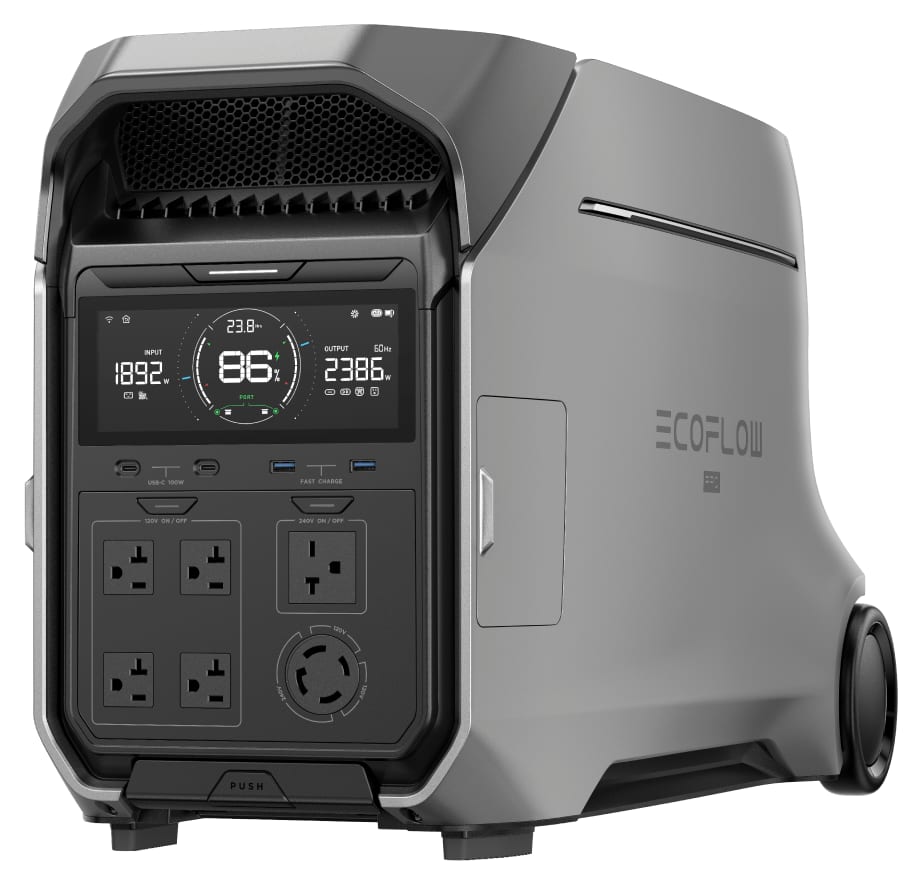
DELTA Pro 3 specs at a glance
| Battery | 4,096Wh LFP, 4,000 cycles to 80% (0.5C, 77°F lab test) |
| AC output | 4,000W continuous (120/240V), 6,000W with X-Boost; 8,000W surge |
| 120V outlets | 4 × NEMA 5-20R (20A), 1 × TT-30R (30A) |
| 240V outlets | 1 × NEMA 6-20R, 1 × NEMA L14-30R (16.7A) |
| 120V + 240V at once? | No. EcoFlow's FAQ: the 120V and 240V output buttons switch one group off when the other is on |
| Expansion | 12 kWh per unit with 2 × DP3 Extra Battery; 36 kWh system (3 units + Smart Home Panel 2), up to 48 kWh with Smart Generators |
| Solar input | 2,600W total, 2 ports (High-PV 30-150V 15A 1,600W; Low-PV 11-60V 20A 1,000W) |
| Wall charging | Standard AC inlet; EcoFlow's FAQ says the US grid port typically supports 120V 2,000W charging, and 4,000W Level 2 charging with its EV X-Stream Adapter and a 240V EV charger |
| Car input | 12V 8A / 48V 20A |
| USB | 2 × USB-C 100W, 2 × USB-A 18W |
| UPS switchover | 10 ms |
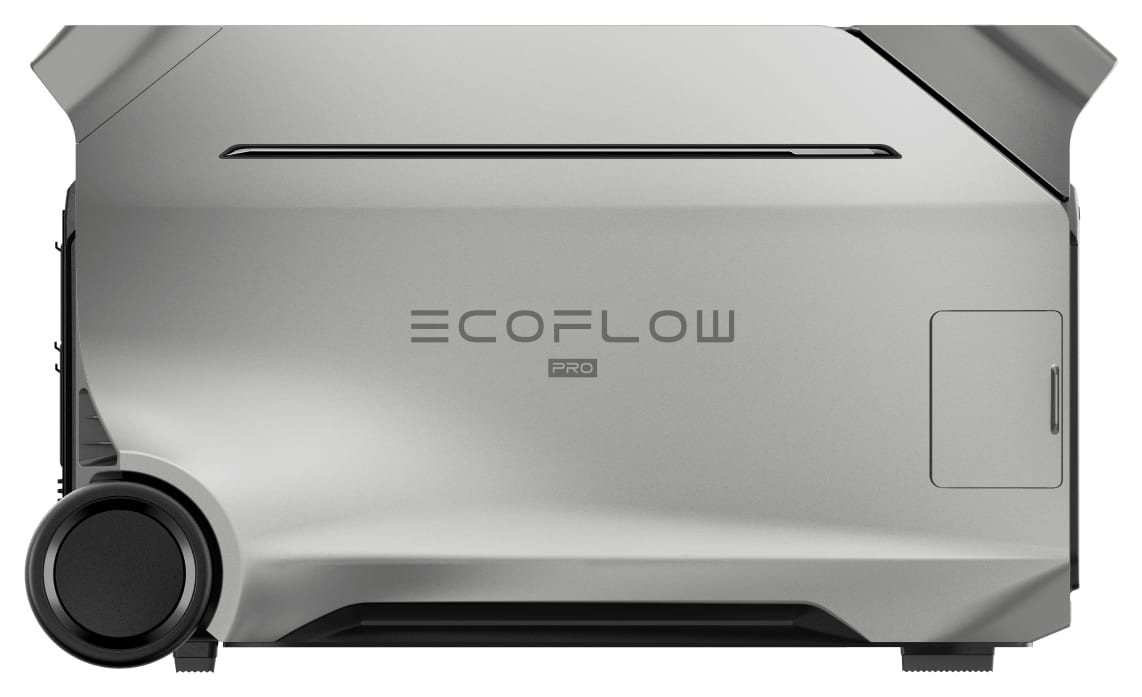
| Weather rating | Battery pack IP65; main unit IP20 (EcoFlow FAQ): indoor or sheltered outdoor use |
| Size / weight | 16.16 × 13.43 × 27.28 in · 113.54 lb (51.5 kg) |
| Warranty | 5 years (3 standard + 2 with EcoFlow app registration) |
| Price | $2,799 (was $3,699) at EcoFlow, Sept 28, 2026 |
Price, bundles and what a kWh costs
At $2,799, the DELTA Pro 3 is $900 off EcoFlow's $3,699 list price. The bundles are where it gets interesting, because adding capacity lowers the cost per kWh fast:
| Package | Price | Was | Capacity | Per kWh | Note |
|---|---|---|---|---|---|
| DELTA Pro 3 | $2,799 | $3,699 | 4.1 kWh | $683 | The unit alone |
| DELTA Pro 3 + 400W Solar Panel | $3,099 | $3,999 | 4.1 kWh | $757 | EcoFlow quotes a solar charge in about 12.8 hours with the 400W panel |
| DELTA Pro 3 + Smart Generator 4000 (Dual Fuel) | $3,689 | $4,589 | 4.1 kWh | $901 | Generator connects directly and auto-recharges the unit |
| DELTA Pro 3 + Extra Battery | $4,459 | $5,598 | 8.19 kWh | $544 | Doubles capacity |
| DELTA Pro 3 + Extra Battery + 400W Solar Panel | $4,789 | $6,297 | 8.19 kWh | $585 | Capacity plus a panel |
| DELTA Pro 3 + 2 × Extra Battery | $6,169 | — | 12.29 kWh | $502 | The single-unit maximum, 12 kWh |
Prices from us.ecoflow.com on September 28, 2026. EcoFlow also sells the Extra Battery alone for $1,899 and two for $3,399. Members-only and flash-sale prices, and bundles marked sold out, are left out. Prices change often.
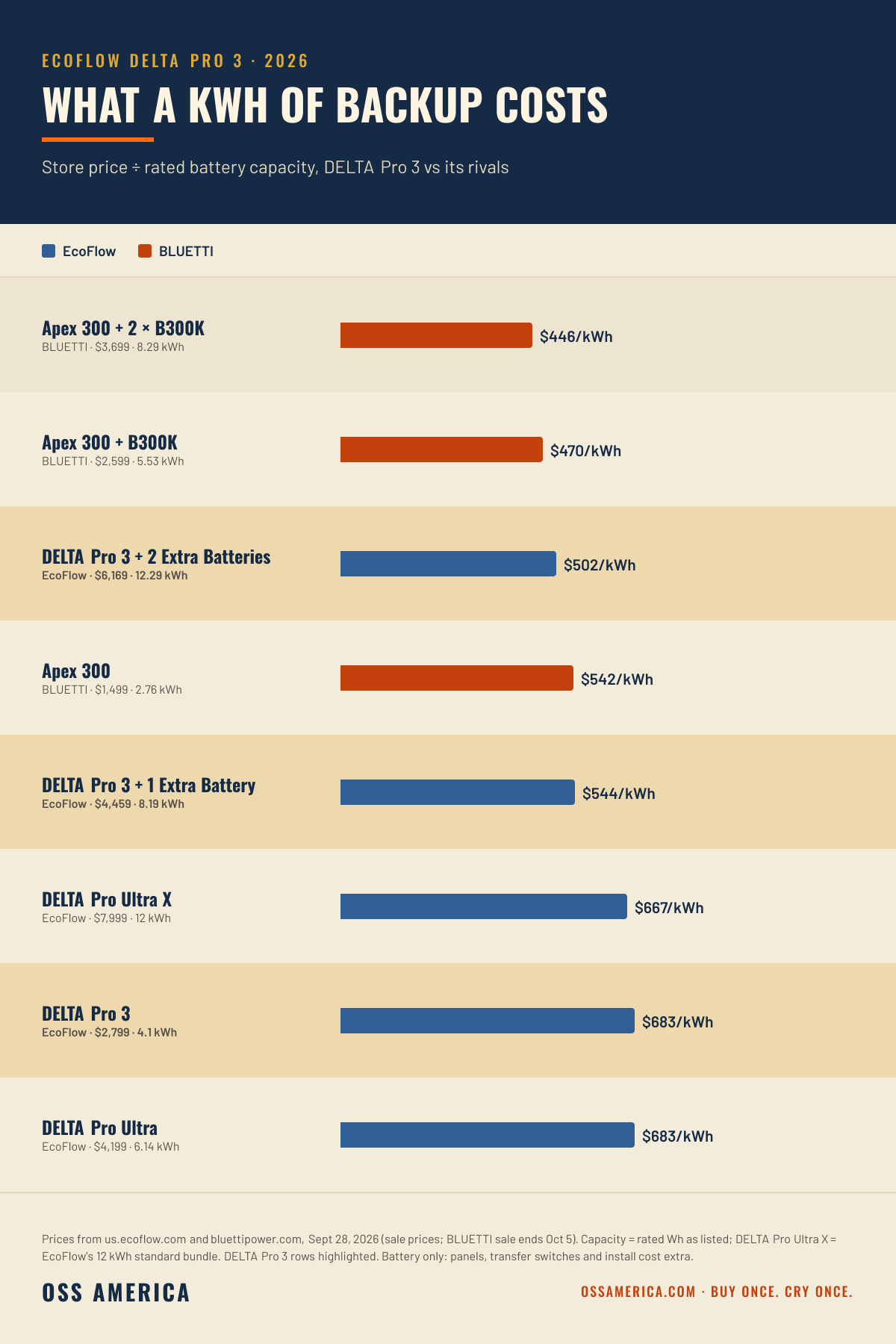
Two things jump out. First, the DELTA Pro 3 alone is one of the more expensive ways to buy a kWh ($683), about the same as the bigger DELTA Pro Ultra. Adding one Extra Battery drops it to $544, and two to $502. Second, BLUETTI's Apex 300 is cheaper per kWh at every size we priced, especially with its B300K batteries, although BLUETTI's pricing was part of a sale that ends October 5. Price per kWh isn't the whole story, which is why the next sections matter.
What the DELTA Pro 3 can actually run
EcoFlow says a single DELTA Pro 3 can start and run a 3-ton central air conditioner and a 1 HP water pump, thanks to 4,000W continuous output, 6,000W with its X-Boost mode and 8,000W surge. Read EcoFlow's footnote, though: the central-AC claim was "tested under controlled laboratory conditions with central AC soft starter." If your AC doesn't have a soft starter, plan on adding one or don't count on it.
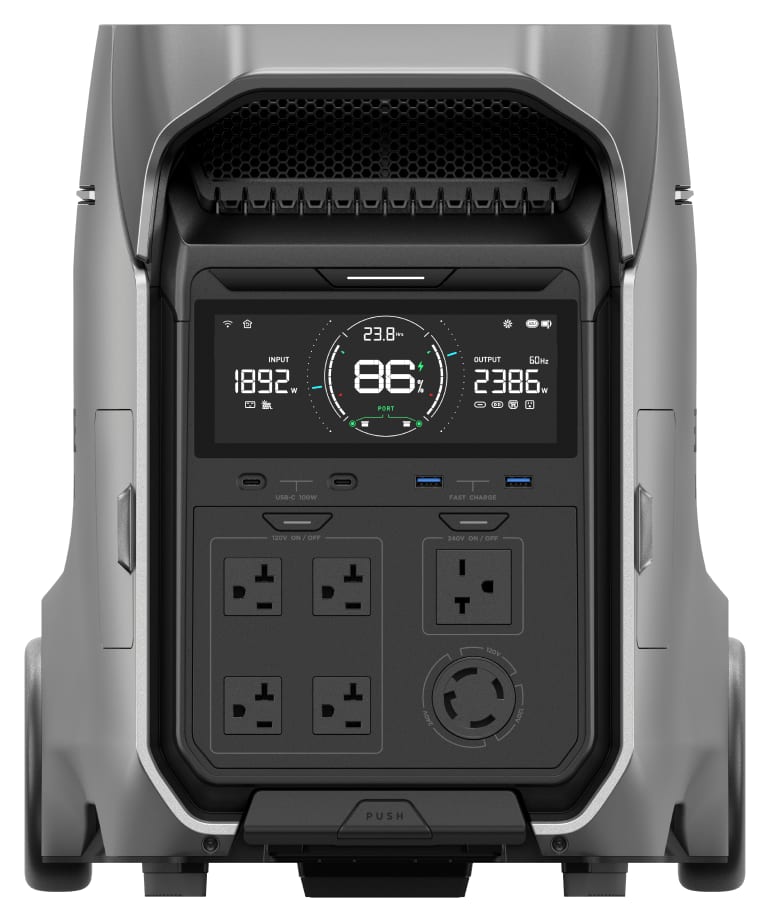
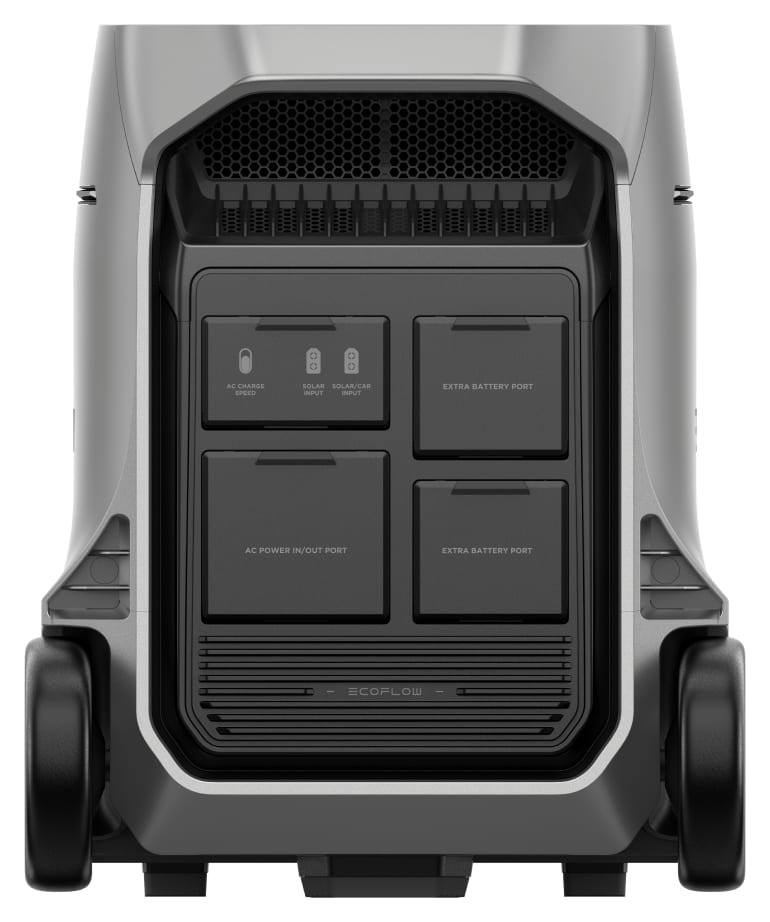
The outlet layout is generous: four 120V 20A outlets, a 30A RV (TT-30) outlet, a 240V NEMA 6-20 and a 120/240V L14-30 you can feed into a home inlet box or transfer switch. The catch is in EcoFlow's own FAQ: the 120V and 240V outlets are either/or. Press the 240V button and the 120V outlets turn off, and vice versa. If you wire the L14-30 into your house through a transfer switch, that's fine, because your panel splits the power. If you were planning to run a 240V well pump from one outlet and extension cords from the others, it won't work that way. BLUETTI says its Apex 300 can do both at once.
Owners on EcoFlow's site report running a side-by-side fridge, a heat pump with lights and a TV, a pellet-stove insert for nearly four days, and in one case a 2,200 sq ft home through two long outages with a DELTA Pro 3 wired to the main panel. Your runtime will depend on what you run. Divide 4,096Wh by your average load in watts for a rough upper bound, then expect less after inverter losses.
Expansion and connecting it to your house
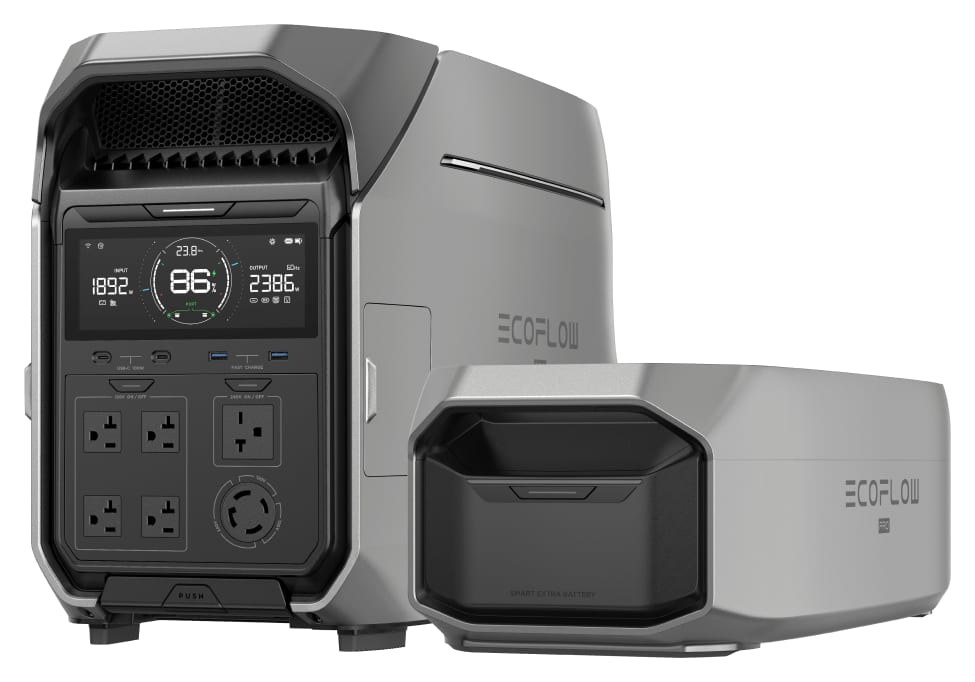
Each DELTA Pro 3 takes up to two DELTA Pro 3 Smart Extra Batteries ($1,899 each) for 12 kWh. The older DELTA Pro Smart Extra Battery also works, according to EcoFlow, though mixing the two leaves some imbalance in state of charge. Link up to three DELTA Pro 3 units through EcoFlow's Smart Home Panel 2 ($1,599, installation required) for 36 kWh and 12 kW, or up to 48 kWh with Smart Generators added.
One limit an owner points out: the unit has two expansion ports, and the Smart Generator uses the same port type as the Extra Batteries. So you can run two batteries, or one battery plus a Smart Generator, but not two batteries and a smart-connected generator. With two batteries attached, a regular generator charges through the standard AC inlet instead.
For the house connection you have three routes, per EcoFlow: the Smart Home Panel 2 (automatic, 20ms switchover, app-controlled circuits), an inlet box fed from the L14-30 outlet, or a manual transfer switch. We'd have a licensed electrician handle the last two. Compatibility is narrower than the names suggest: EcoFlow says the DELTA Pro 3 is not compatible with the original DELTA Pro or the DELTA Pro Ultra main units.
Charging: wall, solar, generator
- Wall outlet: EcoFlow advertises 0-80% in 50 minutes with its X-Stream fast charging and up to 7,000W by combining charging methods. On a normal US outlet, its own FAQ says the grid port typically charges at 120V and 2,000W, and one owner reports 1,800W from a standard plug. Faster AC charging needs EcoFlow's EV X-Stream Adapter and a 240V EV charger (4,000W, per the FAQ).
- Solar: 2,600W across two inputs: a high-voltage port (30-150V, up to 1,600W) and a low-voltage port (11-60V, up to 1,000W). EcoFlow notes that 2,600W is a best-case lab figure. One owner running 12 kWh of batteries calls the solar limit the DELTA Pro 3's biggest weakness, because it can take more than a full sunny day to refill that much storage.
- Generator: EcoFlow's Smart Generator 4000 (Dual Fuel) connects directly and can auto-start; it's $3,689 bundled with the DELTA Pro 3.
- Vehicle: car charging input rated 12V/8A or 48V/20A, and EcoFlow lists its 800W Alternator Charger as compatible.
What owners say
On EcoFlow's site the DELTA Pro 3 averages 4.8/5 from 69 reviews: 57 five-star, 11 four-star, 1 three-star and none below that. These are reviews on the seller's own site, so read them as a signal, not a verdict. The five-star reviews talk about running whole-home circuits through a transfer switch, peak-shaving with rooftop solar, the app, and being able to run it indoors.
The four-star reviews are more useful. The complaints that come up:
- The extendable pull handle. Two owners say theirs arrived broken or broke on first use, and one says it wouldn't retract.
- A thin manual. One owner calls it "literally just a sheet" and couldn't find how to use faster charging.
- Standby drain. One owner says it loses about 5% a day and keeps it plugged in.
- Solar input that feels small next to a fully expanded 12 kWh system, and the two-port limit for batteries and the Smart Generator.
- No backlighting on the buttons and ports, noticed by an owner using it in a camper at night.
One owner also had a unit arrive with a small dent and found getting a partial credit frustrating. EcoFlow's policy offers a return within 30 days of receipt, or a free replacement or refund for quality issues in that window.
DELTA Pro 3 vs DELTA Pro Ultra vs BLUETTI Apex 300
| DELTA Pro 3 | DELTA Pro Ultra | BLUETTI Apex 300 | |
|---|---|---|---|
| Price (Sept 28) | $2,799 | $4,199 | $1,499 |
| Capacity | 4,096Wh | 6,144Wh | 2,764.8Wh |
| Per kWh | $683 | $683 | $542 |
| Output | 4,000W (6,000W X-Boost), 120/240V | 7,200W, 120/240V | 3,840W, 120/240V |
| Max expansion | 12 kWh per unit; 36-48 kWh system | 90 kWh / 21.6 kW | 6 × B300K per unit; 58 kWh / 11.52 kW (2-3 units) |
| 120V + 240V at once | No (either/or) | Not checked | Yes, per BLUETTI |
| Cycle life | 4,000 to 80% | Not checked | 6,000+ to 80% |
| Solar input | 2,600W | Not checked | 2,400W (2 × 1,200W); more with SolarX 4K |
| Weight | 113.54 lb, one piece | 70 lb inverter + 111.8 lb battery | 83.78 lb |
| UPS | 10 ms | 10 ms (backup UPS) | 0 ms or 20 ms, per BLUETTI |
| On-site rating | 4.8/5 (69) | Not checked | 4.76/5 (191) |
| Warranty | 5 years (3 + 2 with app) | Not checked | 5 years |
| EcoFlow → | EcoFlow → | BLUETTI → |
DELTA Pro 3 and DELTA Pro Ultra specs from EcoFlow's DELTA Pro 3 page comparison table; Apex 300 specs from bluettipower.com; all read September 28, 2026. "Not checked" means we didn't confirm it on a page we loaded that day.
More power for bigger homes
EcoFlow DELTA Pro Ultra: $4,199
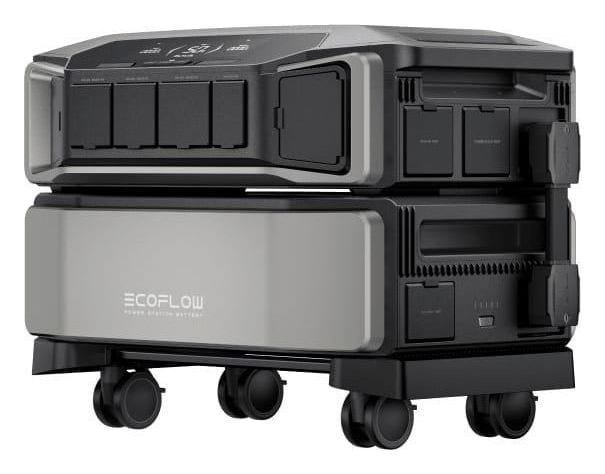
The DELTA Pro Ultra is a two-piece system (a 70 lb inverter on a 111.8 lb battery) with 6,144Wh and 7,200W of 120/240V output for $4,199, down from $5,799. It scales much further, to 90 kWh and 21.6 kW, and it costs about the same per kWh as a DELTA Pro 3. Pick it if you need more than 4,000W at once or plan to go well past 12 kWh. Pick the DELTA Pro 3 if you want one box on wheels. EcoFlow's bigger DELTA Pro Ultra X ($7,999 for 12 kW and 12 kWh) is built as a whole-home system; we compared it with the Tesla Powerwall 3 in DELTA Pro Ultra X vs Powerwall 3.
Cheaper per kWh
BLUETTI Apex 300: $1,499
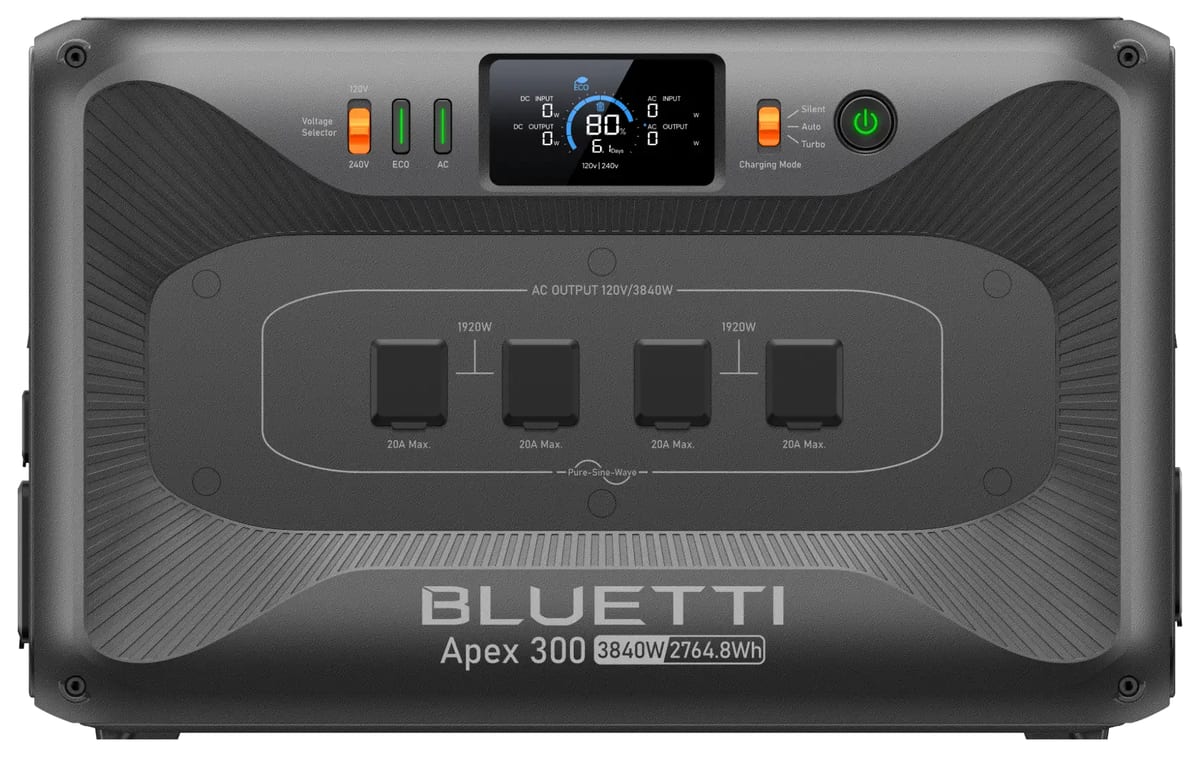
The Apex 300 is the DELTA Pro 3's most direct rival: 2,764.8Wh of LFP, 3,840W of 120/240V output, 83.78 lb, and $1,499 (down from $1,699) in a sale BLUETTI says ends October 5. With one B300K battery it's $2,599 for 5,529.6Wh, and with two it's $3,699 for 8,294.4Wh. That's $446 per kWh against $544 for a DELTA Pro 3 with one Extra Battery. BLUETTI also lists 6,000+ cycles to 80% (vs 4,000), 120V and 240V at the same time, and a 0 ms UPS mode. Owners rate it 4.76/5 from 191 reviews on BLUETTI's site.
The trade-offs: less capacity and output per unit than the DELTA Pro 3, a 120V/15A AC input (BLUETTI lists 1,800W with bypass, and up to 3,840W with its Turbo Charging), and its USB and 12V ports need the separate Hub D1. See our full EcoFlow vs BLUETTI comparison.
Pros and cons
Pros
- + 4,096Wh and 4,000W (6,000W X-Boost) with 120V and 240V outlets in one wheeled unit
- + Expands to 12 kWh per unit, 36-48 kWh as a system
- + LFP battery rated for 4,000 cycles to 80%; IP65-sealed battery pack
- + 10 ms UPS switchover; app control
- + 2,600W solar input plus generator, car and EV-charger options
- + 5-year warranty (with app registration); 4.8/5 from 69 owners
Cons
- − 120V and 240V outlets can't run at the same time
- − $683/kWh alone; BLUETTI Apex 300 is cheaper per kWh
- − 113.5 lb, and two owners report pull-handle failures
- − Standard wall charging is about 1,800-2,000W; faster AC needs an EV adapter
- − Only two expansion ports shared by batteries and the Smart Generator
- − Main unit is IP20: indoor or sheltered use only
- − Shipping in mid October, per EcoFlow on Sept 28
Who should buy the DELTA Pro 3, and who shouldn't
Buy it if you want one portable unit that can back up 240V loads through an inlet box or transfer switch, you like the idea of growing to 8 or 12 kWh later, and you value EcoFlow's app and ecosystem (Smart Home Panel 2, Smart Generator). The DELTA Pro 3 + Extra Battery bundle at $4,459 is the sweet spot for most homes: 8 kWh for about $544 per kWh.
Skip it, or look elsewhere, if lowest cost per kWh is your main goal (the BLUETTI Apex 300 wins there), you need to run 120V and 240V loads from the unit at the same time, you need more than 4,000W continuous (look at the DELTA Pro Ultra), or you want a big solar array to refill a fully expanded system in one day.
Comparing smaller units too? See our 15 best portable power stations and the original EcoFlow DELTA Pro with Smart Extra Battery.
Frequently asked questions
Is the EcoFlow DELTA Pro 3 worth it?
For 240V home backup from a single portable unit, yes, especially bundled with an Extra Battery ($4,459 for 8,192Wh on September 28, 2026). Owners on EcoFlow's site rate it 4.8/5 from 69 reviews. If you mainly want the most kWh per dollar, the BLUETTI Apex 300 with B300K batteries was cheaper per kWh on the same day.
Can the DELTA Pro 3 power a whole house?
It can power a lot of a house, not usually all of it at once. One unit delivers 4,000W continuous (6,000W with X-Boost) at 120/240V. EcoFlow says it can run a 3-ton central AC with a soft starter and a 1 HP water pump. For whole-home backup, EcoFlow links up to three units through the Smart Home Panel 2 for 12 kW and up to 36-48 kWh.
Can it run 120V and 240V at the same time?
Not from its own outlets. EcoFlow's FAQ says the 120V and 240V outputs are controlled by separate buttons, and turning on one group turns off the other. Wired into a home through the L14-30 outlet and a transfer switch or inlet box, it supplies split-phase power to your panel.
Can you use the DELTA Pro 3 outdoors?
Only in a sheltered spot. EcoFlow says the battery pack inside is sealed to IP65, but the main unit is IP20, so it's meant for well-ventilated indoor spaces or covered outdoor areas out of rain and dust.
How long does it take to charge?
EcoFlow advertises 0-80% in 50 minutes with X-Stream fast charging. On a standard US outlet, EcoFlow's FAQ says the grid port typically supports 120V, 2,000W charging, which is slower. Solar tops out at 2,600W under ideal conditions. EcoFlow quotes about 12.8 hours to charge from its 400W panel.
Does the DELTA Pro 3 qualify for the 30% federal tax credit?
Probably not for new purchases. The IRS says the Residential Clean Energy Credit, which covered home battery storage, isn't available for property placed in service after December 31, 2025. EcoFlow's page still carries an older tax disclaimer. Ask a tax professional about your situation.
DELTA Pro 3 or DELTA Pro Ultra?
The DELTA Pro 3 ($2,799, 4,096Wh, 4,000W) is one wheeled box that tops out at 12 kWh per unit. The DELTA Pro Ultra ($4,199, 6,144Wh, 7,200W) is a two-piece system that scales to 90 kWh and 21.6 kW. They cost about the same per kWh. Choose by how much power you need at once and how far you plan to expand. EcoFlow says the two aren't compatible with each other.
The bottom line
The EcoFlow DELTA Pro 3 is a well-built, well-reviewed way to put real 120/240V backup in your home without a permanent install, and it grows with you. Buy it with an Extra Battery, where the price per kWh finally gets competitive, and plan the house connection with an electrician. Go in knowing its limits: it can't run its 120V and 240V outlets together, it weighs 113.5 lb, and BLUETTI's Apex 300 gives you more storage for the money. If those don't bother you, the DELTA Pro 3 is an easy recommendation.
See the DELTA Pro 3 at EcoFlow →
Talk soon,
OSS AMERICA
God · Family · Country · Gear that earns its keep.
Advertisement
FTC Disclosure: OSS America contains affiliate links. We earn a commission from qualifying purchases at no extra cost to you — we only point you at gear we'd stake our own trip on.
More reviews
 Portable Power
EcoFlow DELTA Pro Ultra X vs Tesla Powerwall 3 (2026): Which Home Battery Fits Your House?
EcoFlow DELTA Pro Ultra X vs Tesla Powerwall 3, compared from the makers' own specs: capacity, power, solar input, expansion, warranty, weight, installation, pricing and the 2026 tax-credit reality.
 Portable Power
EcoFlow vs BLUETTI (2026): Which Power Station Gives You More for Your Money?
EcoFlow vs BLUETTI, compared size class by size class: price per kWh, output, weight, cycle ratings, warranty and returns for 1 kWh, 2 kWh, 3 kWh and 240V home backup units, plus which to buy.
 Portable Power
EcoFlow vs Jackery (2026): Which Power Station Gives You More for Your Money?
EcoFlow vs Jackery, compared size class by size class: price per kWh, output, weight, cycle ratings, warranty and returns for 1 kWh, 2 kWh, 3 kWh and 240V home backup units, plus which to buy.
 Portable Power
14 Best-Selling Home Power Products of 2026 (Not a Ranking)
Not a ranking — nobody won. Fourteen of the best-selling home power products on the market, with what each one actually does: the watts, the hours, the fuel, the install, and the honest limits. You decide which fits your house.
 Portable Power
Jackery Explorer 1000 v2 Review — The Honest Take (2026)
The Jackery Explorer 1000 v2 is one of the best portable power stations we've researched — but not for everyone. What it does great, where it falls short, and how it compares to EcoFlow, BLUETTI and Anker.
 Portable Power
The 15 Best Portable Power Stations of 2026 — Ranked for Camping, RV, and Home Backup
We researched 15 portable power stations across 5 use-case tiers — whole-home backup, off-grid RV, overlanding, camping, and solar — with picks for every budget from $400 to $5,000.