
EcoFlow vs Jackery (2026): Which Power Station Gives You More for Your Money?
Advertisement
EcoFlow and Jackery are the two names most people shortlist when they want a battery for outages, camping or the RV. Both sell LiFePO4 power stations from about 1 kWh up to whole-home systems, and both sell direct from their own US stores, usually at a discount off list. So which one actually gives you more battery for your money?
We lined up each brand's current models in four matching size classes: about 1 kWh, 2 kWh, 3 kWh, and 120/240V home backup. For each pair we pulled the price, rated capacity, continuous output, weight, cycle rating and warranty straight from the brands' own US stores, then worked out what one kilowatt-hour of battery costs. Every number here was checked on September 24, 2026.
The short answer
Jackery is cheaper per kWh in three of our four size classes. EcoFlow gives you more output and faster switchover for the money at 1 and 2 kWh. We matched each brand's current models by capacity and divided price by battery size. Jackery won at 1 kWh ($522/kWh vs $653/kWh), 3 kWh (by $20) and home backup ($625/kWh vs $683/kWh). EcoFlow won at 2 kWh, where the DELTA 3 Max is also the stronger unit. Both brands use LiFePO4 batteries, offer 5-year warranties when you buy direct, and take returns for 30 days.
- Best 1 kWh value: Jackery Explorer 1000 v2, $559 ($522/kWh). Check price →
- Best 2 kWh: EcoFlow DELTA 3 Max, $879, 2,400W output. Check price →
- Best whole-home starter: Jackery Explorer 5000 Plus, $3,149, 5 kWh and 7,200W at 120/240V. Check price →
How we compared EcoFlow and Jackery
This is a research-based comparison, not a hands-on test. We haven't run these eight units side by side for this article, and we'll update it if we do. What we did do: pulled every price and spec from us.ecoflow.com and jackery.com on the same day, matched models by rated capacity, and calculated price per kWh of battery (price ÷ watt-hours × 1,000). That tells you how much stored energy each dollar buys. We also looked at price per watt of continuous output, because a big battery that can't run your well pump or window AC isn't much use in an outage.
We compared base units only, with no solar panels or extra batteries, at the sale price each store showed that day. We also read both brands' return policies and warranty terms. Where a spec wasn't published, we say so rather than guess.
Price vs price: every size class compared
| Size class | EcoFlow | Price | Wh / W | $ per kWh | Jackery | Price | Wh / W | $ per kWh | Cheaper per kWh |
|---|---|---|---|---|---|---|---|---|---|
| 1 kWh | DELTA 3 Plus | $669 | 1,024 / 1,800 | $653/kWh | Explorer 1000 v2 | $559 | 1,070 / 1,500 | $522/kWh | Jackery |
| 2 kWh | DELTA 3 Max | $879 | 2,048 / 2,400 | $429/kWh | Explorer 2000 v2 | $899 | 2,042 / 2,200 | $440/kWh | EcoFlow |
| 3 kWh | DELTA 3 Ultra | $1,369 | 3,072 / 3,600 | $446/kWh | HomePower 3000 | $1,349 | 3,072 / 3,600 | $439/kWh | Jackery |
| Home backup (120/240V) | DELTA Pro 3 | $2,799 | 4,096 / 4,000 | $683/kWh | Explorer 5000 Plus | $3,149 | 5,040 / 7,200 | $625/kWh | Jackery |
Sale prices from us.ecoflow.com and jackery.com, September 24, 2026, base unit only (no solar panels or add-on batteries). Wh = rated battery capacity; W = continuous AC output. $ per kWh = price ÷ capacity × 1,000. Prices change often.
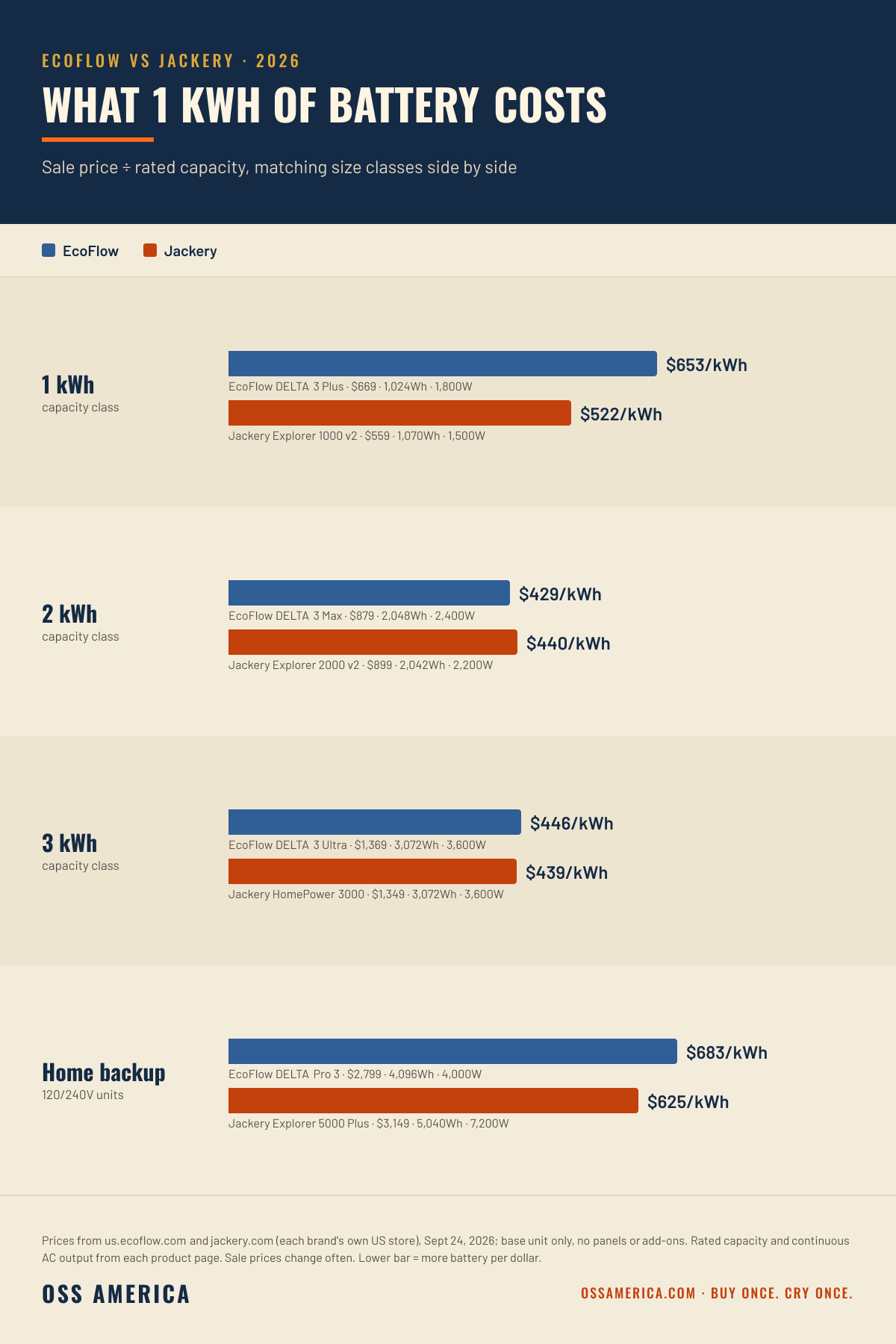
The spread is small in the middle and bigger at the ends. At 2 and 3 kWh the two brands are within about 3% of each other per kWh, so features should decide it. At 1 kWh, Jackery's Explorer 1000 v2 is about 20% cheaper per kWh than the DELTA 3 Plus. At the home-backup level, the Explorer 5000 Plus is about 9% cheaper per kWh than the DELTA Pro 3, and it has 80% more continuous output.
Head-to-head, size by size
1 kWh: DELTA 3 Plus vs Explorer 1000 v2
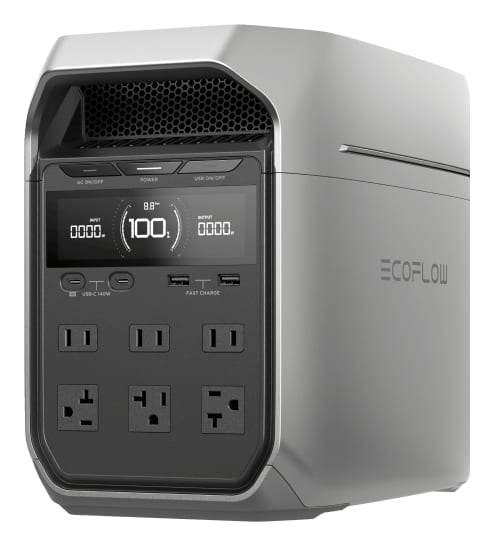
EcoFlow DELTA 3 Plus: 1,024Wh · 1,800W continuous (3,600W surge) · 27.6 lb · 120V · 4,000 to 80% cycle rating
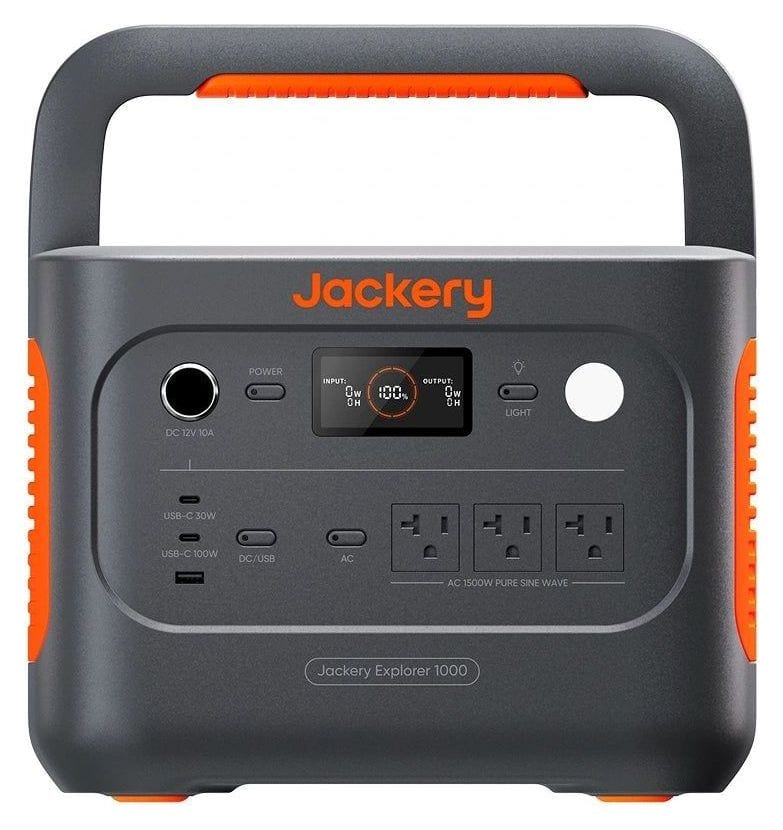
Jackery Explorer 1000 v2: 1,070Wh · 1,500W continuous (3,000W surge) · 23.8 lb · 120V · 4,000 to 70% cycle rating
The Jackery is $110 cheaper and holds a little more energy (1,070Wh vs 1,024Wh), which is why it wins on price per kWh: $522/kWh vs $653/kWh. It's also the lighter unit at 23.8 lb and it's in stock now. The DELTA 3 Plus was a pre-order shipping in November when we checked.
The EcoFlow earns its higher price in other ways. It puts out 1,800W continuous vs 1,500W, has 13 outputs, switches over in under 10 ms (good for a PC or a CPAP), and can add EcoFlow extra batteries later for up to 5 kWh. Per watt of output, the two cost the same: $0.37 vs $0.37. EcoFlow also rates its cells at 4,000 cycles to 80% capacity, while Jackery rates 4,000 cycles to 70%.
Two cheaper options are worth knowing. EcoFlow's DELTA 3 Classic is $499 for the same 1,024Wh and 1,800W, which works out to $487/kWh. Jackery's newer HomePower 1000 v2 is $554 for 1,024Wh. Want more detail on the Jackery? Read our Jackery Explorer 1000 v2 review.
2 kWh: DELTA 3 Max vs Explorer 2000 v2
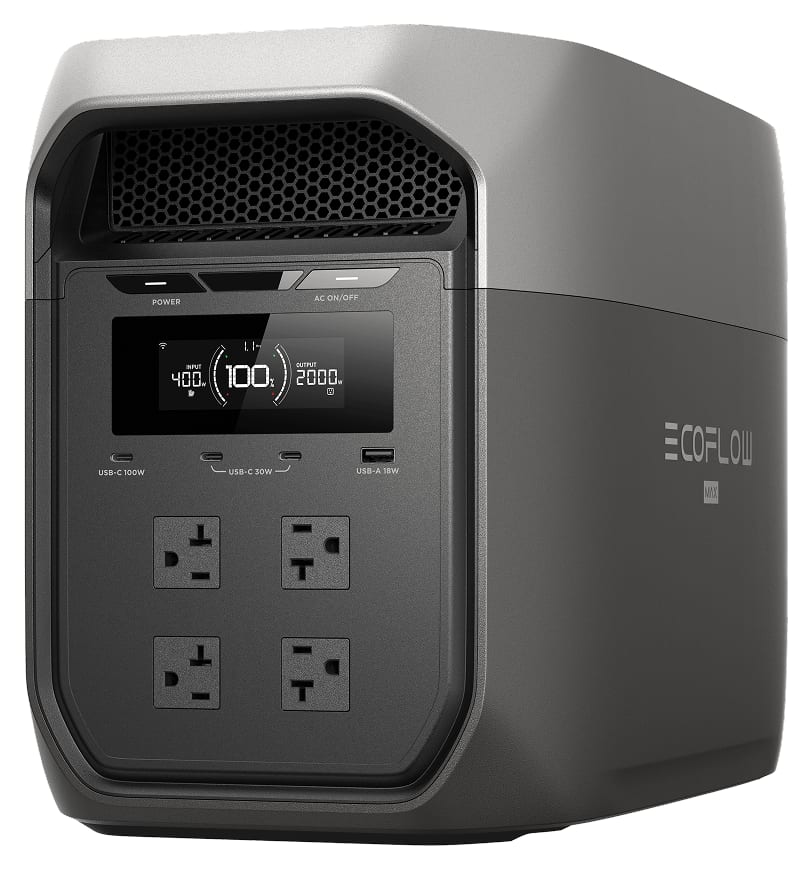
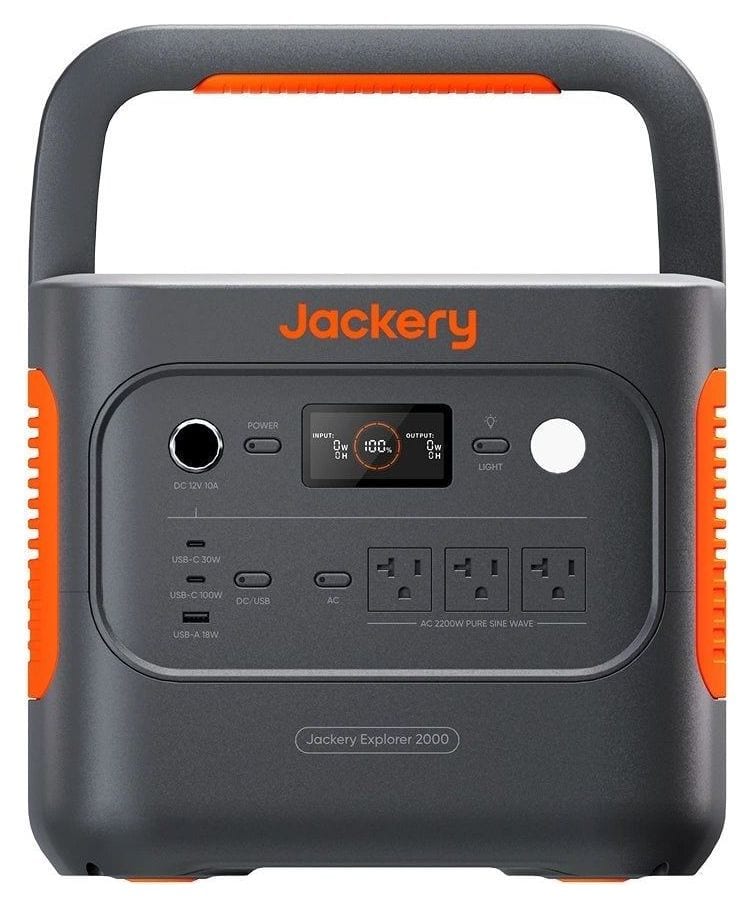
EcoFlow DELTA 3 Max: 2,048Wh · 2,400W continuous (4,800W surge) · 44.8 lb · 120V · not listed (EcoFlow says 10 years) cycle rating
Jackery Explorer 2000 v2: 2,042Wh · 2,200W continuous (4,400W surge) · 39.5 lb · 120V · 4,000 to 70% cycle rating
This is EcoFlow's strongest size class. The DELTA 3 Max costs $20 less than the Explorer 2000 v2, holds slightly more (2,048Wh vs 2,042Wh) and puts out more power: 2,400W continuous (3,400W with X-Boost for resistive loads like kettles) vs 2,200W. That's $429/kWh vs $440/kWh, and $0.37 vs $0.41 per watt.
The Jackery is the lighter one at 39.5 lb vs 44.8 lb, and it recharges from the wall in about 1.7 hours. EcoFlow quotes 0 to 80% in 68 minutes. Jackery's own page now points shoppers to its newer HomePower 2000 Plus v2, which costs $1,069, so the Explorer 2000 v2 is the value pick in Jackery's 2 kWh lineup.
3 kWh: DELTA 3 Ultra vs HomePower 3000
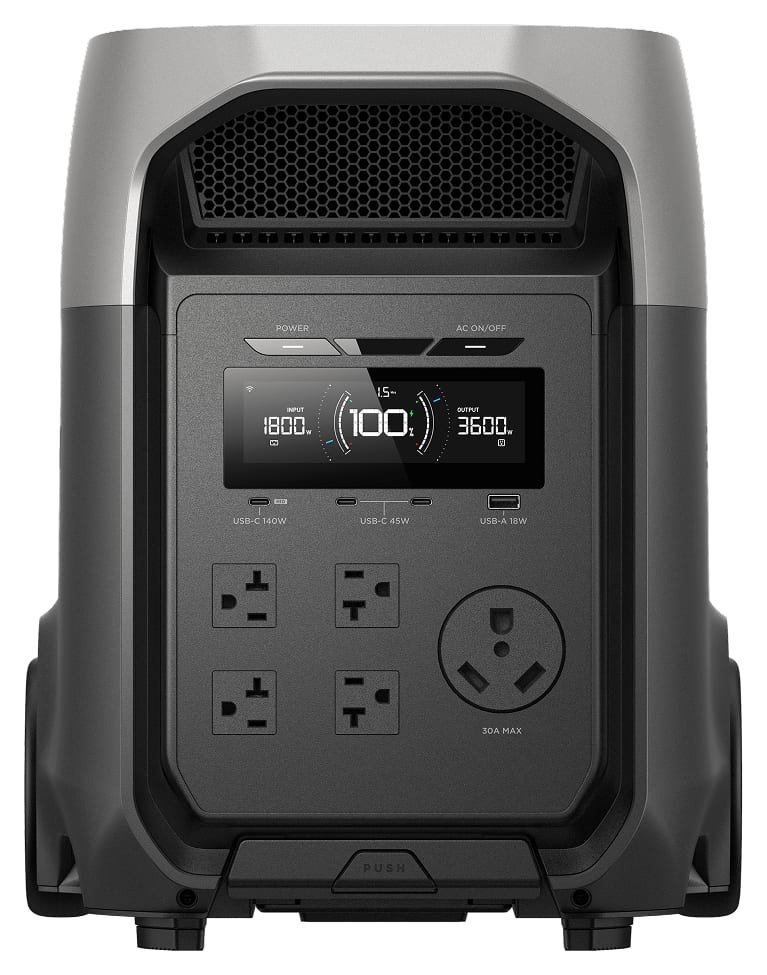
EcoFlow DELTA 3 Ultra: 3,072Wh · 3,600W continuous (7,200W surge) · 72.1 lb · 120V (30A outlet) · not listed (EcoFlow says 10 years) cycle rating
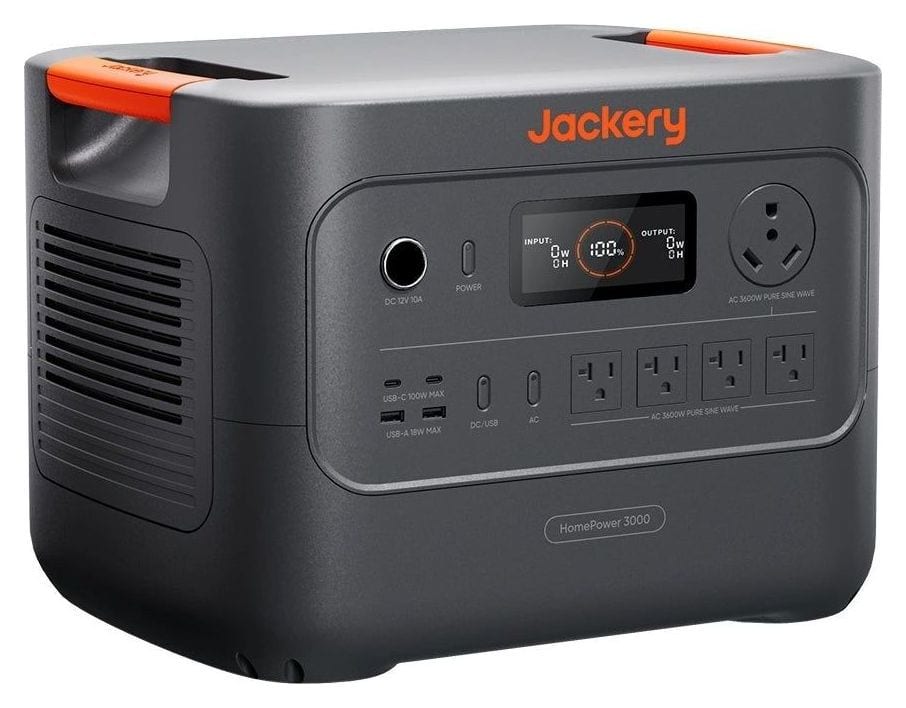
Jackery HomePower 3000: 3,072Wh · 3,600W continuous (7,200W surge) · 59.52 lb · 120V (30A outlet) · 4,000 to 70% cycle rating
This one is nearly a tie. Both are 3,072Wh, both deliver 3,600W continuous with a 7,200W surge, and both have a 30A outlet for an RV or a manual transfer switch. The Jackery is $20 cheaper ($439/kWh vs $446/kWh) and about 12.6 lb lighter at 59.5 lb.
The DELTA 3 Ultra is the more flexible unit. EcoFlow lists expansion to 11 kWh with two DELTA Pro 3 extra batteries and quotes under 10 ms UPS switchover. Jackery lists the HomePower 3000 in its Standard (non-expandable) series and quotes about 20 ms. If you think you'll want more capacity later, pay the extra $20 for the EcoFlow. If you just want a 3 kWh box for the fridge, freezer and Wi-Fi, the Jackery is lighter to carry out of the closet.
Home backup: DELTA Pro 3 vs Explorer 5000 Plus
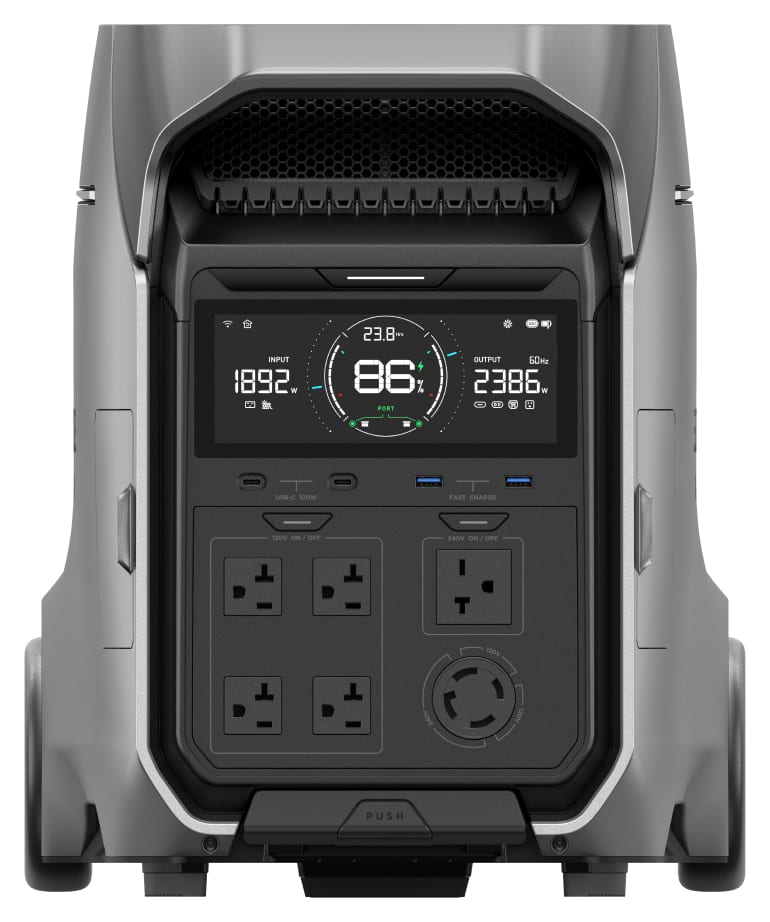
EcoFlow DELTA Pro 3: 4,096Wh · 4,000W continuous (8,000W surge) · 113.5 lb · 120/240V · 4,000 to 80% cycle rating
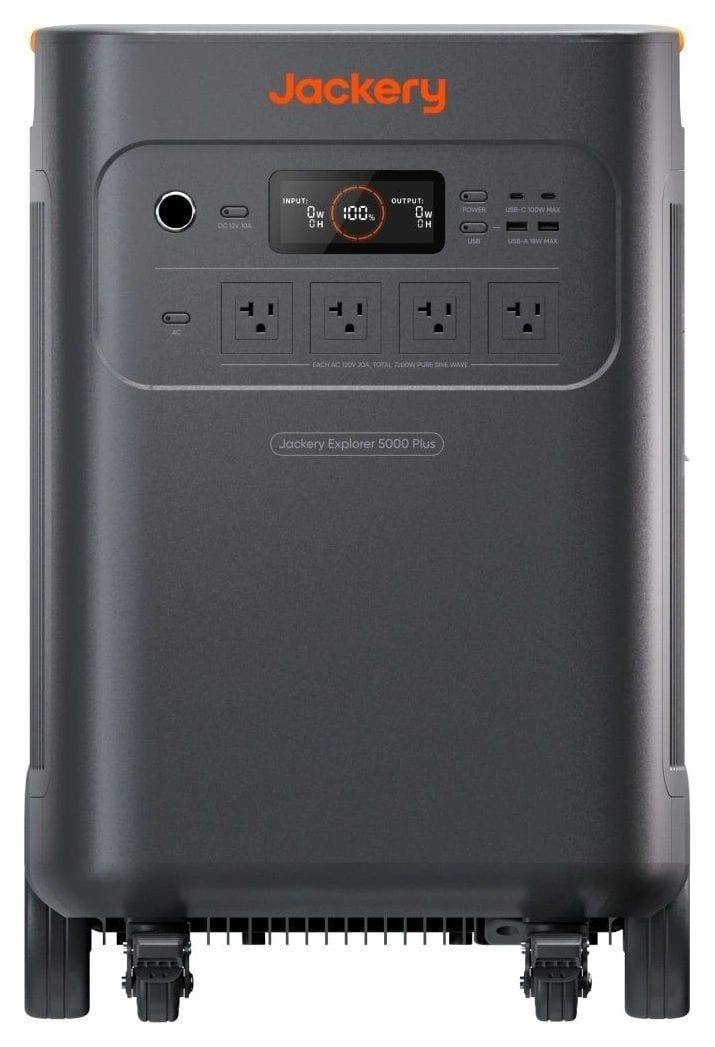
Jackery Explorer 5000 Plus: 5,040Wh · 7,200W continuous (14,400W surge) · 134.5 lb · 120/240V · 4,000 to 70% cycle rating
These are the first units in each lineup that put out both 120V and 240V, so they can run a well pump, a central AC or a dryer through a transfer switch. The Explorer 5000 Plus wins on paper: $350 more money buys 5,040Wh vs 4,096Wh and 7,200W vs 4,000W continuous. That's $625/kWh vs $683/kWh, and far less per watt of output ($0.44 vs $0.70). Jackery says it expands to 60 kWh.
The DELTA Pro 3 is the easier one to live with. It weighs 113.5 lb to the Jackery's 134.5 lb, rolls on wheels, expands to 12 kWh per unit (up to 48 kWh in a system), and EcoFlow lists it as UL 9540 certified. EcoFlow also rates 4,000 cycles to 80% vs Jackery's 4,000 to 70%. When we checked, the DELTA Pro 3 was shipping in late September. If you're planning bigger whole-home backup, see our EcoFlow DELTA Pro Ultra X review and our DELTA Pro extra battery review.
Everything else, side by side
| EcoFlow | Jackery | |
|---|---|---|
| Battery chemistry | LiFePO4 (LFP) across the models we compared | LiFePO4 (LFP) across the models we compared |
| Cycle rating | 4,000 cycles to 80% (DELTA 3 Plus, DELTA Pro 3); not listed for DELTA 3 Max/Ultra | 4,000 cycles to 70% (all four models) |
| Warranty | 5 years: 3-year standard + 2-year extension when you register in the EcoFlow app | 5 years: 3 years + 2 extra years, only when bought at jackery.com |
| Returns | 30 days from receipt, complete and in original packaging | 30 days from receipt for jackery.com orders |
| UPS switchover | Under 10 ms (1-3 kWh units), 10 ms (DELTA Pro 3) | About 20 ms (2-3 kWh units); 0 ms online UPS on the 5000 Plus |
| Heaviest unit here | DELTA Pro 3, 113.5 lb | Explorer 5000 Plus, 134.5 lb |
| App | Yes (Wi-Fi/Bluetooth), with time-of-use and storm alerts | Yes, the Jackery App (battery level, charging, time-of-use on the 5000 Plus) |
One note on cycle ratings: 4,000 cycles to 80% is a stronger claim than 4,000 cycles to 70%, but both are the makers' own lab figures. At one full cycle a day, 4,000 cycles is about 11 years. Most backup users will cycle far less than that.
Where Jackery wins
- More battery per dollar at 1 kWh, 3 kWh and home backup.
- Lighter at 1, 2 and 3 kWh: 23.8, 39.5 and 59.5 lb vs 27.6, 44.8 and 72.1 lb.
- The Explorer 5000 Plus: 7,200W at 120/240V for $3,149 is a lot of power for the money.
- In stock now at every size we compared.
Where EcoFlow wins
- The 2 kWh class: the DELTA 3 Max is cheaper and more powerful than the Explorer 2000 v2.
- More output at 1 kWh: 1,800W vs 1,500W.
- Faster switchover: under 10 ms on its 1-3 kWh units.
- Expandability at 1 and 3 kWh, and a stronger 80% cycle rating where it's published.
- A lighter home-backup unit: the DELTA Pro 3 is 21 lb lighter than the Explorer 5000 Plus.
EcoFlow: pros
- + DELTA 3 Max is the best 2 kWh value here
- + More continuous output at 1 and 2 kWh
- + Under-10 ms UPS switchover on its 1-3 kWh units
- + Expandable DELTA 3 Plus and DELTA 3 Ultra
- + 4,000 cycles to 80% rating (DELTA 3 Plus, DELTA Pro 3)
EcoFlow: cons
- − Costs more per kWh at 1 kWh and home backup
- − DELTA 3 Plus was pre-order only (ships November)
- − Heavier at 1, 2 and 3 kWh
- − Full 5-year warranty needs app registration
Jackery: pros
- + Cheaper per kWh in three of four size classes
- + Lighter at 1, 2 and 3 kWh
- + Explorer 5000 Plus: 7,200W at 120/240V
- + Everything we compared was in stock
Jackery: cons
- − 4,000 cycles rated to 70%, not 80%
- − About 20 ms switchover on the 2-3 kWh units
- − HomePower 3000 isn't expandable
- − 5-year warranty only when bought at jackery.com
Which should you buy?
For camping, tailgates and a small outage kit (about 1 kWh): the Jackery Explorer 1000 v2 at $559 is the better value and it's lighter. Pick the EcoFlow DELTA 3 Plus if you need 1,800W for a microwave or coffee maker, or you want to add batteries later.
For a fridge-and-freezer outage plan (about 2 kWh): the EcoFlow DELTA 3 Max. It's cheaper than the Jackery and more powerful.
For a 3 kWh unit: it's a coin flip on price. Buy the Jackery HomePower 3000 to save $20 and 12 lb. Buy the EcoFlow DELTA 3 Ultra if you might expand to 11 kWh.
For 240V home backup: the Jackery Explorer 5000 Plus gives you more capacity and nearly twice the output for $350 more. The EcoFlow DELTA Pro 3 is the lighter, more modular choice. Either way, have a licensed electrician install the transfer switch.
Still deciding between brands? Our 15 best portable power stations of 2026 covers more models.
Frequently asked questions
Is EcoFlow or Jackery better?
Neither wins everywhere. On price per kWh, Jackery was cheaper at 1 kWh, 3 kWh and home backup when we checked, and EcoFlow was cheaper at 2 kWh. EcoFlow generally gives you more output and faster switchover at the smaller sizes. Jackery's units are lighter at 1-3 kWh.
Which is cheaper per kWh, EcoFlow or Jackery?
Jackery in three of our four matched size classes: $522/kWh vs $653/kWh at 1 kWh, $439/kWh vs $446/kWh at 3 kWh, and $625/kWh vs $683/kWh for 120/240V home backup. EcoFlow's DELTA 3 Max was cheaper at 2 kWh, $429/kWh vs $440/kWh. Both brands change sale prices often.
Do EcoFlow and Jackery use the same battery type?
Yes. Every model we compared uses LiFePO4 (lithium iron phosphate) cells. EcoFlow rates 4,000 cycles to 80% capacity on the models where it publishes a figure. Jackery rates 4,000 cycles to 70%.
What warranty do EcoFlow and Jackery offer?
Both offer 5 years, with a catch. EcoFlow gives 3 years standard plus 2 more when you register in its app. Jackery gives 3 years plus 2 extra only when you buy directly from jackery.com.
Can either one power my whole house?
Not the 1-3 kWh units, which are 120V only. The DELTA Pro 3 and Explorer 5000 Plus both put out 120V and 240V and can back up home circuits through a transfer switch. Jackery says the 5000 Plus can run up to a 5-ton AC. For longer whole-home backup you'd add battery packs or step up to a bigger system like EcoFlow's DELTA Pro Ultra X.
What's the return policy?
Both give you 30 days from delivery on orders from their own sites. EcoFlow requires the product complete in its original packaging. Jackery's 30-day policy applies to orders placed on jackery.com.
The bottom line
EcoFlow vs Jackery comes down to size. Jackery gives you more battery per dollar at 1 kWh, 3 kWh and home backup, and its units are lighter to carry. EcoFlow's DELTA 3 Max is the best buy at 2 kWh, and EcoFlow's smaller units put out more power and switch over faster. Pick the size you need first, then buy the brand that wins that class. Both are solid, LiFePO4-based choices with 5-year warranties when you buy direct.
Talk soon,
OSS AMERICA
God · Family · Country · Gear that earns its keep.
Advertisement
FTC Disclosure: OSS America contains affiliate links. We earn a commission from qualifying purchases at no extra cost to you — we only point you at gear we'd stake our own trip on.
More reviews
 Portable Power
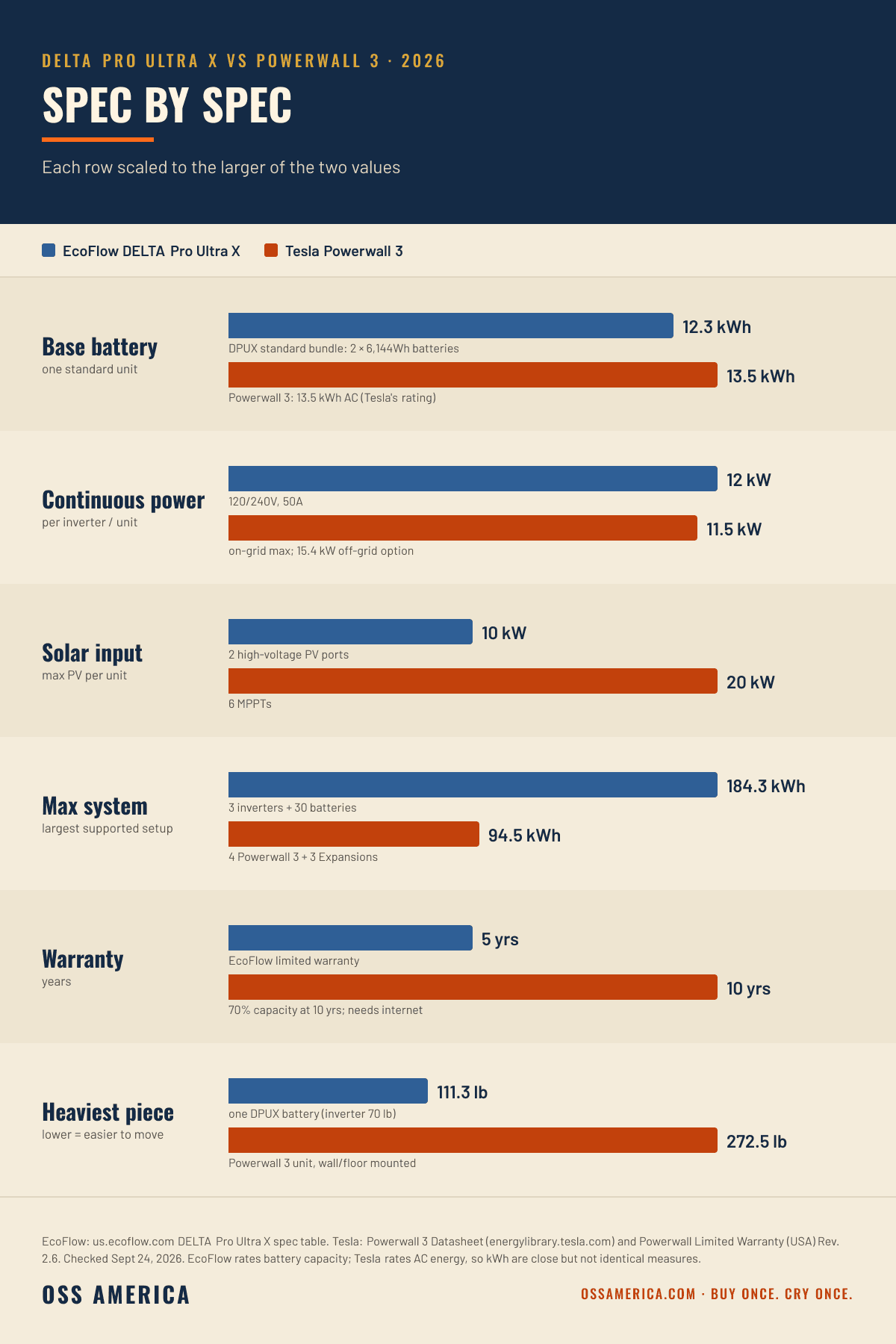
EcoFlow DELTA Pro Ultra X vs Tesla Powerwall 3 (2026): Which Home Battery Fits Your House?
EcoFlow DELTA Pro Ultra X vs Tesla Powerwall 3, compared from the makers' own specs: capacity, power, solar input, expansion, warranty, weight, installation, pricing and the 2026 tax-credit reality.
 Portable Power
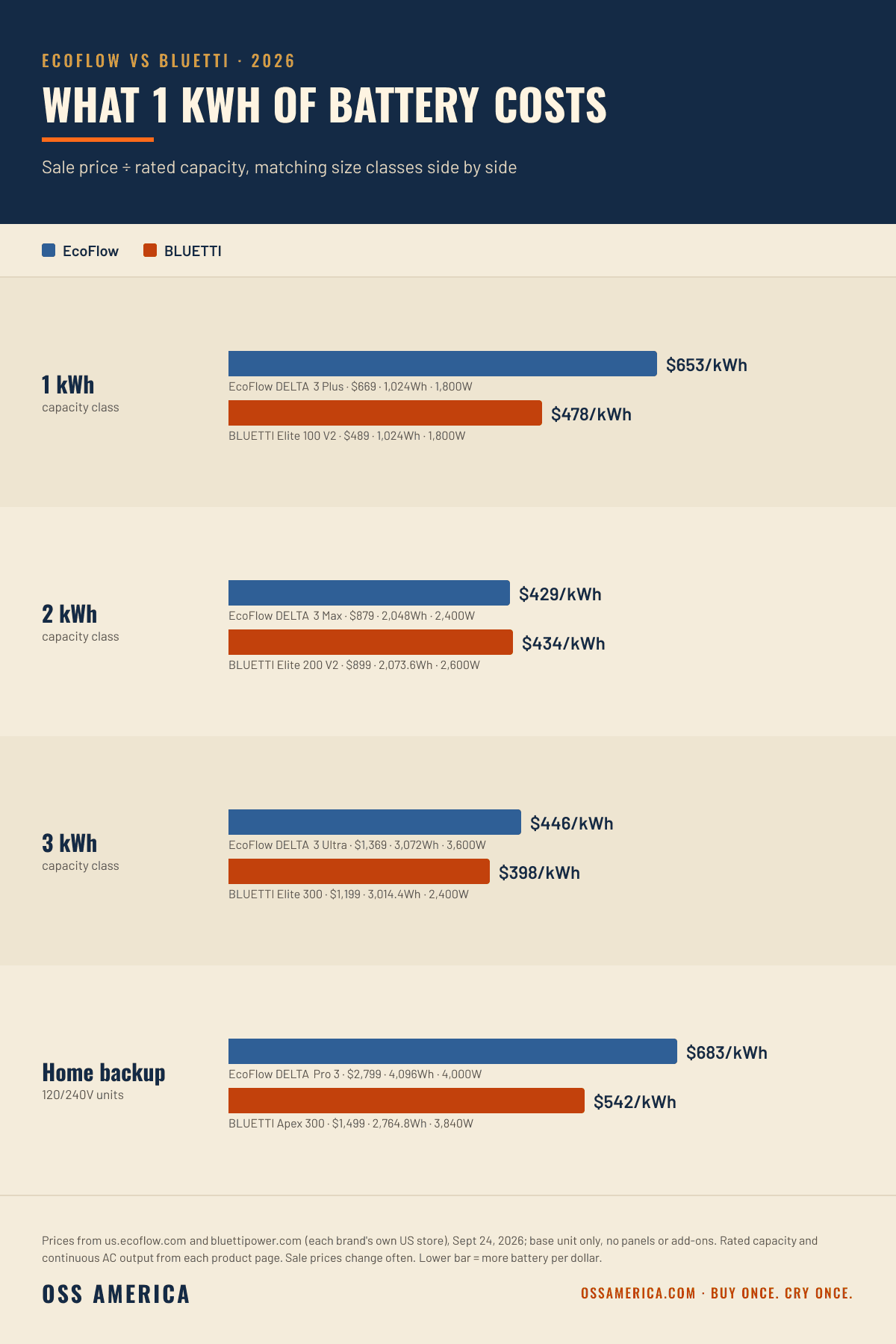
EcoFlow vs BLUETTI (2026): Which Power Station Gives You More for Your Money?
EcoFlow vs BLUETTI, compared size class by size class: price per kWh, output, weight, cycle ratings, warranty and returns for 1 kWh, 2 kWh, 3 kWh and 240V home backup units, plus which to buy.
 Portable Power
14 Best-Selling Home Power Products of 2026 (Not a Ranking)
Not a ranking — nobody won. Fourteen of the best-selling home power products on the market, with what each one actually does: the watts, the hours, the fuel, the install, and the honest limits. You decide which fits your house.
 Portable Power
Jackery Explorer 1000 v2 Review — The Honest Take (2026)
The Jackery Explorer 1000 v2 is one of the best portable power stations we've researched — but not for everyone. What it does great, where it falls short, and how it compares to EcoFlow, BLUETTI and Anker.
 Portable Power
The 15 Best Portable Power Stations of 2026 — Ranked for Camping, RV, and Home Backup
We researched 15 portable power stations across 5 use-case tiers — whole-home backup, off-grid RV, overlanding, camping, and solar — with picks for every budget from $400 to $5,000.
 Top PickPortable Power
16 Best Solar Generators For 2026
Sixteen solar generators, from budget LiFePO4 units to whole-home systems, counted down from #16 to #1 with the specs that matter and who each one suits.