
Jackery Explorer 1000 v2 Review — The Honest Take (2026)

Advertisement
Portable power stations went from RV-owner curiosity to essential American gear in about five years. What changed: LiFePO4 (lithium iron phosphate) batteries got cheaper and safer, inverters got more efficient, and the "off-grid weekend" market took off. Every serious outdoor brand now sells one. Most are noise. A few are the real deal.
The Jackery Explorer 1000 v2 is one of the real ones — and this review is going to tell you exactly why + where it falls short + who should buy something else. No fluff, no hype. If it sucked, we'd say it sucked. It doesn't suck. It's the honest first-buy for anyone building a serious portable-power kit for camping, RV, blackout, or truck-bed job use.
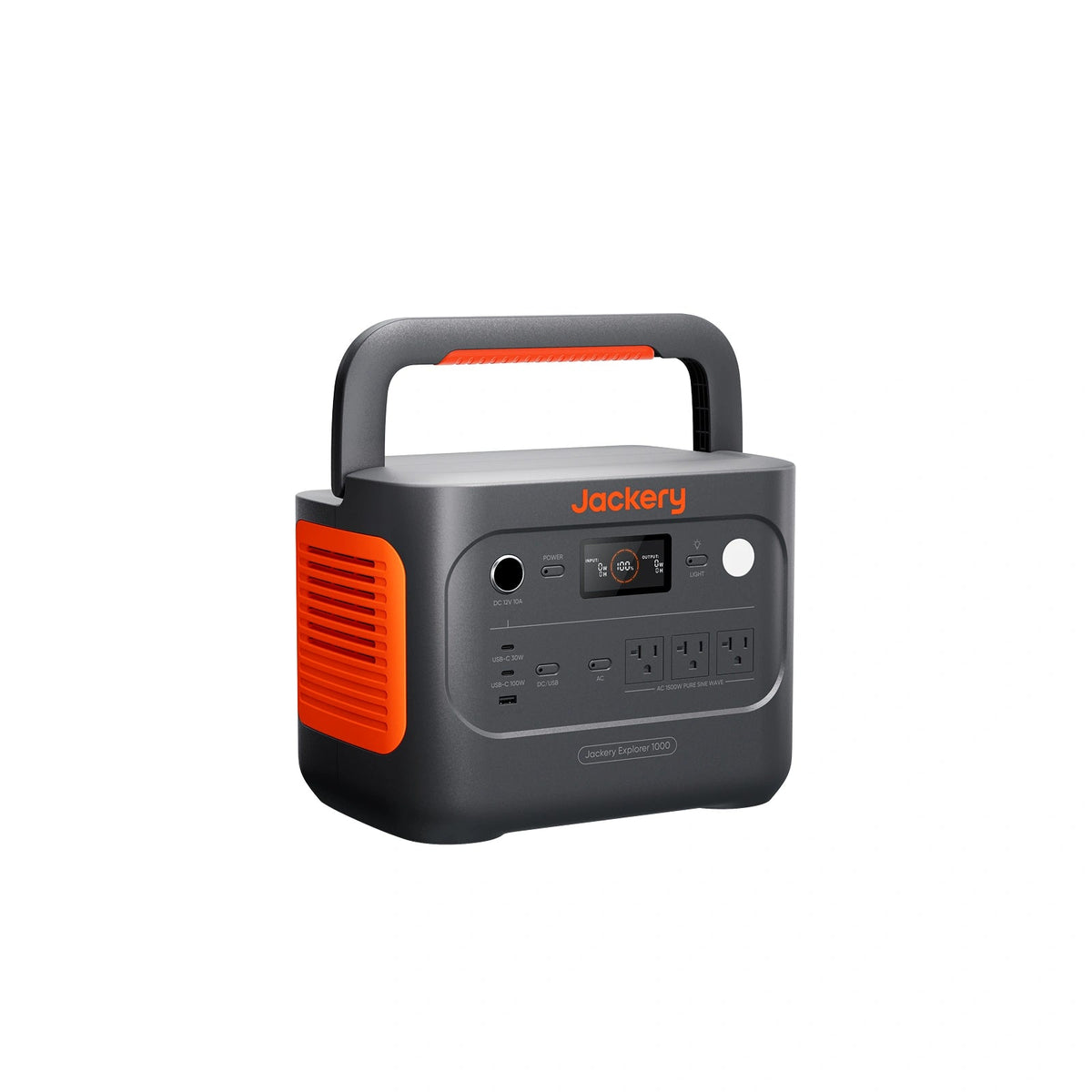
👉 Check current price on Amazon
🏆 The Quick Verdict (skip the whole review)
Best for: First-time portable power buyers who need real 1,000+ watt-hour capacity without dropping $2,000. Camping, small RV, weekend blackout, mobile job site, van build starter kit.
Skip if: You need to power a full RV air conditioner all night (need 2,000Wh+), or you'll use it as your primary home battery backup (get the 2000+ series with expandable capacity).
Best price right now: ~$549 direct from Jackery, or check the current listing at Amazon. Save the $80 with the Prime Store Card offer if you have it.
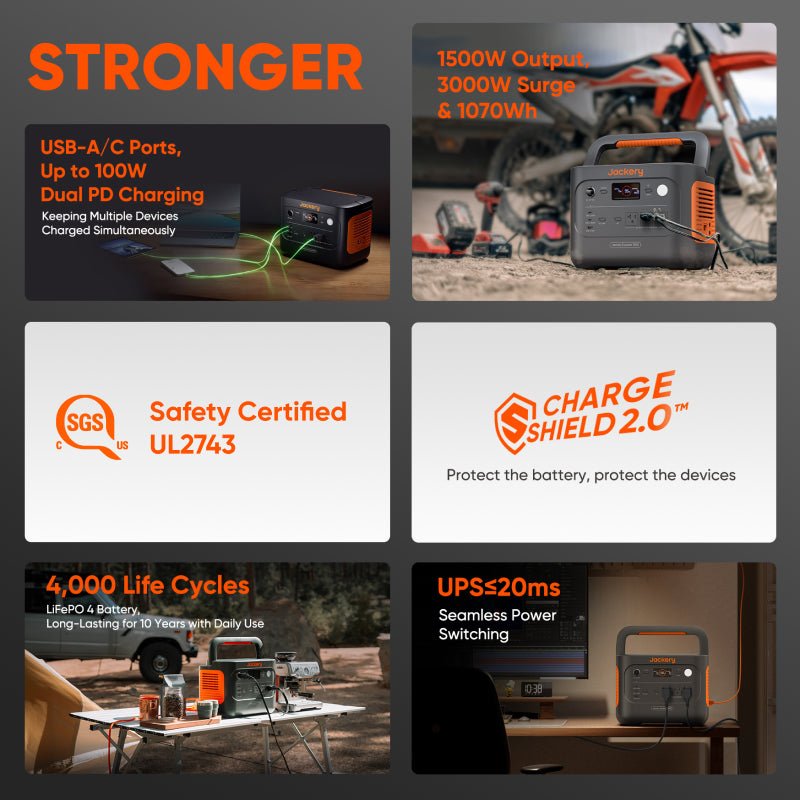
Bottom line: If you own zero portable power today and want the strongest single-unit purchase for your first ~$600, this is it. LiFePO4 chemistry means 10-year lifespan, 1-hour full recharge is genuinely fast, and the 1,500W inverter runs everything short of a hair dryer.
What You're Actually Buying
The Explorer 1000 v2 is Jackery's second-generation 1,000-watt-hour class portable power station. "Second generation" is meaningful here — the original Explorer 1000 (2020) used lithium-ion NMC chemistry with a 500-cycle lifespan. The v2 is a full LiFePO4 rebuild with a 4,000-cycle lifespan (10+ years at one full cycle per day) at almost the exact same price point. That's the story most reviewers bury — this isn't the old Explorer 1000 with a sticker change. It's a fundamentally different product using the battery chemistry the industry standardized on in 2024-2025.
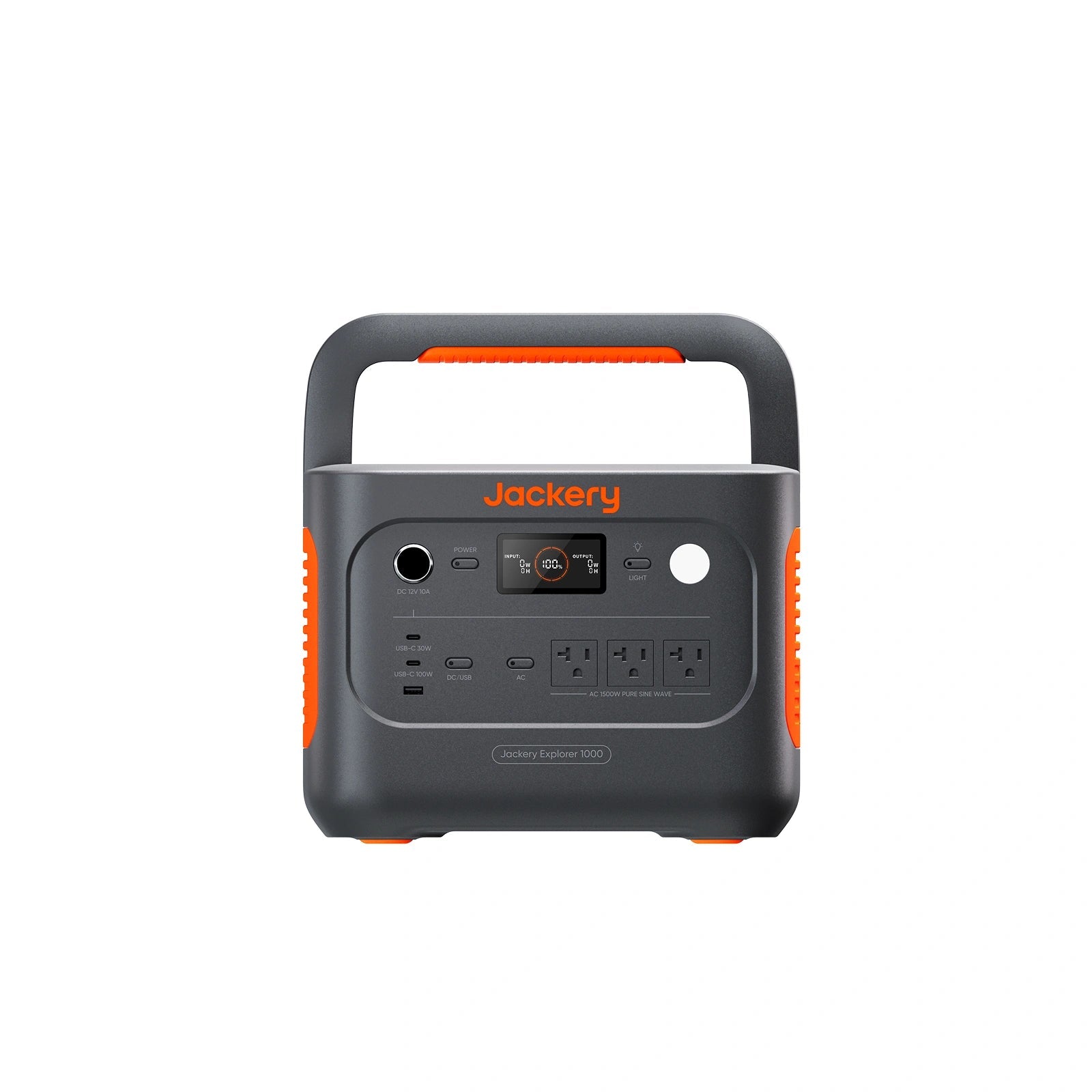
The specs that matter
Battery capacity: 1,070 Wh (LiFePO4)
AC output: 1,500W continuous / 3,000W surge (pure sine wave)
Number of AC outlets: 3 (all 120V standard US)
USB-C ports: 100W Power Delivery + 100W PD (two total, both fast-charge capable)
USB-A ports: 2 (standard 15W)
Car outlet: 1 (12V, 10A)
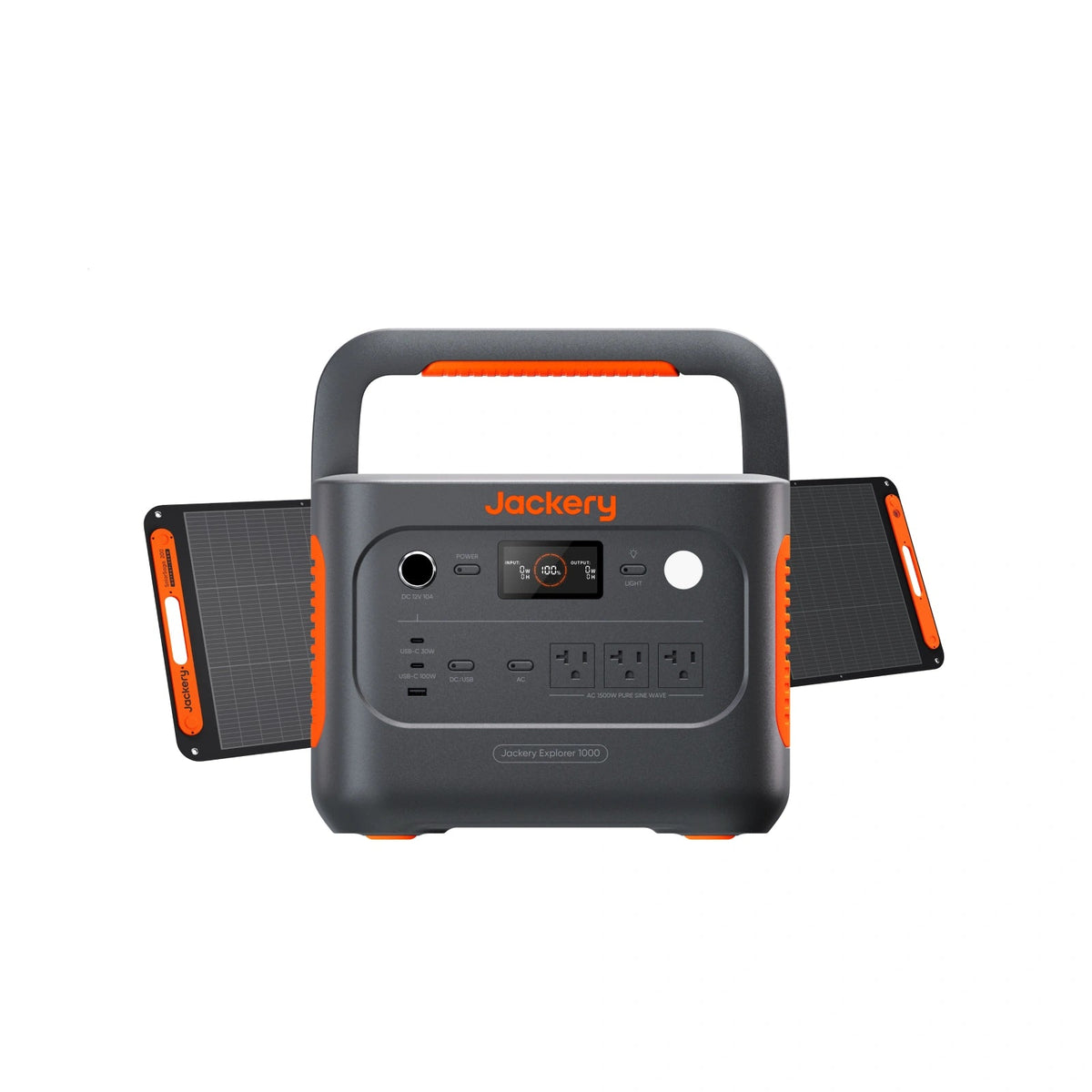
Solar input: Up to 400W (compatible with Jackery SolarSaga 100W/200W panels)
Fast AC charge time: 1 hour to 100% (via included charger)
Weight: 23.8 lbs (10.8 kg)
Dimensions: 12.6" × 8.7" × 10.1"
Warranty: 5 years (Jackery direct — one of the longest in the category)
Chemistry: LiFePO4 (lithium iron phosphate) — 4,000-cycle rated lifespan
UPS mode: Yes — 20ms switchover for uninterrupted power backup
App control: Jackery app (iOS + Android) via Bluetooth 5.0 + WiFi
What actually runs on it (estimated run times, 1,070 Wh)
65W laptop: ~14 hours
Full-size refrigerator (150W avg): ~6 hours
Portable CPAP (30W): ~30 hours (2-3 nights)
Starlink dish (50W): ~18 hours
65" LED TV (100W): ~9 hours
Coffee maker (900W, one pot): ~4-5 pots
Space heater (1,500W): ~35-40 minutes (this is the limit — heaters are the enemy of portable power)
Chest freezer (85W avg): ~10 hours
Electric blanket (100W): ~9 hours
Why LiFePO4 chemistry is the whole ballgame
The single biggest difference between a great portable power station and a mediocre one in 2026 is battery chemistry. Two options exist:
NMC lithium (older): Lighter, cheaper, higher energy density per pound. Downside: 500-800 cycle lifespan before capacity drops below 80%, thermal runaway risk in heat, degrades faster in cold. This is what powered the original Jackery, Anker, and most sub-2024 units.
LiFePO4 lithium iron phosphate (current): Heavier per watt-hour, slightly more expensive. Upside: 4,000-6,000 cycle lifespan (10+ years at daily use), inherently stable chemistry (won't thermal-runaway), performs better in temperature extremes. This is what serious brands standardized on in 2024-2025.
Practical translation: a Jackery Explorer 1000 v2 charged and discharged once every single day would still be at 80%+ capacity 10 years from now. An old NMC unit doing the same job would be at 60% capacity in 18-24 months. If you're keeping this thing in a truck bed or RV for a decade, LiFePO4 isn't a nice-to-have — it's the difference between "still works" and "dead brick." The Explorer 1000 v2's 5-year warranty (vs. the industry-standard 2 years) is Jackery putting their money where the chemistry is.
What it can realistically run — the scenario math
Here's how the Explorer 1000 v2's specs work out in the scenarios you'll actually use it in. These are estimates from the 1,070Wh capacity and typical load figures, not our own test results:
Car camping: A 12V fridge that pulls 25-40W while its compressor runs, plus LED string lights and phone/tablet charging, is a light load. At an average draw around 30W, 1,070Wh works out to roughly 30+ hours before you count any solar. Add laptop work and that number comes down.
Home blackout: A full-size fridge (150W avg), a gas furnace blower fan (60W when on) and a CPAP (30W) together pull up to about 240W, which works out to roughly 4-5 hours. The fridge alone gets you about 6 hours. Skip the coffee maker and heat.
Truck-bed job site: A 12" miter saw (1,200W spikes) or circular saw (1,400W spikes) fits inside the 1,500W continuous rating, one tool at a time, and the 3,000W surge rating is what's built to handle tool start-ups — that's the specific spec that separates real work-capable units from consumer toys.
RV overnight: An RV fridge converted to 12V (45W avg) alone works out to roughly 20 hours. Add interior lights, phone charging and a small heater running intermittently and it drops fast — heaters are the enemy of portable power.
Where it falls short: a portable AC unit (5,000 BTU, ~500W continuous) works out to about 2 hours at best, less once inverter losses are counted. If you need to power AC, you need the Jackery Explorer 2000 series or bigger.
Honest cons — what nobody else will tell you
Every review post glosses over the negatives to protect affiliate commissions. Here's the honest list:
The fan is loud under heavy load. Under 500W continuous, it's silent. Above 1,000W, the internal fan spins up audibly — think small window AC. For camping, not an issue. For blackout in a bedroom, you'll hear it.
The 1,500W inverter WILL trip on some hair dryers. Hair dryers commonly draw 1,600-1,800W. The 3,000W surge handles the startup spike but sustained draw above 1,500W triggers protection. Not a design flaw — a spec limit. Just know it.
The app is fine, not great. Bluetooth pairing works reliably; WiFi is spottier depending on your home network. The app shows battery percentage, output wattage, and time-to-empty. It does NOT let you schedule loads, program EcoFlow-style. If you need advanced app control, EcoFlow's ecosystem is more mature.
No expansion battery on this specific model. The Explorer 1000 v2 is a self-contained unit — you can't daisy-chain a second battery to double capacity. If future-expansion matters to you, look at the Explorer 2000 Plus or the EcoFlow River 3 Max.
Solar charging is real but slow with the base panels. Jackery advertises up to 400W solar input, but the SolarSaga 100W panel that ships in the "Solar Kit" bundle only delivers ~80W in ideal midday sun. You'd need 4 panels running in perfect conditions to hit the 400W cap. Real-world solar recharge from 20% → 100% with one 200W panel: 6-8 hours of good sun.
How it stacks up vs the 3 real competitors
Feature | ||||
|---|---|---|---|---|
Capacity | 1,070 Wh | 288 Wh (smaller class) | 1,152 Wh | 1,056 Wh |
AC output | 1,500W / 3,000W surge | 600W / 1,200W surge | 1,800W / 2,700W surge | 1,800W / 2,400W surge |
Battery chemistry | LiFePO4 (4,000 cycles) | LiFePO4 (3,000 cycles) | LiFePO4 (3,500 cycles) | LiFePO4 (3,000 cycles) |
Fast AC charge time | 1 hour | 1 hour | 1.5 hours | 58 minutes |
Weight | 23.8 lbs | 10.6 lbs | 37 lbs | 28.4 lbs |
Warranty | 5 years | 5 years | 5 years | 5 years |
Current price | ~$549 | ~$399 (smaller class) | ~$799 | ~$599-799 |
Who wins the head-to-heads
Jackery 1000 v2 vs. EcoFlow River 3 Max: These aren't the same class. The River 3 Max is a smaller 288Wh unit — half the capacity, one-third the output. The Jackery is the direct competitor to EcoFlow's DELTA 2 (1,024Wh), which retails ~$799. On a straight capacity-per-dollar basis, the Jackery at $549 vs. the EcoFlow DELTA 2 at $799 is a genuine value delta.
Jackery 1000 v2 vs. BLUETTI AC180: The AC180 has more capacity (1,152 vs 1,070 Wh) and higher AC output (1,800 vs 1,500W). But it costs $250 more, weighs 13 pounds more, and BLUETTI's app + customer support ranks lower in third-party reviews. For most buyers, the extra capacity isn't worth the price + weight penalty. If you specifically need to run 1,600-1,800W loads sustainably (small AC units, larger power tools), the AC180 wins on spec. For everything else, the Jackery wins on value.
Jackery 1000 v2 vs. Anker SOLIX C1000: The closest direct competitor. Anker has slightly higher AC output (1,800W), 58-minute fast charge (vs Jackery's 1 hour — essentially identical). Anker's app ecosystem is more mature. But Anker's price ranges $50-250 higher depending on sales. Jackery has 4,000 cycles vs Anker's 3,000, and Jackery's US-based service network is deeper. Real coin flip — buy whichever is cheaper on the day you're shopping.
Who this is really for (and who should skip it)
Buy the Jackery Explorer 1000 v2 if you:
Own zero portable power today and want the strongest single-unit first purchase
Camp 5-15 times per year and need to power essentials without generator noise
Live in a hurricane, wildfire, or ice-storm-prone region and want reliable overnight blackout backup
Work as a contractor, mobile mechanic, or field tech and need a truck-bed power source
Are building out a van or small RV and want a proven battery unit as the core
Value 5-year warranty + established US service network (Jackery has been in North America since 2012)
Skip the Jackery Explorer 1000 v2 and buy bigger if you:
Need to power a full RV AC unit for more than 90 minutes → get the Explorer 2000 Plus
Want whole-home blackout backup (fridge + furnace + freezer + lighting for 24+ hours) → get 2000Wh+
Plan to run a full workshop off it (multiple simultaneous tools) → get 2000Wh+ with 3,000W+ inverter
Want expandable capacity for future growth → look at units with expansion batteries
Skip the Jackery Explorer 1000 v2 and buy smaller if you:
Only need to keep phones + laptops running during short outages → get a 300-500Wh unit for $200-300
Won't camp with it and won't have a blackout use case → don't buy portable power at all, get a UPS for your desk
The Bottom Line
The Jackery Explorer 1000 v2 is the honest answer for anyone whose first portable power purchase needs to actually WORK. It's not the cheapest unit at the 1,000Wh capacity level, and it's not the highest-capacity unit at $549. But it hits the specific intersection of: real capacity, real inverter output, real LiFePO4 lifespan, real warranty, and a real US service network — at a price that makes the math work for a serious first buy.
If we're being honest: the marketing hype in this category is exhausting. Everyone claims their power station is "revolutionary." The Jackery Explorer 1000 v2 isn't revolutionary. It's competent, honest, and reliable — which in a market drowning in Amazon-brand knockoffs and inflated spec sheets is more valuable than "revolutionary" anyway. This is the unit we'd hand someone who wants to buy ONE thing and not have to think about it for a decade.
👉 Check current price on Amazon →
Direct from Jackery. 5-year warranty registration handled at checkout. Free US shipping.
FAQ — the questions everyone actually asks
How long will the battery actually last before needing replacement?
At Jackery's rated 4,000-cycle spec, the battery will still be at 80%+ capacity after 4,000 full charge-discharge cycles. If you cycle it every single day, that's ~11 years. If you cycle it weekly (typical camping use), it's a 75+ year lifespan (you'll die before the battery does — the unit fails from something else first). Realistic answer: 10-15 years of hard use, 20+ years of casual use.
Can I run a CPAP overnight on this?
Yes. A typical CPAP draws 30-60W. The Explorer 1000 v2's 1,070 Wh capacity gives you 18-35 hours of runtime on a CPAP — 2-3 nights of use per charge. If you use a heated humidifier attachment, cut that in half. This is one of the most common purchase drivers.
Can I charge it while using it?
Yes — pass-through charging is supported. Plug it into wall power AND run devices off it simultaneously. Great for use as an emergency UPS on your home office setup.
Does it come with solar panels?
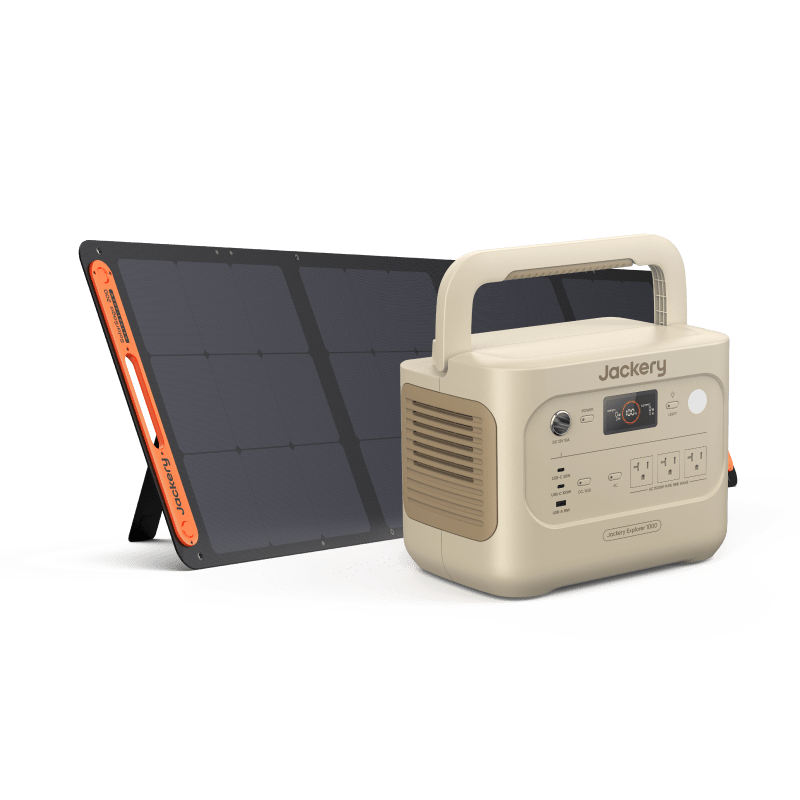
Not in the base package. The "Solar Generator" bundles include a 100W or 200W SolarSaga panel — those bundles cost $699 (with 100W panel) or $899 (with 200W panel). If you'll actually use solar, buy the 200W bundle; the 100W panel is too small to meaningfully recharge the unit in reasonable time.
Is Jackery a Chinese company?
Jackery was founded by former Apple engineers in California in 2012. The company is US-headquartered (Fremont, CA) with manufacturing operations in China (like nearly every consumer electronics brand). US customer service, US warranty processing, and US shipping all handled domestically.
Can I bring it on an airplane?
No. FAA rules cap lithium-ion carry-on batteries at 100Wh. The Explorer 1000 v2's 1,070Wh capacity is 10x over that limit. Ground transport only.
What happens if the unit fails during the warranty period?
Jackery's 5-year warranty is one of the longest in the category. In the event of a manufacturing defect, they'll repair or replace at no cost. Return shipping is covered by Jackery. Register the serial number at checkout to activate the warranty — takes 30 seconds.
→ Buy the Jackery Explorer 1000 v2 direct from Jackery ←
Disclosure: As a Jackery affiliate, OSS America earns a commission if you purchase through the links in this post — at zero extra cost to you. Buying through these links helps keep the lights on at ossamerica.com without a paywall. We only publish reviews of products we'd actually stake our own name on. If we thought this unit was a poor buy, we'd say so — see our honest cons section above.
Related: EcoFlow vs Jackery
Advertisement
FTC Disclosure: OSS America contains affiliate links. We earn a commission from qualifying purchases at no extra cost to you. Every pick is research-based: specs, verified prices and owner reviews.
More reviews
 Portable Power
EcoFlow DELTA Pro 3 Review (2026): Specs, Real Price, Owner Reviews and Rivals
An honest EcoFlow DELTA Pro 3 review: 4,096Wh, 4,000W, 120/240V, every bundle priced per kWh, what 69 owners say, the either/or 240V catch, and how it stacks up against the DELTA Pro Ultra and BLUETTI Apex 300.
 Portable Power
EcoFlow DELTA Pro Ultra X vs Tesla Powerwall 3 (2026): Which Home Battery Fits Your House?
EcoFlow DELTA Pro Ultra X vs Tesla Powerwall 3, compared from the makers' own specs: capacity, power, solar input, expansion, warranty, weight, installation, pricing and the 2026 tax-credit reality.
 Portable Power
EcoFlow vs BLUETTI (2026): Which Power Station Gives You More for Your Money?
EcoFlow vs BLUETTI, compared size class by size class: price per kWh, output, weight, cycle ratings, warranty and returns for 1 kWh, 2 kWh, 3 kWh and 240V home backup units, plus which to buy.
 Portable Power
EcoFlow vs Jackery (2026): Which Power Station Gives You More for Your Money?
EcoFlow vs Jackery, compared size class by size class: price per kWh, output, weight, cycle ratings, warranty and returns for 1 kWh, 2 kWh, 3 kWh and 240V home backup units, plus which to buy.
 Portable Power
14 Best-Selling Home Power Products of 2026 (Not a Ranking)
Not a ranking — nobody won. Fourteen of the best-selling home power products on the market, with what each one actually does: the watts, the hours, the fuel, the install, and the honest limits. You decide which fits your house.
 Portable Power
The 15 Best Portable Power Stations of 2026 — Ranked for Camping, RV, and Home Backup
We researched 15 portable power stations across 5 use-case tiers — whole-home backup, off-grid RV, overlanding, camping, and solar — with picks for every budget from $400 to $5,000.