
Essential Off-Grid Power Kit Review: Grid Doctor 3300 Plus a Power Bank for Home and Away

Most backup-power plans fail in one of two places. The first is the house: the fridge, the freezer, the Wi-Fi and the CPAP all quit at once, and a phone flashlight is not a plan. The second is everywhere else: the evacuation drive, the shelter, the hotel lobby, the truck, where the big battery stays behind and your phone dies at 8% right when you need the map.
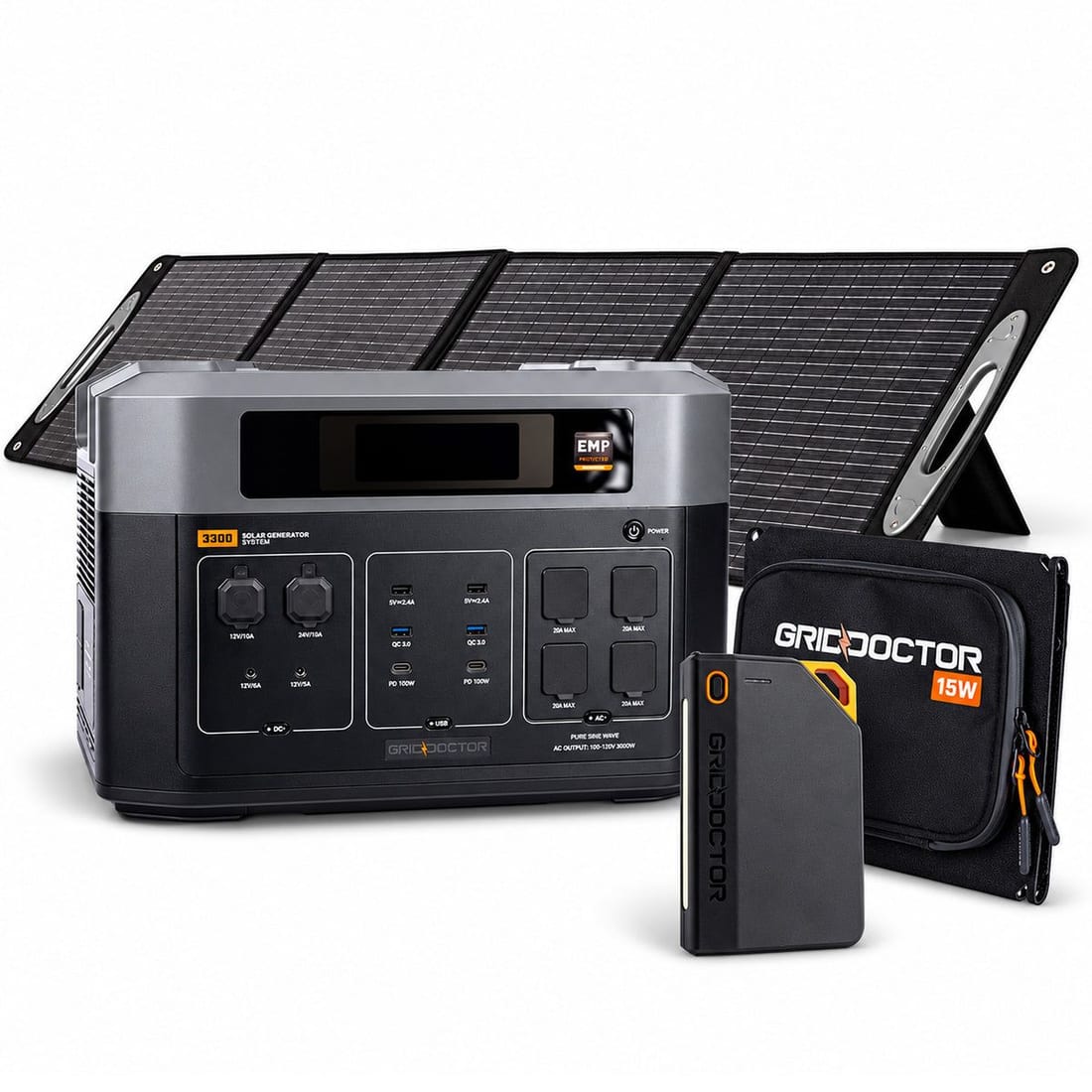
BePrepared's Essential Off-Grid Power Kit is built around that split. One box covers the house with the Grid Doctor 3300 and its 200 W solar panel. A pocket-size 65 W power bank with its own 15 W folding panel covers the road. Two batteries, two solar panels, two jobs. We did not test this kit. This guide is built from the maker's and BePrepared's published specs, the store's policies, the owner reviews and some honest math, so you can decide whether the kit is the right buy or whether you should build it yourself.
The short answer
A whole-home-essentials battery plus a grab-and-go charger, each with its own solar panel, for $3,116.90. It is the same price as buying the pieces separately, so you buy it for the complete setup, not for a discount.
- The kit: Grid Doctor 3300 (2,048 Wh, 3,300 W) + 200 W panel + 65 W power bank + 15 W panel, $3,116.90 with free shipping. See the kit →
- At home: keeps a full-size fridge going about 29 hours on one charge by our estimate, a CPAP about 44 hours.
- Away: the 75 Wh power bank refills a typical phone about 4 times and weighs 16.7 oz.
- Just the big unit: the Grid Doctor 3300 system alone is $2,997. See the 3300 →
- Skip it if: you need 240 V (well pump, central air) or a whole-house backup.
Why a two-battery kit makes sense
A 57 lb power station is a home tool. You set it up in the kitchen or the garage, plug the fridge in and leave it. It is not what you carry into a shelter or toss in a go-bag. A power bank is the opposite: light, always charged, always with you, but far too small to keep food cold.
The kit pairs the two so you are not choosing. BePrepared's own pitch says it plainly: the 3300 and 200 W panel power "household essentials," while the compact power bank keeps directions, a laptop and that "we got here safely" call going away from home. Because each battery has its own panel, a cloudy week does not force you to choose between charging the fridge and charging the phones.
How we judged it
OSS America did not test this kit. We read BePrepared's product page, specifications and policies, Grid Doctor's published specs, and every owner review shown on the kit page, then ran our own runtime and solar math from the rated numbers. Where a claim comes from the maker or the store, we say so. Prices and stock were checked on November 6, 2026.
The kit vs. buying the pieces
We added it up. The kit costs exactly what its parts cost on BePrepared's site: the Grid Doctor 3300 system at $2,997 plus the 65 W power bank with 15 W panel at $119.90 (the bank is $69.95 alone and the 15 W panel $49.95 alone). There is no bundle discount, but there is also no markup, and you get one order and one box of matched gear.
| Setup | What you get | Price (Nov 6) | Best for |
|---|---|---|---|
| Essential Off-Grid Power Kit | 3300 + 200 W panel + 65 W power bank + 15 W panel | $3,116.90 | Families who want home backup and a grab-and-go charger |
| Grid Doctor 3300 system | 3300 + 200 W panel + cables | $2,997 | You already own a good power bank |
| 3300 system + second 200 W panel | 3300 + two 200 W panels | $3,444 | Long outages where solar has to carry the fridge |
| Kit + second 200 W panel | Everything above plus a second 200 W panel | $3,563.90 | The full setup: home, road and faster solar |
| 65 W power bank + 15 W panel only | Power bank + 15 W panel | $119.90 | Go-bags, trucks, travel and phones only |
Prices from beprepared.com on November 6, 2026. BePrepared ships free on orders over $299 to the lower 48.
What one full charge covers
The two batteries work on very different scales, so we charted them separately. After conversion losses (we assume about 85%), the 3300 gives you roughly 1,741 Wh to spend and the power bank roughly 64 Wh.
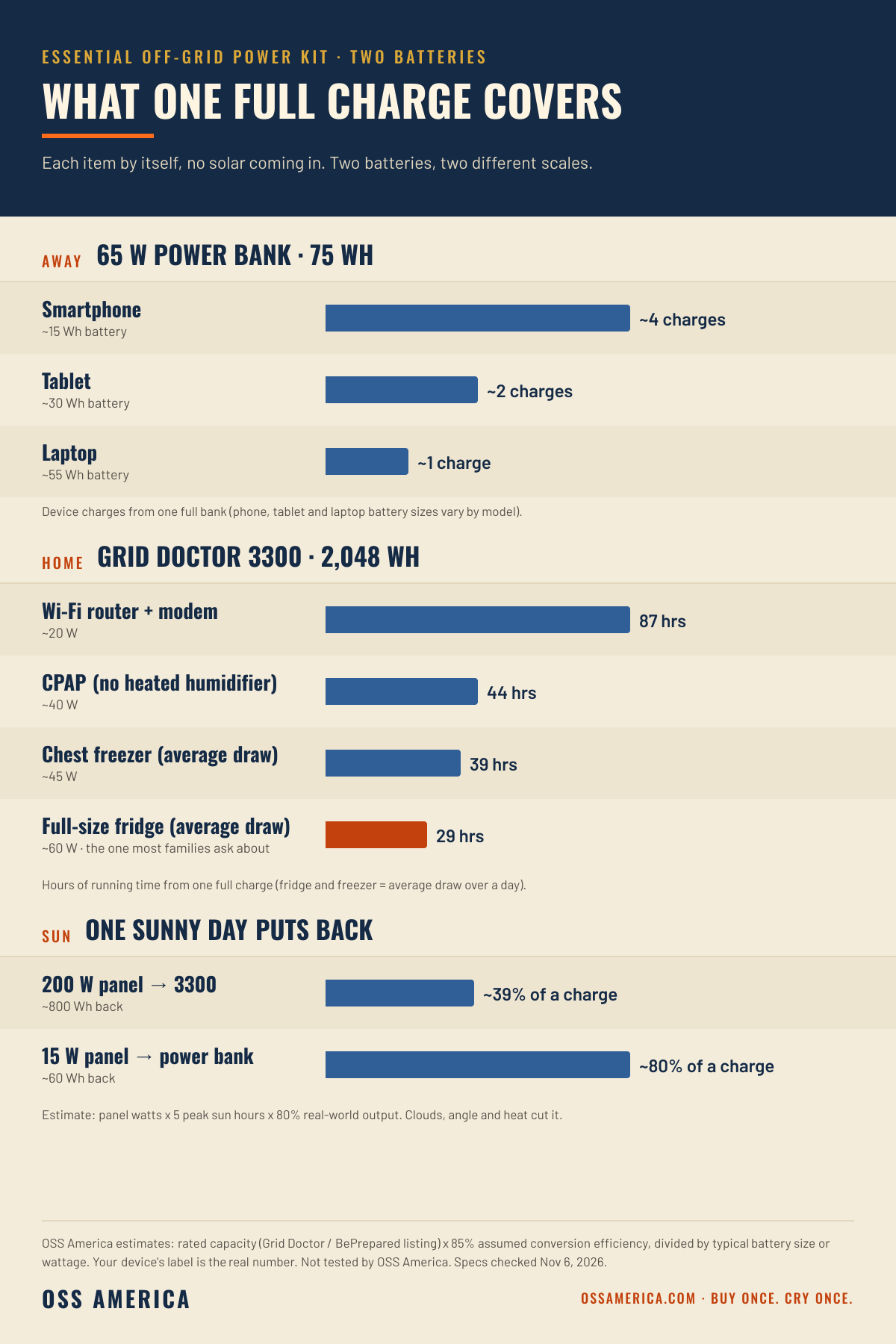
The fridge is the number most families care about: about 29 hours for a typical full-size refrigerator on one charge. And the solar side is what makes the kit work for longer outages. On a clear day, the 200 W panel puts back roughly 800 Wh by our math, about 40% of the 3300, while the little 15 W panel can refill most of the power bank. Owners who added panels back that up: one reported about 520 W in full sun from three 200 W panels, and another about 530 W on a partly cloudy day.
Every piece in the kit, ranked by how much it matters in an outage
Here is each part of the kit, from the smallest to the one that carries the most weight when the power goes out.
4. Grid Doctor 15 W folding solar panel
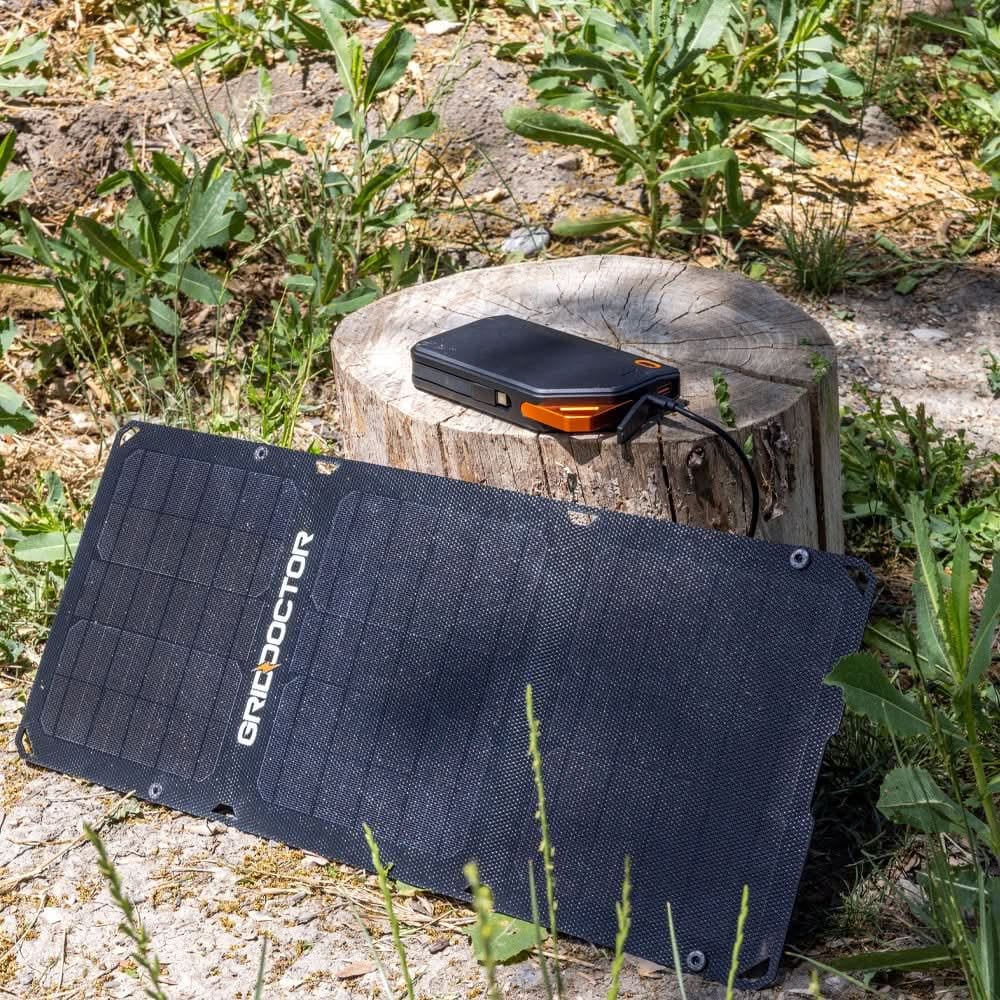
| Output | 15 W max, USB-C |
| Cells | Monocrystalline silicon, 22%+ efficiency |
| Size | Folded 9.43 x 7.4 x 1.65 in · open 9.43 x 22.37 x 1.05 in |
| Weight | 1.3 lb |
| Certifications | RoHS, REACH, FCC |
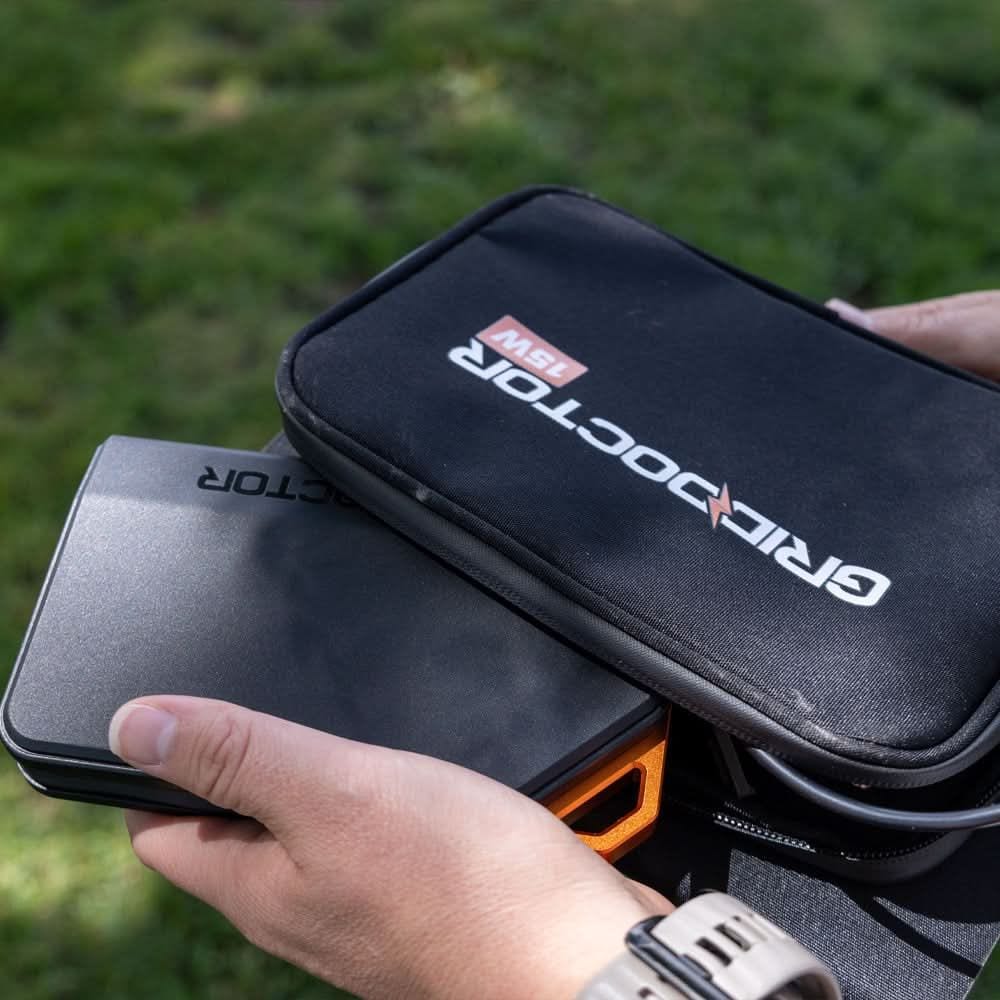
Why it ranks here: it is the smallest piece, but it means the power bank never depends on a wall outlet. It folds to roughly the size of a paperback, has a zip pouch that holds the bank (one owner called the pocket "so handy"), and in a clear day of sun it can put most of a charge back into the bank by our estimate. It is not meant for the 3300.
Buy it if: you want your phone charger to keep working after the house battery is packed away.
Skip it if: you only ever charge phones from the car or the 3300 itself.
3. Grid Doctor 65 W power bank
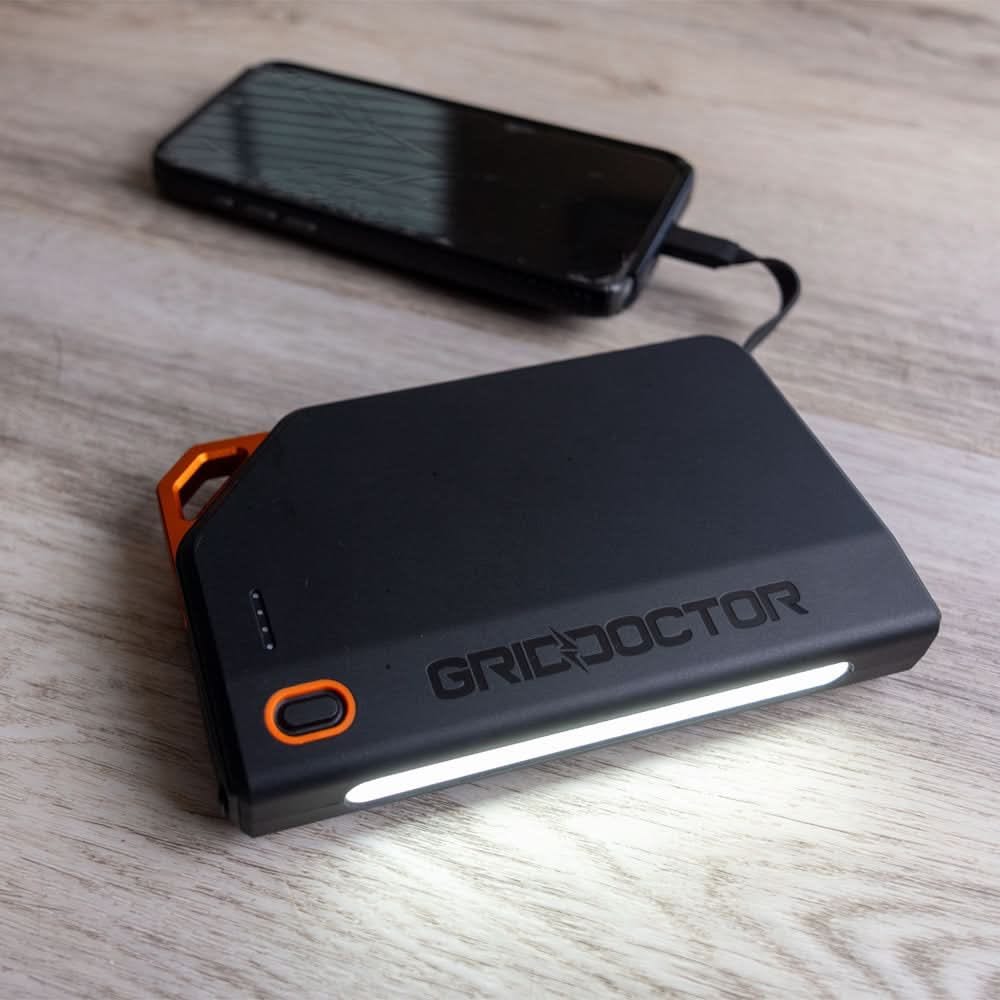
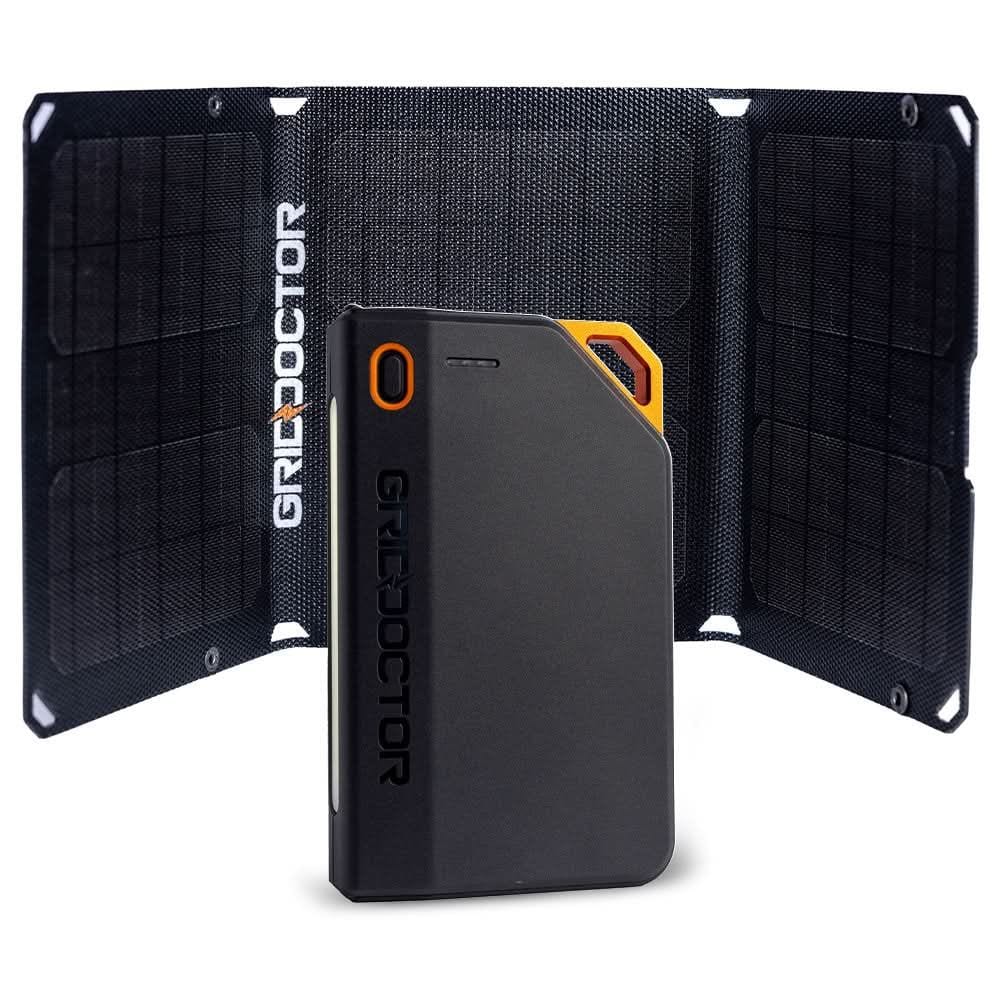
| Capacity | 75 Wh (20,000 mAh) |
| Outputs | 2 x USB-C PD 65 W, 1 x USB-A QC 3.0 22.5 W · 95 W max total |
| Inputs | USB-C 65 W max or DC 65 W max |
| Size / weight | 3.70 x 6.12 x 1.10 in, 16.7 oz |
| Temperatures | Discharge 14–104°F · charge 32–104°F |
| Certifications | UN38.3, FCC; BePrepared lists it as TSA compliant and within FAA carry-on guidelines |
Why it ranks here: it is the piece you will use most, outage or not. A 65 W USB-C port can charge many laptops, and the 75 Wh battery refills a typical phone about four times by our math. It has a built-in cable, and Grid Doctor's photos show a built-in light strip that one owner called a great addition. At 16.7 oz it lives in a go-bag, a glovebox or a carry-on.
One owner note worth knowing: charging took them "6 hours plus," and they planned to buy a stronger wall adapter. No wall charger is listed in the box, so pair it with a USB-C PD charger; the bank accepts up to 65 W.
Buy it if: you want phones, radios and a laptop covered away from home.
Skip it if: you already carry a good 20,000 mAh+ USB-C power bank.
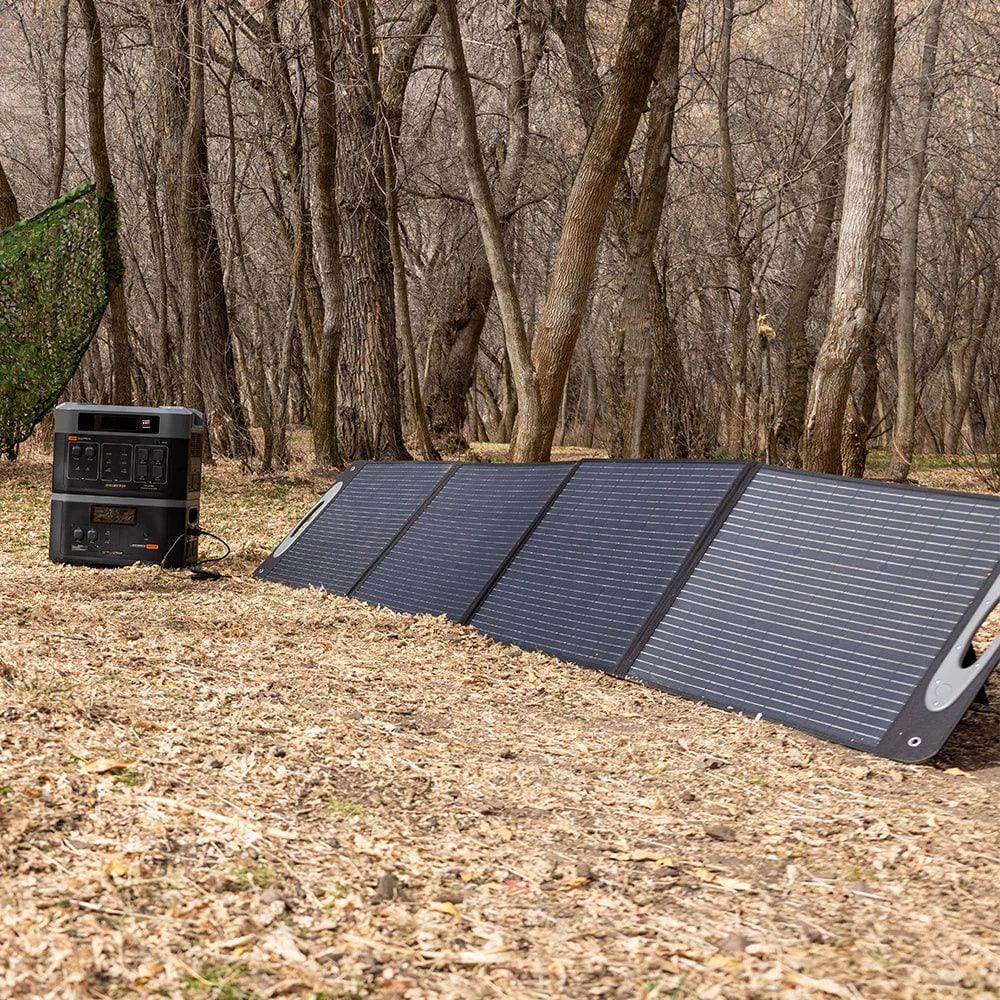
2. Grid Doctor 200 W waterproof solar panel
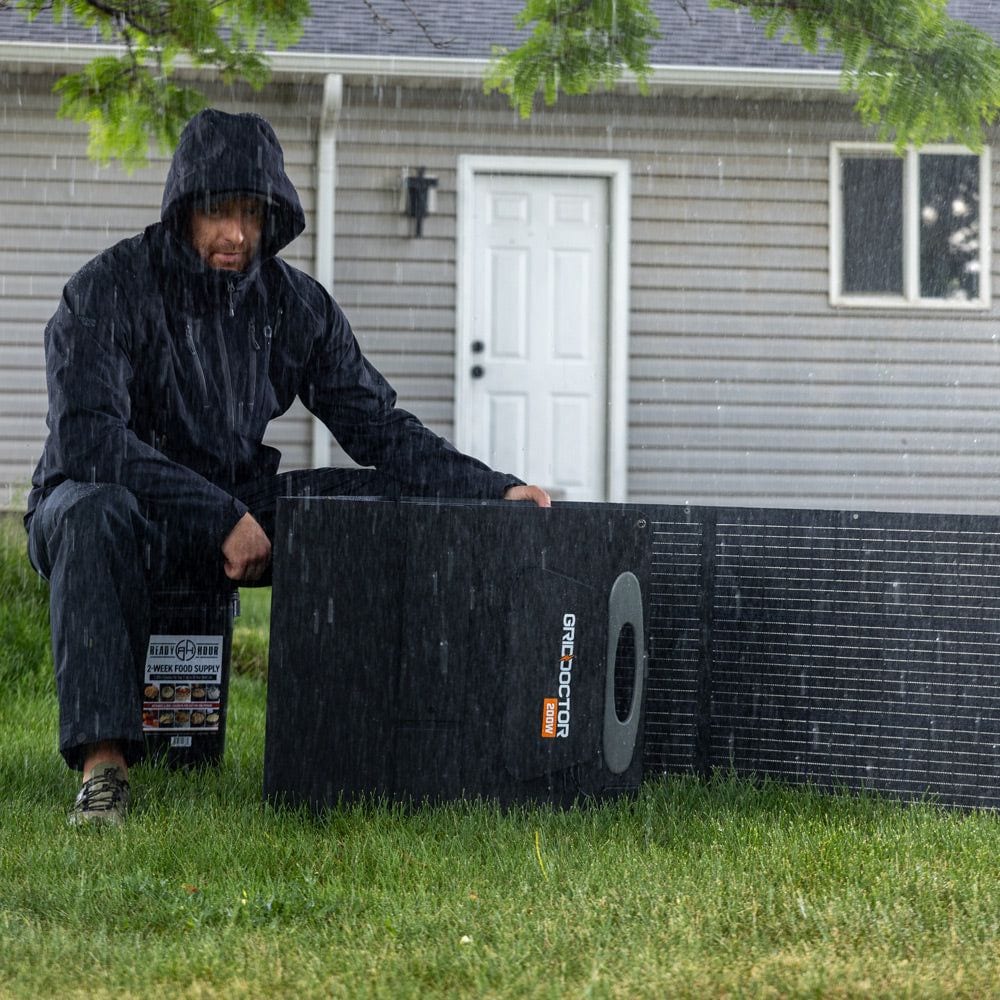
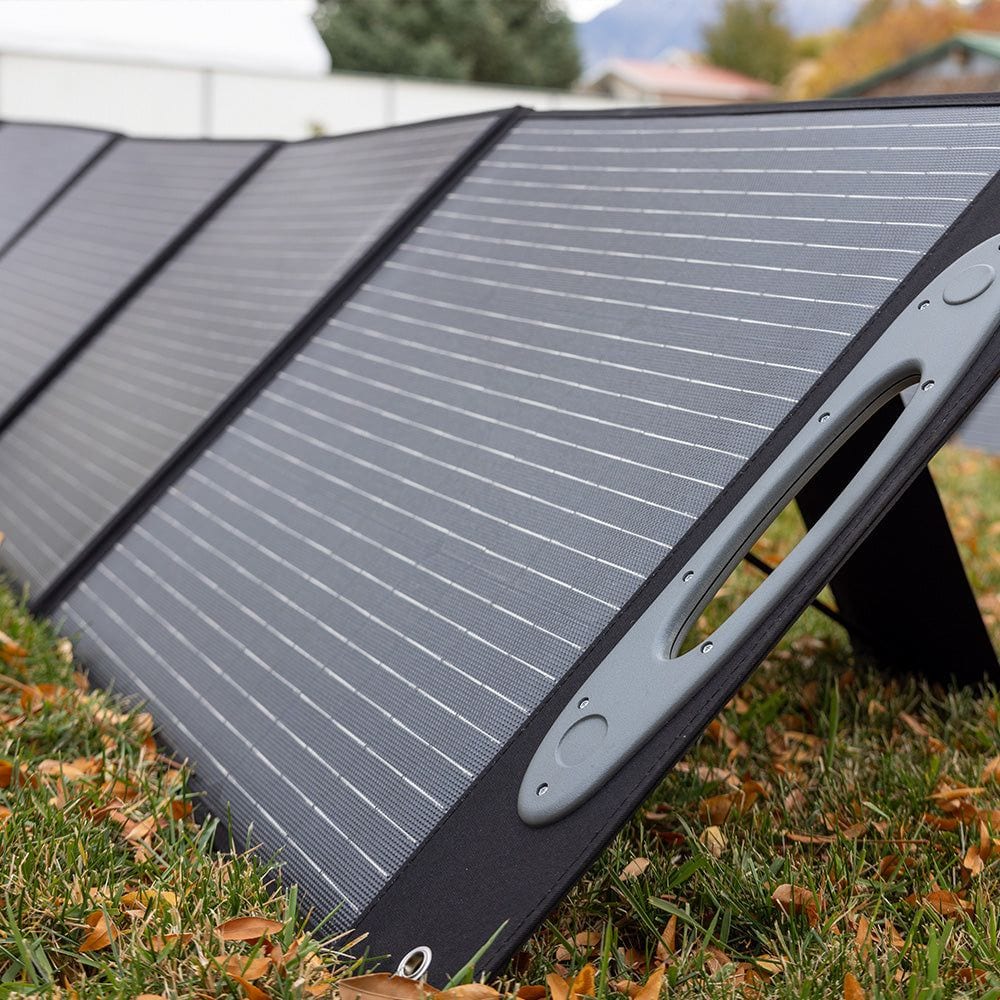
| Output | 200 W (the 3300 accepts up to 1,000 W of solar, five of these panels) |
| Rating | Waterproof: IP67 per BePrepared's kit page (My Patriot Supply lists IP68) |
| Weight | 19.2 lb |
| Connection | XT60-MC4 solar cable to the 3300 (included) |
| Certifications | RoHS, FCC |
Why it ranks here: without it, the 3300 is a big battery with a countdown. With it, the 3300 refills about 40% of a charge on a clear day by our estimate, which is enough to keep a fridge going day after day if you go easy on everything else. Because it is waterproof, it can stay set up through rain. One owner ran an extension cable under the garage door so the panel stays outside and the generator stays inside. A second panel is the first add-on we would consider ($447).
Buy it if: you expect outages longer than a day.
Skip it if: you only need power for a few hours at a time and can recharge from the wall.
1. Grid Doctor 3300 with EMP Intercept
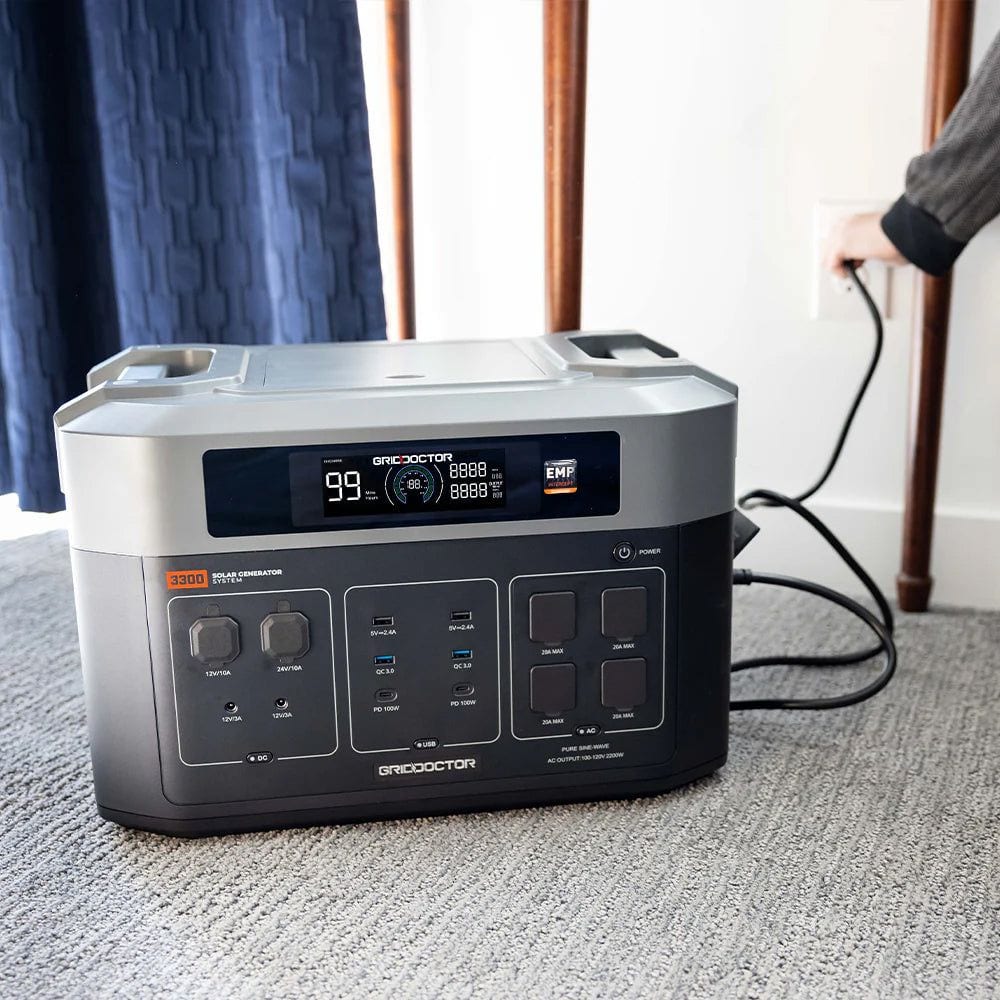
| Battery | 2,048 Wh LiFePO4, rated for 3,500 cycles |
| Inverter | 3,300 W continuous, 6,600 W surge, 120 V |
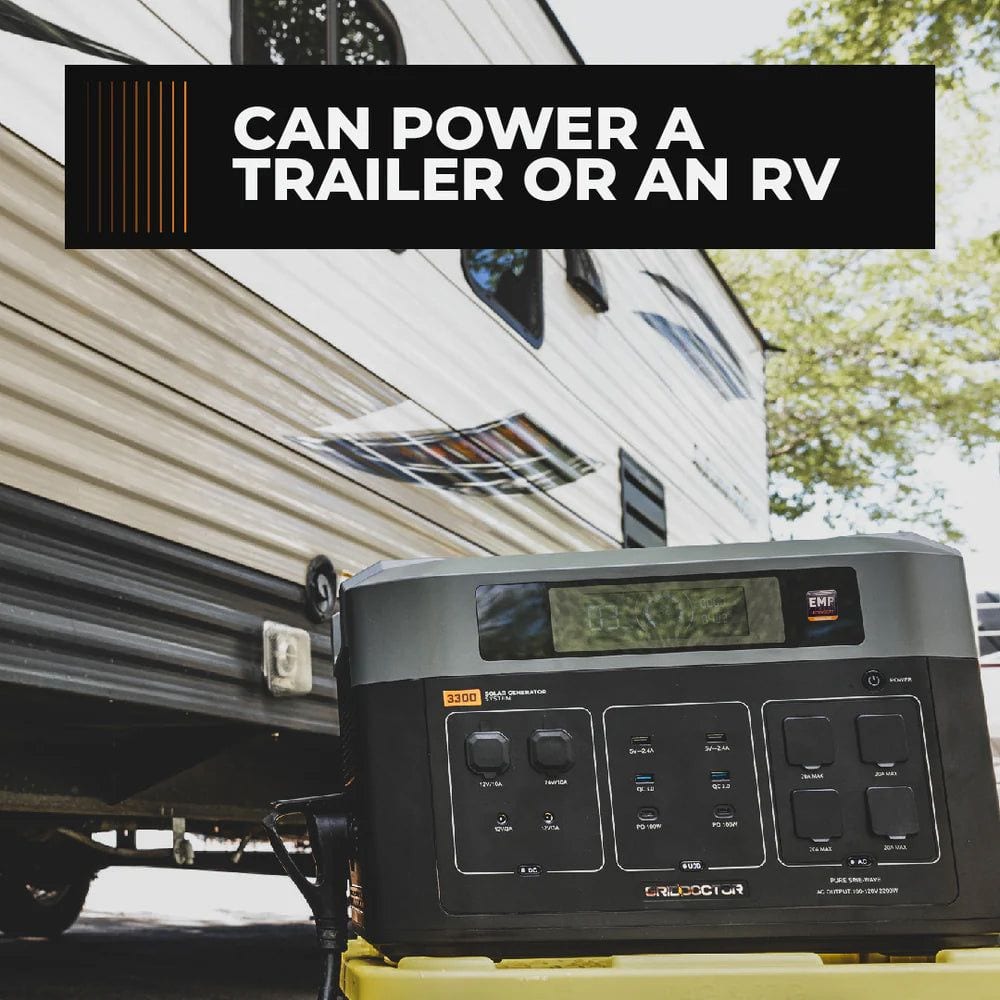
| Outputs | 4 x 120 V/20 A household outlets, 1 x 30 A RV outlet, USB-A, USB-C 100 W PD, 12 V car socket, 48 V aviation socket |
| Charging | AC (1,800 W quick / 600 W slow) · solar up to 1,000 W · 12 V/24 V vehicle |
| Expansion | Up to 16,384 Wh with expansion batteries (sold separately) |
| Size / weight | 18.7 x 11.65 x 12.58 in, 57.2 lb |
| Certifications | UN38.3 and UL 2743 (per BePrepared) |
Why it ranks first: it is the part that keeps the house running. 3,300 W runs almost any single 120 V appliance and several at once, the LiFePO4 battery is built for thousands of cycles, and its UPS mode can take over when the grid fails. It is also the reason the kit costs what it does.
BePrepared says the built-in EMP Intercept Technology "protects connected electronics from power surges, lightning, and electromagnetic pulses." We found no independent EMP test, so read the EMP part as the maker's claim; the surge protection is the part a family is most likely to use. Our full Grid Doctor 3300 review covers the EMP claim, the 15 outputs, charging times and the fine print in detail.
Buy it if: you want the fridge, lights, Wi-Fi and medical gear covered in an outage.
Skip it if: you need 240 V loads like a well pump, central air or an electric range.
What owners say
The kit page shows 17 reviews averaging 4.9 out of 5 (15 five-star, 2 four-star). One honest caveat: the store's review widget pools reviews from the Grid Doctor family (the 3300, its panels, the expansion battery and the power bank), and several are older than the kit itself, so read them as owner feedback on the parts, not on this exact box.
The patterns are still useful. Buyers repeatedly mention fast, well-packed shipping, and one praised the customer service. One family set up the system the day it arrived, charged it from two panels in a few hours and ran their pellet grill on the battery. Panel owners report roughly 520 to 530 W from three 200 W panels. The one practical complaint was slow power bank charging with a weak wall adapter.
Essential Off-Grid Power Kit: pros and cons
Pros
- + Covers home and away: a 2,048 Wh house battery plus a 16.7 oz grab-and-go power bank
- + Two independent solar paths, so the fridge and the phones never compete for one panel
- + Same price as buying the pieces separately, with free shipping
- + LiFePO4 house battery rated for 3,500 cycles, with UPS mode and a 30 A RV outlet
- + Power bank charges laptops at 65 W and is listed as airline carry-on friendly
Cons
- − No bundle discount, so it only saves time, not money
- − 120 V only: no well pump, central air or electric range
- − The 3300 weighs 57.2 lb; plan on a cart if it moves often
- − EMP protection is the maker's claim; we found no independent EMP test
See the Essential Off-Grid Power Kit →
Which setup to buy
- Families in storm country with no backup yet: the Essential Off-Grid Power Kit. It covers the fridge and the phones in one order.
- You already carry a good power bank: the Grid Doctor 3300 system alone at $2,997, and put the difference toward a second panel.
- Outages that last days: the kit plus a second 200 W panel. Two panels put back roughly 1,600 Wh on a clear day by our estimate.
- Go-bags, trucks and travel only: the 65 W power bank with 15 W panel at $119.90, or a bigger step up with the Grid Doctor 300 ($497, 320 Wh, 300 W).
Before you buy: shipping, returns and storage
- Shipping time. When we checked, BePrepared's shipping page said same-day shipping was paused because of high order volume and new orders were estimated to ship within 7–9 business days. Shipping is free on orders over $299 to the lower 48. Order before the storm, not during it.
- Returns. BePrepared takes returns within 30 days on unopened, unused products in the original packaging. You pay return shipping, and the original shipping cost may be deducted from the refund. Call 888-579-6849 to start one. Decide before you open the box.
- Storage. BePrepared says to charge the 3300 to at least 60% for storage and check it every three months, and to keep the 3300 and the power bank dry even though the 200 W panel is waterproof. Grid Doctor also says not to charge the 3300 from a GFCI outlet.
- Know your loads. Check each device's running and startup watts against the 3300's 3,300 W continuous and 6,600 W surge, as BePrepared advises.
Frequently asked questions
What comes in the Essential Off-Grid Power Kit?
The Grid Doctor 3300 power station with EMP Intercept, a 200 W waterproof solar panel, an AC charging cable, an XT60-MC4 solar cable and an XT60 vehicle cable for the 3300, the Grid Doctor 65 W power bank with built-in cable, and a 15 W solar panel for the power bank.
Is the Essential Off-Grid Power Kit cheaper than buying the parts?
No. On November 6, 2026 the kit was $3,116.90, exactly the price of the Grid Doctor 3300 system ($2,997) plus the 65 W power bank with 15 W panel ($119.90). You buy it for the complete matched setup.
How long will the kit run a refrigerator?
About 29 hours for a typical full-size fridge on one full charge of the 3300, by our estimate (2,048 Wh at 85% efficiency, average fridge draw about 60 W). The included 200 W panel puts back roughly 800 Wh on a clear day.
How many times can the power bank charge a phone?
About four full charges for a typical phone with a 15 Wh battery, by our estimate from its 75 Wh rating. It can also give a typical laptop about one full charge through its 65 W USB-C port.
Can I take the 65 W power bank on a plane?
BePrepared lists the power bank as TSA compliant and within FAA guidelines for carry-on travel. Pack it in your carry-on, not checked luggage, and check your airline's current rules.
Does the Grid Doctor 3300 protect against an EMP?
BePrepared says its EMP Intercept Technology protects connected electronics from power surges, lightning and electromagnetic pulses. We found no independent EMP test results, so treat the EMP part as the maker's claim.
Can the kit run a whole house?
No. The 3300 is 120 V only with 2,048 Wh of storage, so it runs essentials such as a fridge, lights, Wi-Fi and a CPAP. It will not run 240 V loads like a well pump or central air.
Can I return the kit if it isn't right for me?
BePrepared accepts returns within 30 days on unopened, unused products in the original packaging. You pay return shipping and the original shipping cost may be deducted, so decide before you open it.
The final word
The Essential Off-Grid Power Kit is not a deal; it is a plan in a box. The Grid Doctor 3300 keeps the house running, the 200 W panel keeps the 3300 alive past day one, and the power bank with its own panel keeps your phones and laptop going wherever you end up. If you need both halves, buy the kit. If you already have a good power bank, buy the 3300 system and spend the difference on a second panel. Either way, read the fine print on returns before you open the box. Building out the rest of your plan? See our Grid Doctor 3300 review, best portable power stations, best solar generators, best emergency food supply, best emergency radios and best camping lanterns.
See the Essential Off-Grid Power Kit →
Get the free Blackout-Ready Home Checklist — join the OSS America newsletter for honest gear guides like this one, straight to your inbox.
Talk soon,
OSS AMERICA
God · Family · Country · Gear that earns its keep.
FTC Disclosure: OSS America contains affiliate links. We earn a commission from qualifying purchases at no extra cost to you. Every pick is research-based: specs, verified prices and owner reviews.
More reviews
 Portable Power
Grid Doctor 3300 EMP Review: What It Runs, What It Costs and the Best Way to Buy
The Grid Doctor 3300 packs 2,048 Wh, a 3,300 W inverter and built-in EMP surge protection. What it really runs in an outage, what owners say, the fine print on returns, and which bundle to buy.
 Portable Power
EcoFlow DELTA Pro 3 Review (2026): Specs, Real Price, Owner Reviews and Rivals
An honest EcoFlow DELTA Pro 3 review: 4,096Wh, 4,000W, 120/240V, every bundle priced per kWh, what 69 owners say, the either/or 240V catch, and how it stacks up against the DELTA Pro Ultra and BLUETTI Apex 300.
 Portable Power
EcoFlow vs BLUETTI (2026): Which Power Station Gives You More for Your Money?
EcoFlow vs BLUETTI, compared size class by size class: price per kWh, output, weight, cycle ratings, warranty and returns for 1 kWh, 2 kWh, 3 kWh and 240V home backup units, plus which to buy.
 Portable Power
EcoFlow DELTA Pro Ultra X vs Tesla Powerwall 3 (2026): Which Home Battery Fits Your House?
EcoFlow DELTA Pro Ultra X vs Tesla Powerwall 3, compared from the makers' own specs: capacity, power, solar input, expansion, warranty, weight, installation, pricing and the 2026 tax-credit reality.
 Portable Power
EcoFlow vs Jackery (2026): Which Power Station Gives You More for Your Money?
EcoFlow vs Jackery, compared size class by size class: price per kWh, output, weight, cycle ratings, warranty and returns for 1 kWh, 2 kWh, 3 kWh and 240V home backup units, plus which to buy.
 Portable Power
14 Best-Selling Home Power Products of 2026 (Not a Ranking)
Not a ranking — nobody won. Fourteen of the best-selling home power products on the market, with what each one actually does: the watts, the hours, the fuel, the install, and the honest limits. You decide which fits your house.