
Grid Doctor 3300 EMP Review: What It Runs, What It Costs and the Best Way to Buy

The power goes out at 9 p.m. in an ice storm. The house goes quiet, the fridge stops humming, and somewhere around midnight you start doing the math on how long the food in the freezer will last. A gas generator means a cold trip outside, a full tank and a noise the whole street can hear. The Grid Doctor 3300 is the other answer: a big lithium battery with real household outlets that you can run inside the house, recharge from the sun, and keep plugged in so it takes over the second the grid drops.
It is also one of the most expensive single products in the preparedness world at $2,997, and its headline feature, built-in EMP protection, is something almost nobody can verify at home. We did not test this unit. This review is built from Grid Doctor's published specs, the store policies, 164 verified-buyer reviews and some honest math on what 2,048 watt-hours actually runs. Here is what you are buying, what it will and will not power, and the smartest way to buy it.
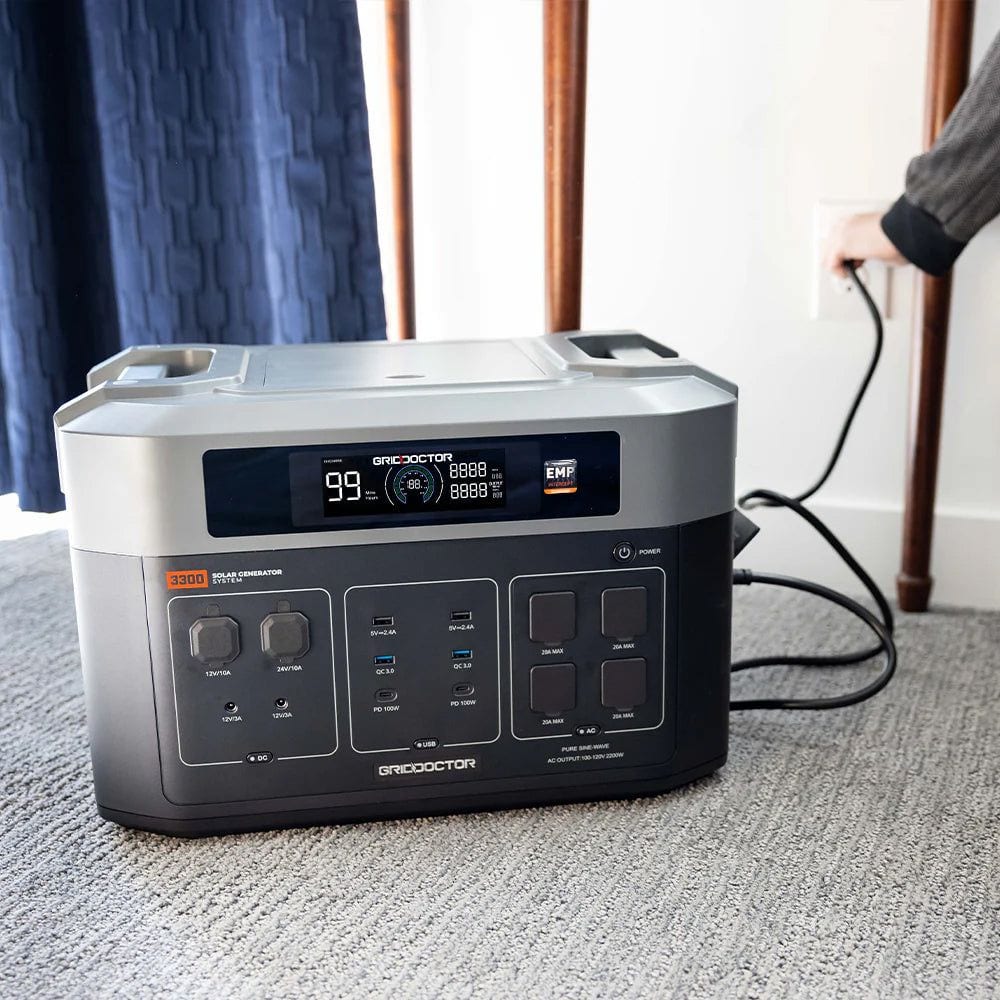
The short answer
A 2,048 Wh LiFePO4 power station with a 3,300 W inverter, a 30 A RV outlet and built-in surge/EMP protection. Strong for keeping a fridge, lights, Wi-Fi and medical gear going; not a whole-house backup.
- The unit: Grid Doctor 3300 EMP + one 200 W waterproof panel, $2,997 (same price at My Patriot Supply, BePrepared and Camping Survival on Nov 6). See it at My Patriot Supply →
- Best bundle for most homes: BePrepared's Essential Off-Grid Power Kit adds a 65 W power bank with its own 15 W panel, $3,116.90. See the kit →
- Biggest bundle: Camping Survival's Total Off Grid Power Bundle adds the Grid Doctor 300 and the 65 W power bank, $3,613.90. See the bundle →
- Runs a full-size fridge: about 29 hours on one charge by our estimate, longer with sun coming in.
- Skip it if: you need 240 V for a well pump or central AC, or you only need to charge phones and lights.
What the Grid Doctor 3300 is
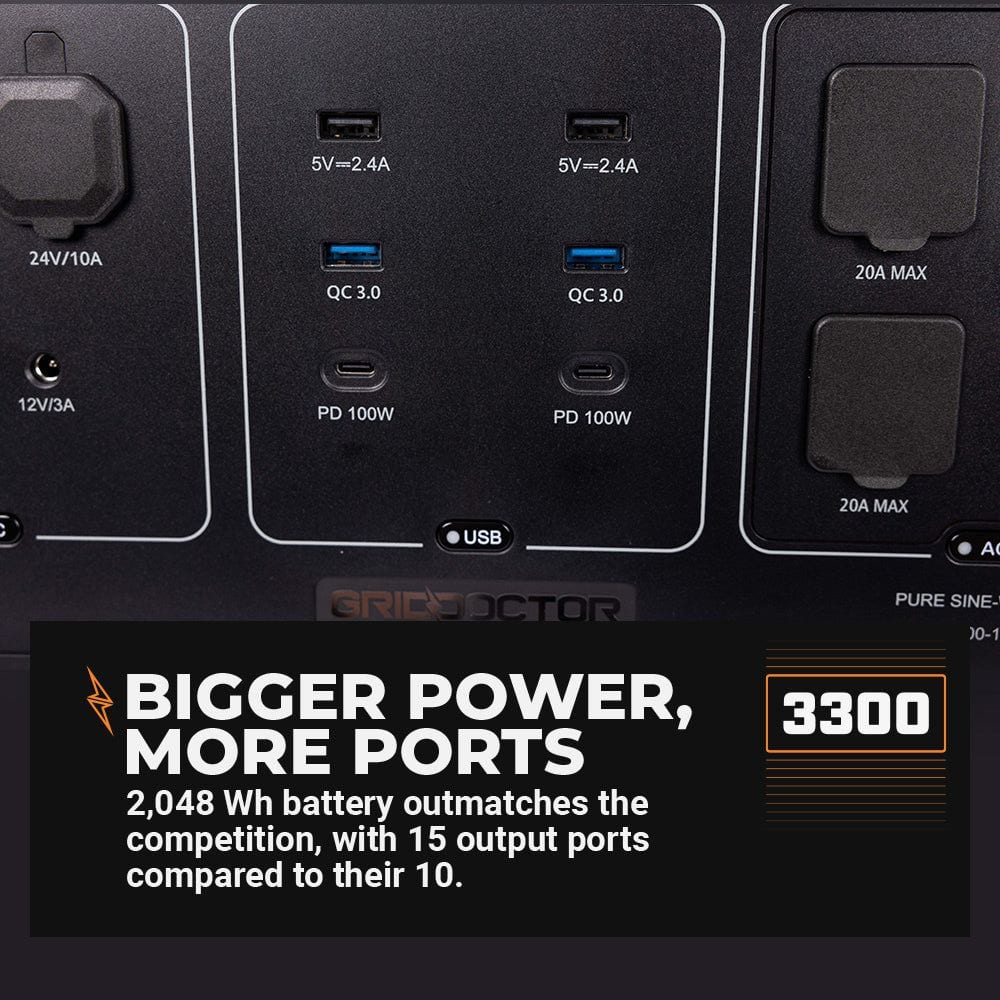
Grid Doctor is the solar power line sold by Ready Hour and My Patriot Supply, the Utah preparedness company best known for long-shelf-life food. The 3300 is the big one in the family. Think of it as a quiet, fume-free generator with no engine: a 2,048 Wh lithium iron phosphate (LiFePO4) battery, a 3,300 W pure sine wave inverter (6,600 W surge) and 15 outputs, in a 57.2 lb case with built-in handles.
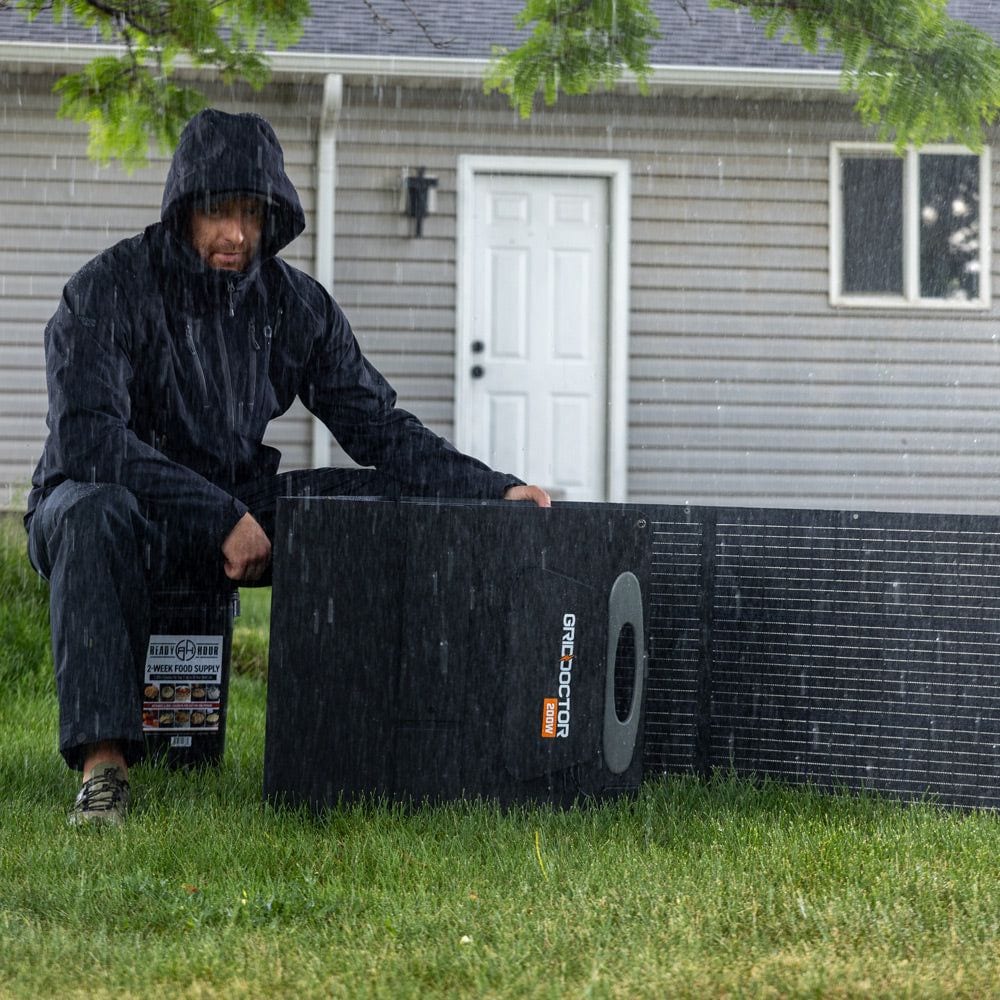
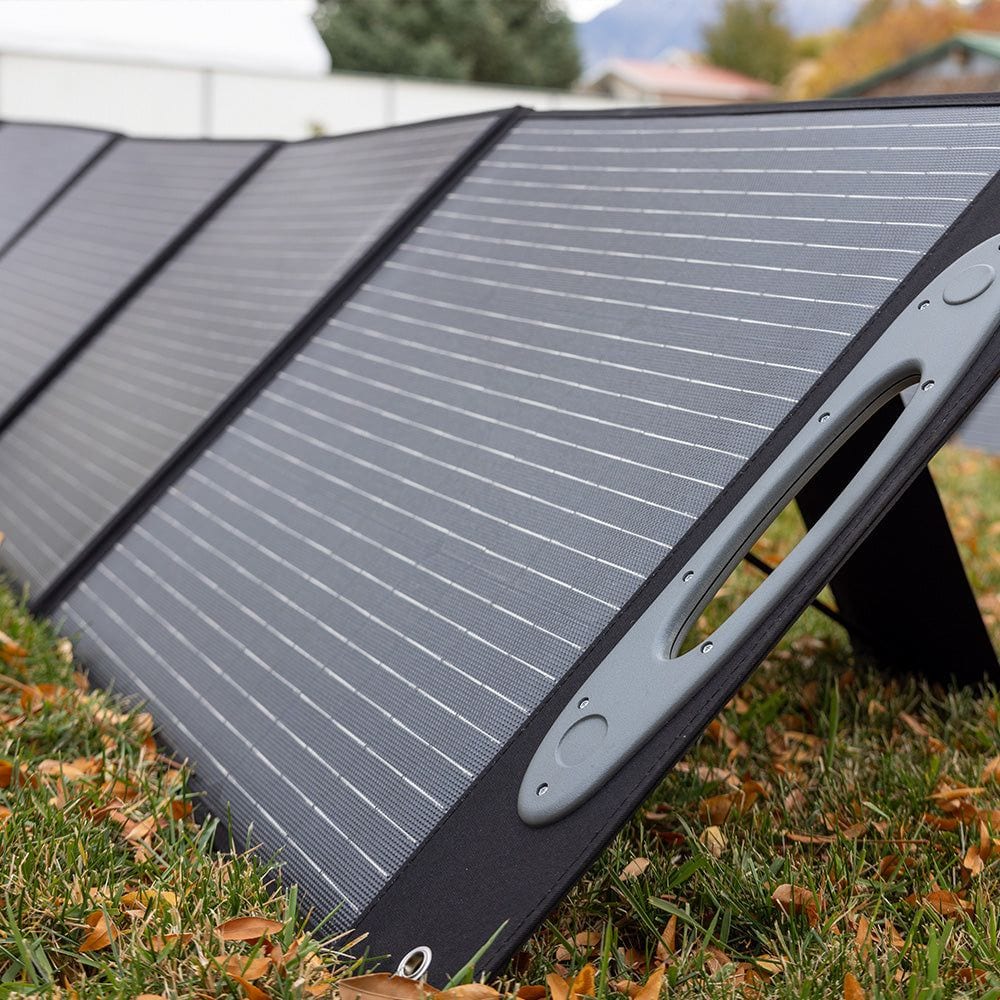
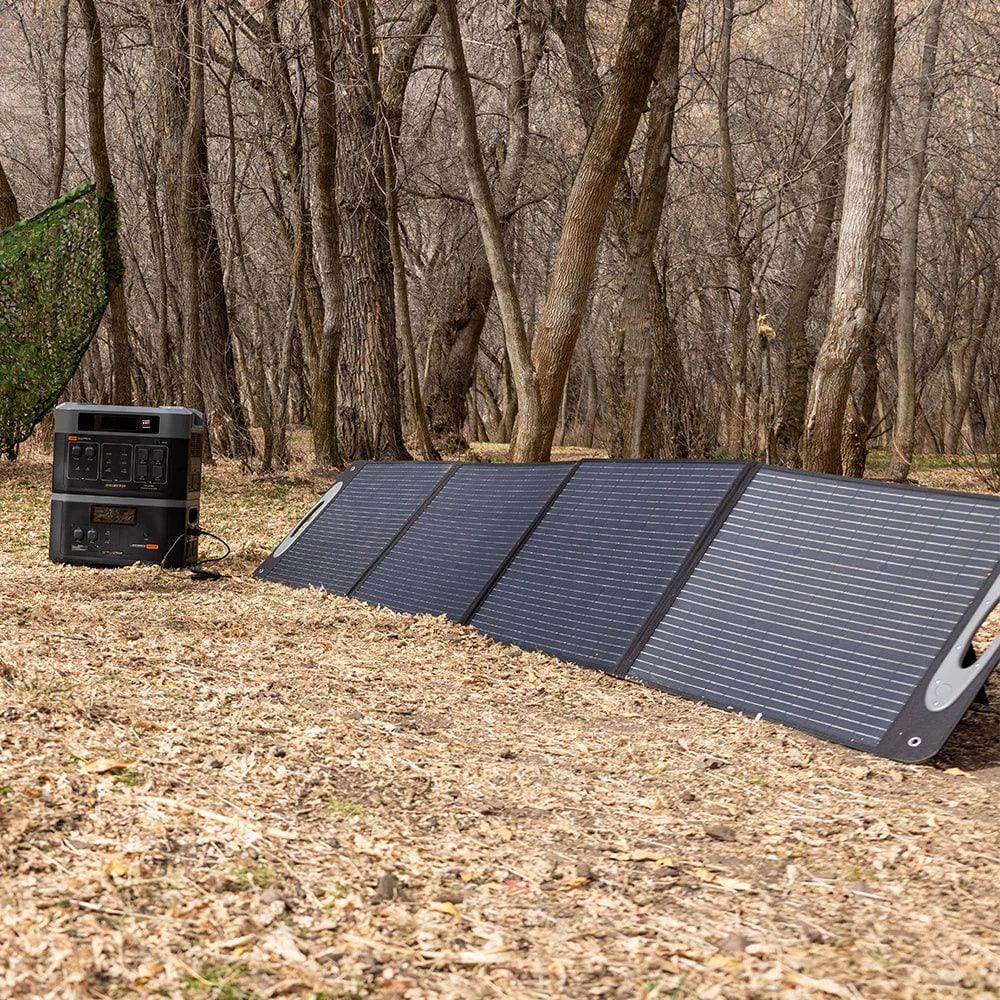
The system price includes one folding 200 W solar panel rated IP68 waterproof, so the panel can stay out in rain or snow. Charge it three ways: from a wall outlet (1,800 W quick-charge mode or 600 W slow mode), from solar (12–120 V, up to 1,000 W, which is five of the 200 W panels), or from a 12 V or 24 V vehicle socket. You can use it while it charges, and in UPS mode it sits between the wall and your devices and, according to Grid Doctor, switches to battery in 15 milliseconds when the grid fails, fast enough that a router or CPAP should not even blink.
The EMP Intercept claim, in plain English
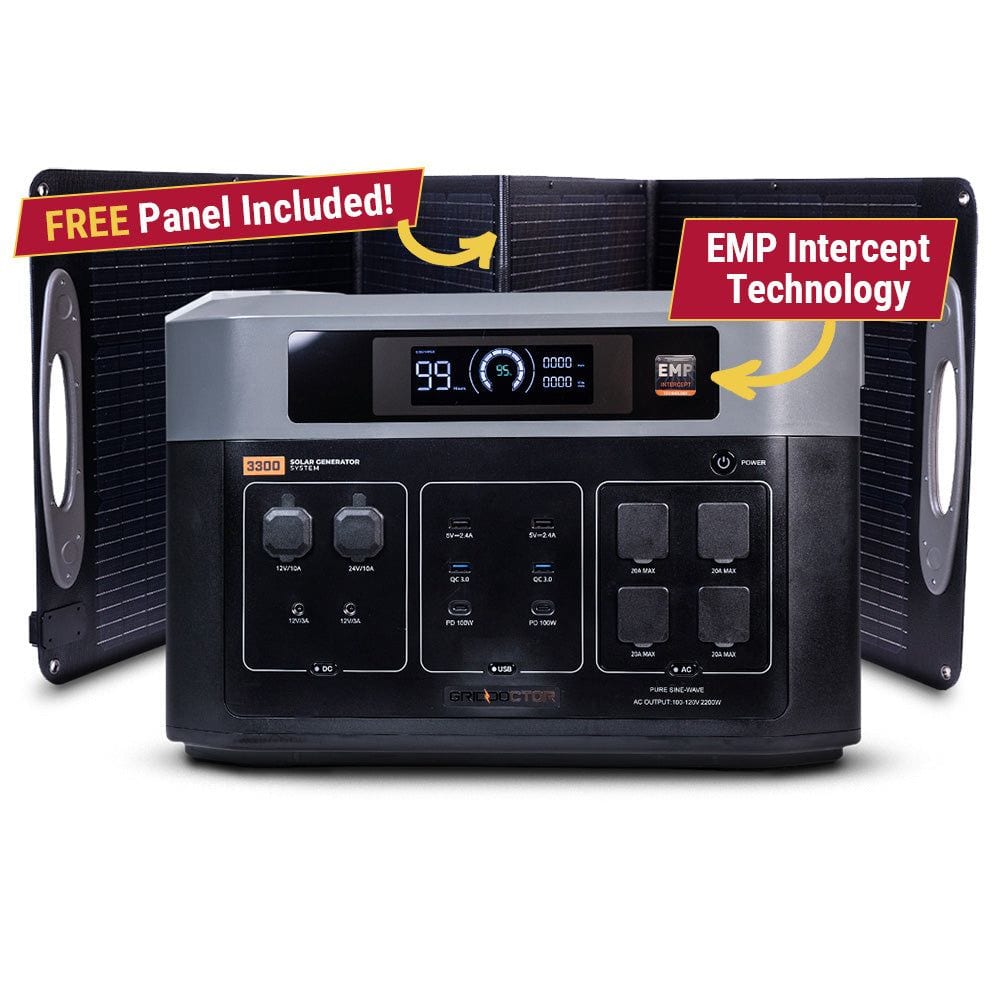
This is the feature that sets the 3300 apart from the EcoFlows and Jackerys of the world, so it deserves a careful read. Grid Doctor calls EMP Intercept "a high-tech surge protector on steroids." Its published numbers: protection against up to 260,000 amps AC and 152,000 amps DC, with a 3-nanosecond reaction time. My Patriot Supply's page says the system was "independently tested to react in 3 nanoseconds" and that it is built to help protect internal components from lightning strikes, grid surges and electromagnetic pulse.
What that means for you: the circuit is built in and always on, with no buttons to press. The surge numbers are a real, useful spec for lightning and grid spikes, the threats a family is far more likely to face. Grid Doctor's site goes further and says it protects the 3300 from "any EMP," including a solar flare or a nuclear detonation.
Our honest read on EMP protection
We could not find independent, published EMP test results for the Grid Doctor 3300, and nobody can test a real EMP at home. Read the EMP part as the maker's claim. The surge protection is the part you will most likely use. One owner's tip is worth repeating: if EMP is your main worry, some buyers also store the unit in a Faraday bag, which Grid Doctor sells (it was out of stock when we checked).
What 2,048 Wh actually runs
Watts tell you what the 3300 can start; watt-hours tell you how long it lasts. The inverter's 3,300 W is plenty for almost any single household appliance on 120 V, including a microwave, a coffee maker or a circular saw, and it can run several at once. The battery is the limit. After conversion losses (we assume about 85%), you have roughly 1,741 Wh to spend. Here is how far that goes, one item at a time:
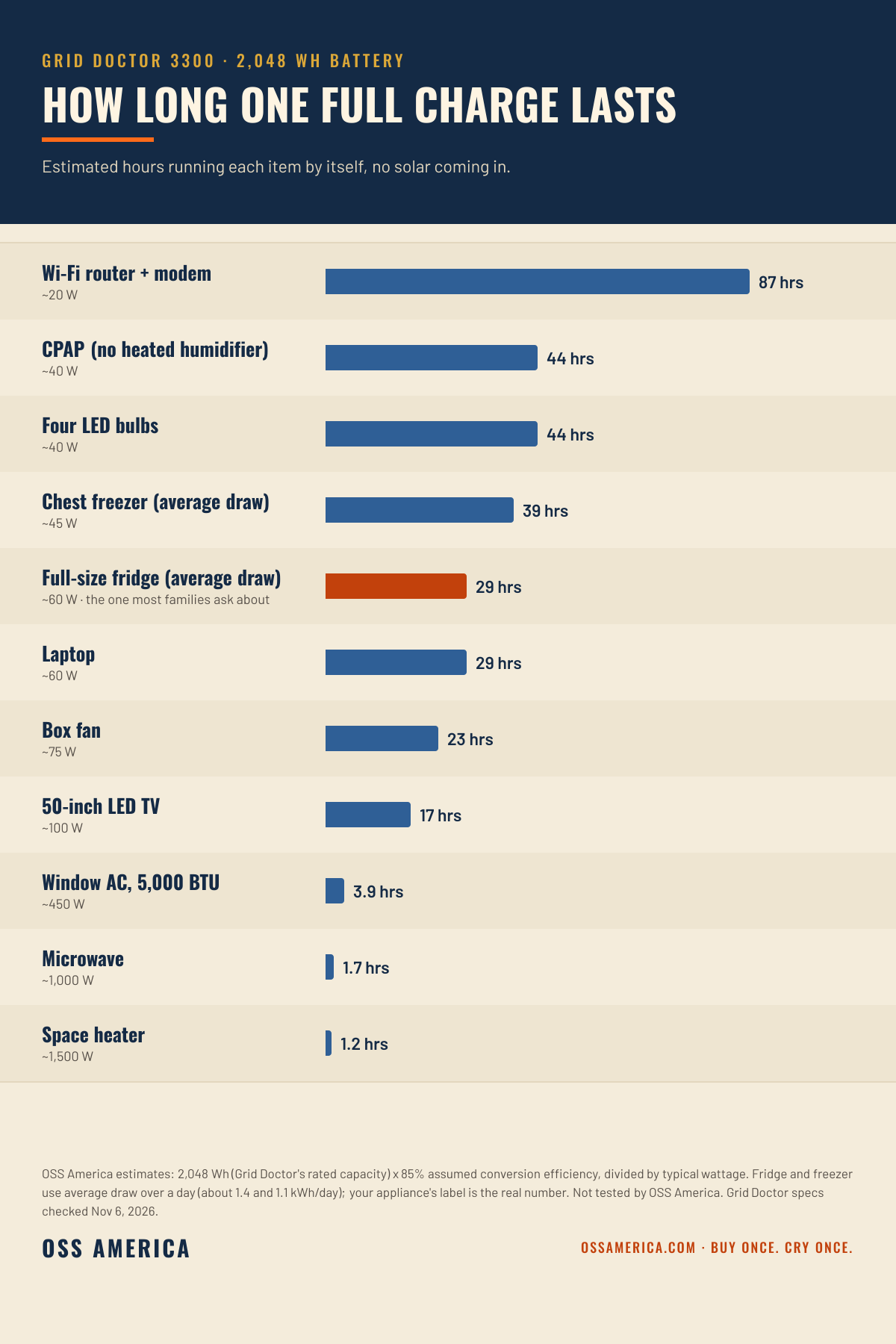
The number most families care about is the fridge: about 29 hours for a typical full-size refrigerator, which lines up with My Patriot Supply's own "30+ hours depending on the model." A chest freezer full of venison runs about 39 hours. The big heat makers are a different story: a 1,500 W space heater drains the battery in about an hour, and a small window AC in about four. The 3300 keeps the essentials alive; it does not replace the grid.
That is where the sun comes in. A 200 W panel in a good, clear day (about 5 peak sun hours) puts back roughly 800 Wh by our math, about 40% of the battery, which is enough to keep a fridge going day after day if you are careful with everything else. Add panels up to the 1,000 W limit and a sunny day can refill the whole battery. On the wall, the 1,800 W quick-charge mode refills 2,048 Wh in a little over an hour on paper. One owner wrote that his charged from the wall "in about 40 minutes" out of the box, starting from a partial charge.
Specs
| Battery | 2,048 Wh LiFePO4 (51.2 V / 40,000 mAh), rated 3,500+ cycles |
| Inverter | 3,300 W pure sine wave, 6,600 W surge, 120 V |
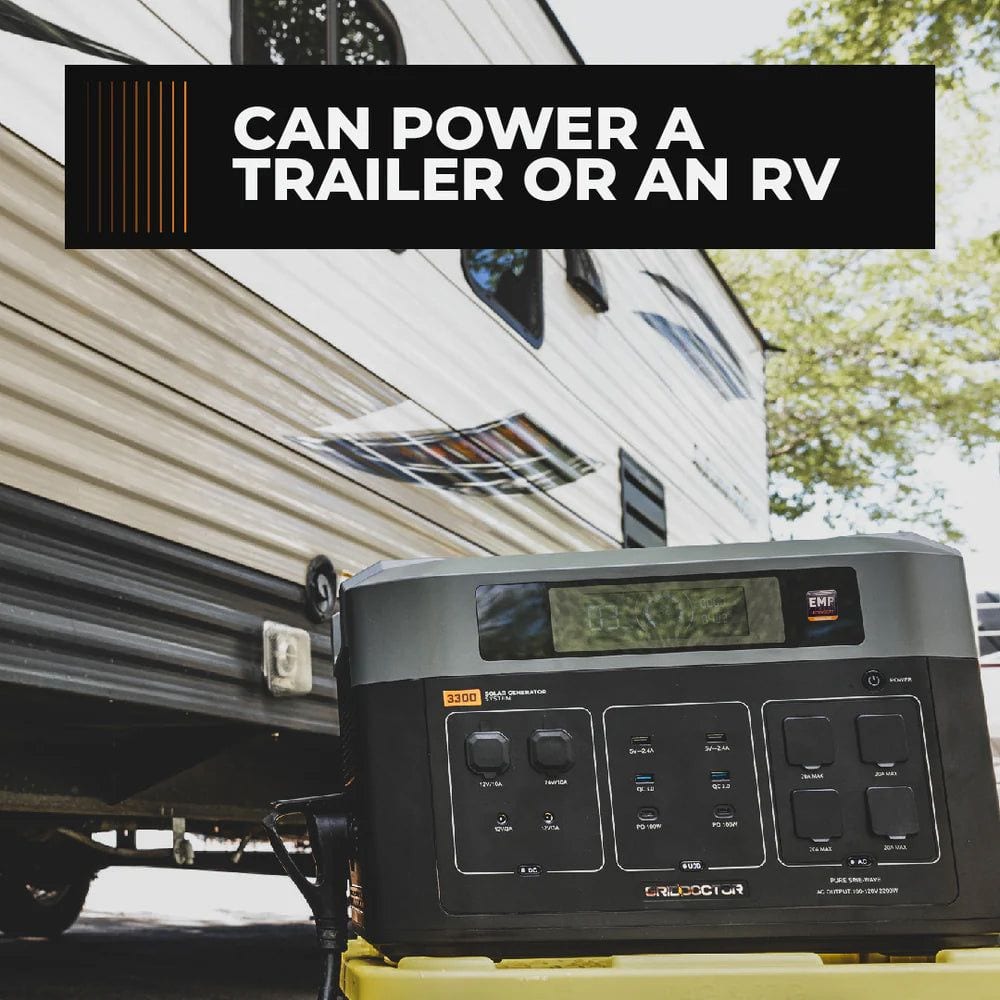
| AC outlets | 4 x 120 V/20 A household outlets + 1 x 120 V/30 A RV outlet |
| USB / DC | 2 USB-A, 2 USB-A QC 3.0, 2 USB-C 100 W PD, 12 V car socket, 12 V DC, 48 V/15 A aviation socket (720 W) |
| Charging | AC 1,800 W quick / 600 W slow · solar 12–120 V, 1,000 W max · car 12 V/24 V · pass-through + UPS |
| Surge / EMP | EMP Intercept: AC 260 kA, DC 152 kA, 3 ns reaction (Grid Doctor's figures) |
| Expansion | Up to 7 expansion batteries, 16,384 Wh total (Grid Doctor) |
| Size / weight | 18.7 x 11.65 x 12.58 in, 57.2 lb |
| Temperatures | Discharge 14–104°F · charge 32–104°F · store at 68–86°F |
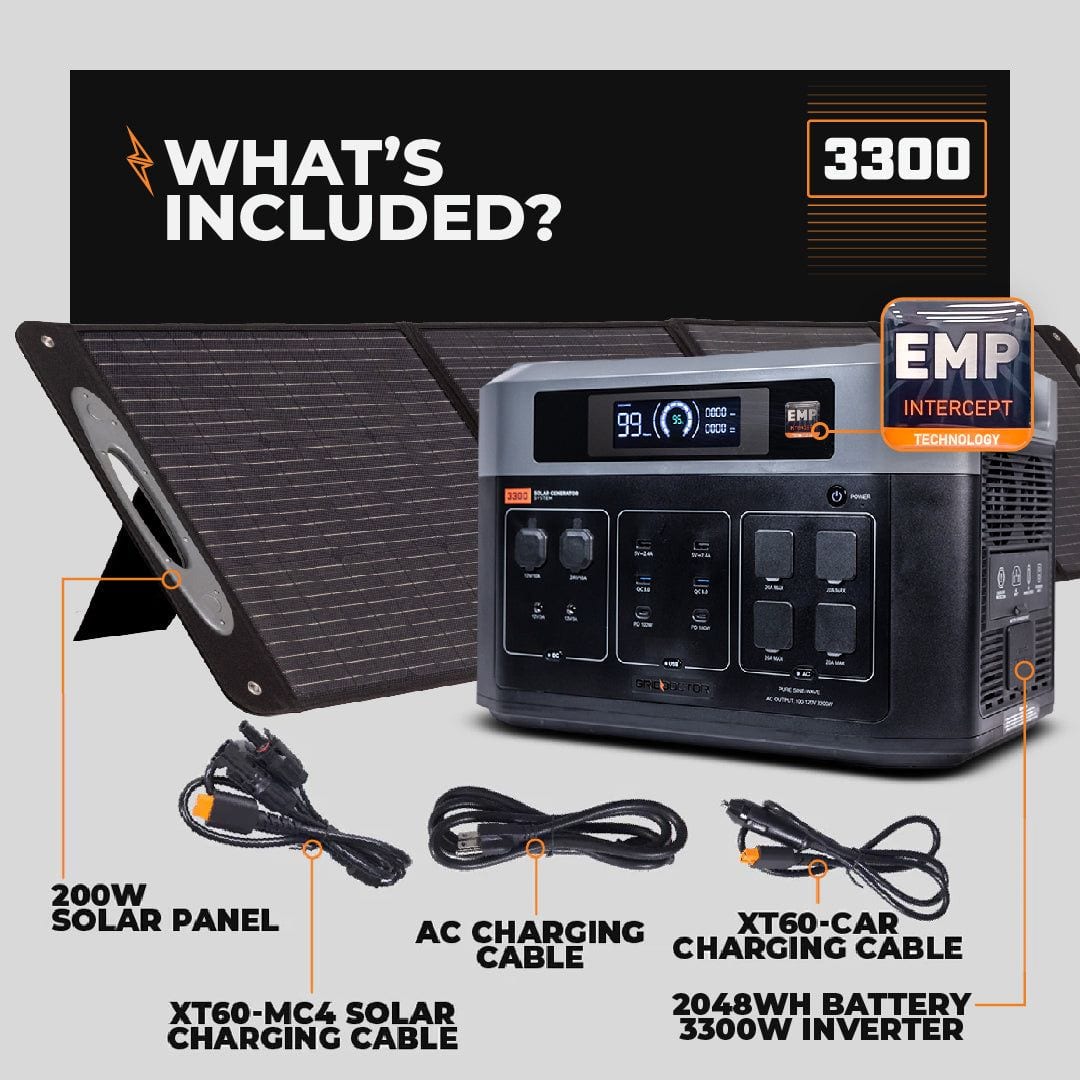
| Included | 3300 generator, 200 W IP68 panel (19.2 lb), AC cable, XT60 solar cable, XT60 car cable, manual |
| Certification | UN38.3 (generator); RoHS, FCC, IP68 (panel) |
What owners say
On My Patriot Supply, the 3300 holds a 4.7 out of 5 from 164 reviews: 140 five-star, 11 four-star, 5 three-star, 3 two-star and 5 one-star. The happy owners talk about how easy it is to run ("If you can plug in a phone charger, you can operate this system," as the store puts it), units arriving charged and ready, and fast wall charging. The most common practical note is the weight: one owner bought the hand cart and called it "a great investment."
The few bad reviews are worth knowing about. One owner said a unit stopped charging within the first year and the fix took many calls, and an RV owner wrote that it would not keep a fridge going overnight, which is a reminder that RV fridges and inverter loads vary a lot. Another buyer was unhappy to see the same system on sale days after buying it, so it pays to watch for promotions.
Grid Doctor 3300: pros and cons
Pros
- + Real household power: 3,300 W runs almost any single 120 V appliance, and several at once
- + LiFePO4 battery rated for 3,500+ cycles, safe to run indoors with no fumes or fuel
- + 30 A RV outlet and a 48 V aviation socket, rare on power stations this size
- + UPS mode keeps a router, CPAP or freezer powered through an outage without a blink
- + Waterproof 200 W panel included, with room to grow to 1,000 W of solar
Cons
- − 120 V only: it will not run a 240 V well pump, central AC or an electric range
- − Heavy at 57.2 lb; plan on a cart if it moves often
- − The EMP protection is Grid Doctor's claim; we found no independent EMP test
- − Expansion batteries were not listed for sale at the stores we checked, so the 'up to 16,384 Wh' growth path depends on restocks
Which way to buy it
The 3300 costs the same $2,997 everywhere we looked. The real choice is whether to buy the system alone or one of the two bundles, and neither bundle is discounted: each costs exactly what its parts cost on their own. Buy a bundle for convenience and one checkout, not for savings.
| Option | What you get | Price (Nov 6) | Best for |
|---|---|---|---|
| Grid Doctor 3300 system | 3300 generator + 200 W panel + cables | $2,997 | Most buyers: one strong backup for the essentials |
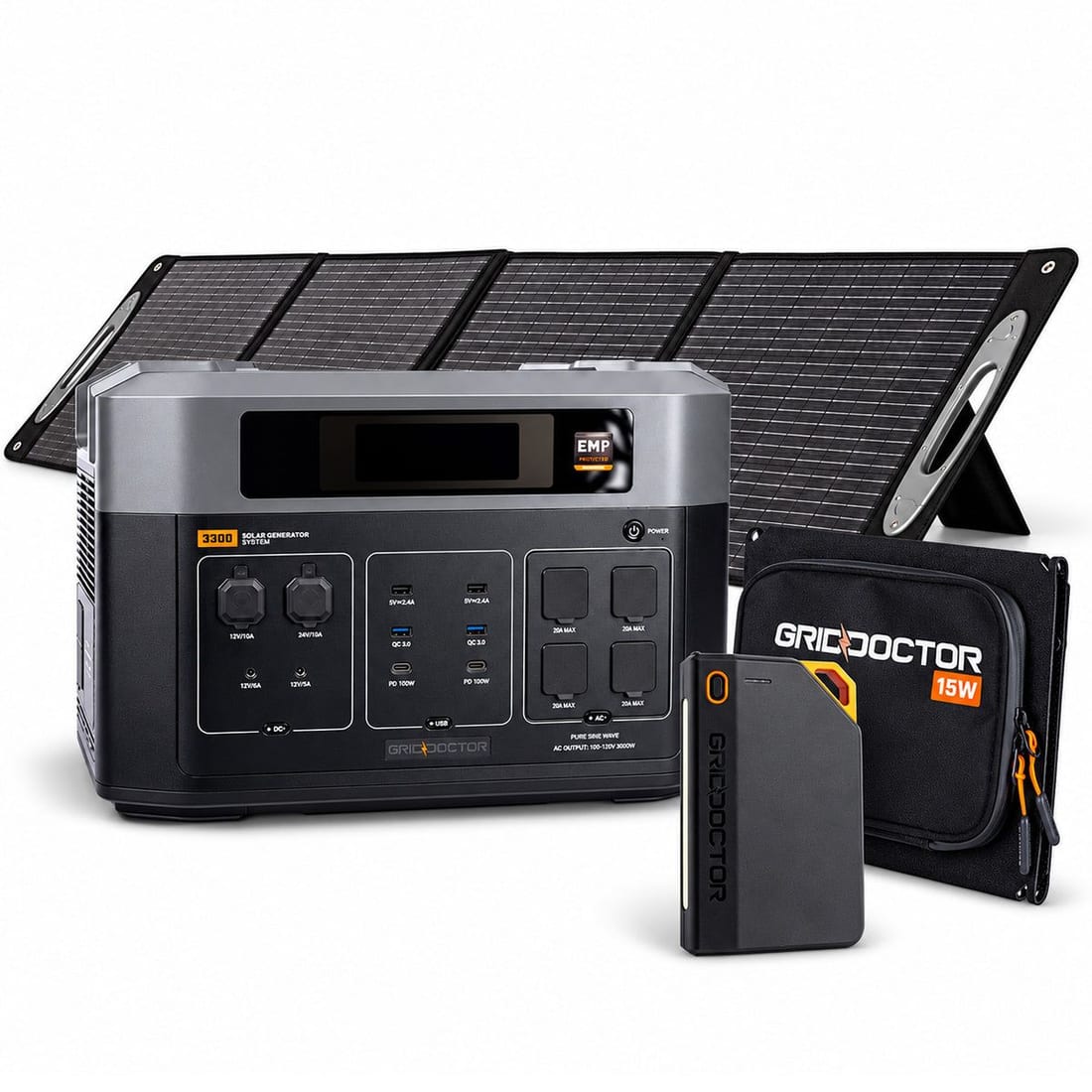
| Essential Off-Grid Power Kit (BePrepared) | 3300 system + 65 W power bank with 15 W panel | $3,116.90 | Families who want a grab-and-go charger for phones and a laptop |
| Total Off Grid Power Bundle (Camping Survival) | 3300 system + Grid Doctor 300 (320 Wh) with 100 W panel + 65 W power bank | $3,613.90 | Two-location setups: house plus truck, camp or a second room |
Prices from mypatriotsupply.com, beprepared.com and campingsurvival.com on November 6, 2026. My Patriot Supply also offers Affirm financing from about $104/month.
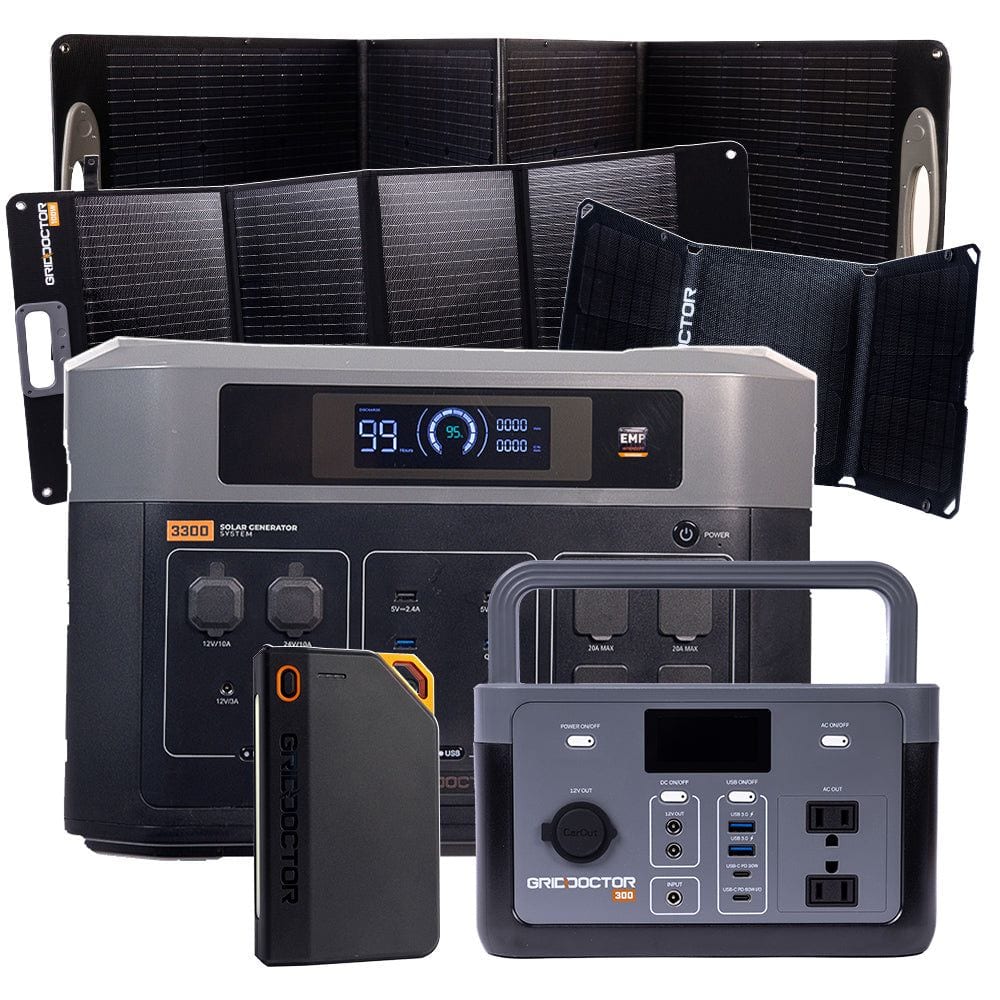
The add-on we would think about first is a second 200 W waterproof panel ($447). With two panels a clear day puts back roughly 1,600 Wh by our estimate, enough to run a fridge and the essentials on sun alone. If you want a smaller unit for the truck instead, the Grid Doctor 300 system ($497) packs 320 Wh and a 100 W panel into 8.6 lb.
Who should buy the Grid Doctor 3300
- Families in storm country who lose power for a day or three after hurricanes, ice storms or heat waves and want the fridge, freezer, lights and Wi-Fi to keep going.
- Anyone on home medical equipment like a CPAP or oxygen concentrator who needs UPS-style backup. Check your device's watts first.
- RV and trailer owners who want a 30 A plug-in without a gas generator at the campsite.
- Preppers who already store food and water and want the power piece that recharges from the sun.
Skip it if you need to back up a whole house or anything on 240 V (that is a standby generator or a home battery job), or you only need to keep phones and lights going, where a much smaller unit makes more sense. See our best portable power stations and best solar generators for smaller and cheaper options, and our best emergency generators if you need whole-house power.
Before you buy: shipping, returns and warranty
- Shipping time. When we checked, My Patriot Supply's shipping page asked customers to allow 8–14 business days for orders to be packed and shipped because of high order volume. Shipping is free on the system. Do not wait for the storm warning to order.
- Returns. My Patriot Supply accepts returns within 30 days on unopened, unused products only; you pay return shipping, and shipping costs are deducted from the refund. Lithium batteries also need hazmat paperwork to ship back. In other words, decide before you open the box.
- Warranty. The product page lists My Patriot Supply's Disaster Replacement Warranty, which replaces eligible products destroyed by a natural disaster such as a fire, flood or hurricane. It is not a defect warranty, and we did not find a published defect-warranty term for the 3300 on the product pages, so ask the store (866-229-0927) before you buy.
- Charging tip from the maker. Grid Doctor says not to charge the 3300 from a GFCI outlet, and to store it at 60% charge or more, topping it up every 3 months.
Frequently asked questions
How long will a Grid Doctor 3300 run a refrigerator?
About 29 hours for a typical full-size fridge on one full charge, by our estimate (2,048 Wh at 85% efficiency, with an average fridge draw of about 60 W). My Patriot Supply says "30+ hours depending on the model." Solar charging during the day stretches that much further.
Does the Grid Doctor 3300 really protect against an EMP?
Grid Doctor says its built-in EMP Intercept protects against up to 260,000 amps AC and 152,000 amps DC with a 3-nanosecond reaction, and that it guards against EMPs, lightning and grid surges. We found no independent EMP test results, so treat the EMP part as the maker's claim. Some owners also store the unit in a Faraday bag.
Can the Grid Doctor 3300 run a whole house?
No. It is 120 V only and holds 2,048 Wh, so it runs essentials, not a whole house. It will not power 240 V loads such as a well pump, central air or an electric range.
How do you charge the Grid Doctor 3300?
From a wall outlet (1,800 W quick or 600 W slow mode, not a GFCI outlet), from solar panels (up to 1,000 W, 12–120 V) or from a 12 V or 24 V vehicle socket. You can use it while it charges.
How much does the Grid Doctor 3300 weigh?
57.2 lb for the generator and 19.2 lb for the included 200 W panel, per Grid Doctor's specs.
Is it safe to use the Grid Doctor 3300 indoors?
Yes. It burns no fuel and makes no fumes, so Grid Doctor rates it safe for indoor use. Keep it dry and ventilated while it charges.
Where is the best place to buy the Grid Doctor 3300?
The system was $2,997 at My Patriot Supply, BePrepared and Camping Survival on November 6, 2026. The bundles at BePrepared ($3,116.90) and Camping Survival ($3,613.90) add smaller Grid Doctor units at their normal prices.
Can I return the Grid Doctor 3300 if I don't like it?
Only if it is unopened and unused, within 30 days, at My Patriot Supply. You pay return shipping and the original shipping cost is deducted, so make the decision before you open it.
The bottom line
The Grid Doctor 3300 is a serious piece of preparedness gear: 3,300 W of real household power, a long-life LiFePO4 battery, a 30 A RV plug and a waterproof panel in the box. It will keep a fridge cold for over a day on one charge and much longer with the sun on your side. Go in clear-eyed about three things: it is 120 V only, the EMP protection is the maker's claim, and returns only work if the box stays sealed. If that fits your plan, buy the system, add a second panel, and keep your food and water stored next to it. Building out the rest of the plan? See our best emergency food supply, best emergency radios and My Patriot Supply review.
Get the free Blackout-Ready Home Checklist — join the OSS America newsletter for honest gear guides like this one, straight to your inbox.
Talk soon,
OSS AMERICA
God · Family · Country · Gear that earns its keep.
FTC Disclosure: OSS America contains affiliate links. We earn a commission from qualifying purchases at no extra cost to you. Every pick is research-based: specs, verified prices and owner reviews.
More reviews
 Portable Power
Essential Off-Grid Power Kit Review: Grid Doctor 3300 Plus a Power Bank for Home and Away
BePrepared's Essential Off-Grid Power Kit pairs the Grid Doctor 3300 and a 200 W panel with a 65 W power bank and its own 15 W panel. What each piece runs, the real price math and who should buy it.
 Portable Power
EcoFlow DELTA Pro 3 Review (2026): Specs, Real Price, Owner Reviews and Rivals
An honest EcoFlow DELTA Pro 3 review: 4,096Wh, 4,000W, 120/240V, every bundle priced per kWh, what 69 owners say, the either/or 240V catch, and how it stacks up against the DELTA Pro Ultra and BLUETTI Apex 300.
 Portable Power
EcoFlow vs BLUETTI (2026): Which Power Station Gives You More for Your Money?
EcoFlow vs BLUETTI, compared size class by size class: price per kWh, output, weight, cycle ratings, warranty and returns for 1 kWh, 2 kWh, 3 kWh and 240V home backup units, plus which to buy.
 Portable Power
EcoFlow DELTA Pro Ultra X vs Tesla Powerwall 3 (2026): Which Home Battery Fits Your House?
EcoFlow DELTA Pro Ultra X vs Tesla Powerwall 3, compared from the makers' own specs: capacity, power, solar input, expansion, warranty, weight, installation, pricing and the 2026 tax-credit reality.
 Portable Power
EcoFlow vs Jackery (2026): Which Power Station Gives You More for Your Money?
EcoFlow vs Jackery, compared size class by size class: price per kWh, output, weight, cycle ratings, warranty and returns for 1 kWh, 2 kWh, 3 kWh and 240V home backup units, plus which to buy.
 Portable Power
14 Best-Selling Home Power Products of 2026 (Not a Ranking)
Not a ranking — nobody won. Fourteen of the best-selling home power products on the market, with what each one actually does: the watts, the hours, the fuel, the install, and the honest limits. You decide which fits your house.