
Best Portable Power Stations for CPAP Machines: Power Outages and Camping Nights

If you sleep on a CPAP, a power outage isn't an inconvenience. It's a bad night, or a string of them. The same goes for a hunting camp or a campground with no hookups. A portable power station is the quiet, no-fumes way to keep the machine running, and searches for a "power station for CPAP" have gone from almost nothing to steady interest this fall as storm season and camping trips stack up.
Buy too small and you're out of power at 3 a.m.; buy too big and you're hauling 45 pounds you didn't need. We compared seven stations from 288 Wh to 2,048 Wh using the makers' own specs, live prices and owner reviews, and estimated how many nights each one runs a CPAP with and without a heated humidifier. This is research-based, not a hands-on test, and it isn't medical advice: check your own machine's power specs with your CPAP maker or equipment supplier, and talk to your doctor about backup power if you depend on therapy.
The short answer
For a CPAP, look for 12V DC output, a quiet fan and, for outages, a fast backup switchover. Our picks:
- Best overall: EcoFlow DELTA 3, about $579, 1,024 Wh, UPS under 10 ms, car outlet. Check price at EcoFlow →
- Best value: BLUETTI AC180, about $499, 1,152 Wh, 449 reviews. Check price at BLUETTI →
- Best for camping: EcoFlow RIVER 2 Pro, about $369, 768 Wh, 18.2 lb. Check price at EcoFlow →
- Best small AC station: BLUETTI Elite 30 V2, about $290, 288 Wh, 9.48 lb. Check price at BLUETTI →
- Best for long outages: EcoFlow DELTA 3 Max, about $879, 2,048 Wh. Check price at EcoFlow →
Prices checked November 8, 2026 on each maker's own store, before tax. They change often.
How we chose
This guide is built from research, not from our own nights on these machines. We started with the search demand: Google interest in "power station for CPAP" went from zero to 21 over the last 30 days in the U.S. Then we read each model's specs, price, stock and owner reviews on the maker's own store on November 8, 2026.
For a CPAP we weighted five things: usable capacity (how many nights per charge), a 12V DC outlet (so the machine can run from its DC cord or converter), the backup switchover time for outages, fan noise next to the bed, and weight for camping. We dropped two candidates: EcoFlow's RIVER 3 Plus wasn't for sale on EcoFlow's U.S. store, and the DELTA 3 Classic's spec table lists no 12V car outlet.
To estimate runtime, the CPAP draw comes from ResMed's battery guide for running its machines from a deep-cycle battery. It lists an AirSense 10 at 20 cmH2O without a humidifier at about 1.66 amps at 12 volts (about 20 watts), and at 10 cmH2O with the humidifier on 8 and a heated tube at about 4.92 amps (about 59 watts). We rounded those to 20 W and 60 W and assumed 8-hour nights and 85% of rated capacity actually reaching the machine.
All seven at a glance
| # | Station | Size | Capacity | AC output | 12V outlet | Backup switch | Weight | Nights (20 W / 60 W) | Price | Store |
|---|---|---|---|---|---|---|---|---|---|---|
| #1 | EcoFlow DELTA 3 | Mid | 1,024 Wh | 1,800W | Yes, 120-126W | UPS <10 ms | 27.6 lb | 5.4 / 1.8 | $579.00 | EcoFlow |
| #2 | BLUETTI AC180 | Mid | 1,152 Wh | 1,800W | Yes, 120-126W | Not listed | 35.3 lb | 6.1 / 2.0 | $499.00 | BLUETTI |
| #3 | EcoFlow RIVER 2 Pro | Mid | 768 Wh | 800W | Yes, 120-126W | EPS <30 ms | 18.2 lb | 4.1 / 1.4 | $369.00 | EcoFlow |
| #4 | BLUETTI Elite 30 V2 | Small | 288 Wh | 600W | Yes, 120-126W | UPS ≤10 ms | 9.48 lb | 1.5 / 0.5 | $289.99 | BLUETTI |
| #5 | EcoFlow TRAIL 300 DC | Small | 288 Wh | None (DC only) | Yes, 120W | None | 5.69 lb | 1.5 / 0.5 | $159.00 | EcoFlow |
| #6 | EcoFlow DELTA 3 Max | Large | 2,048 Wh | 2,400W | Yes, 120-126W | UPS <10 ms | 44.8 lb | 10.9 / 3.6 | $879.00 | EcoFlow |
| #7 | Jackery Explorer 1000 Plus | Mid | 1,264 Wh | 2,000W | Yes, 120-126W | EPS, time not listed | 32 lb | 6.7 / 2.2 | $619.00 | Amazon (price: Jackery list) |
Prices and stock checked November 8, 2026 on each maker's own store; they change often. Jackery's price is its jackery.com list price (the link goes to an Amazon search). Nights are our estimates (see How we chose). Switchover times are maker claims.
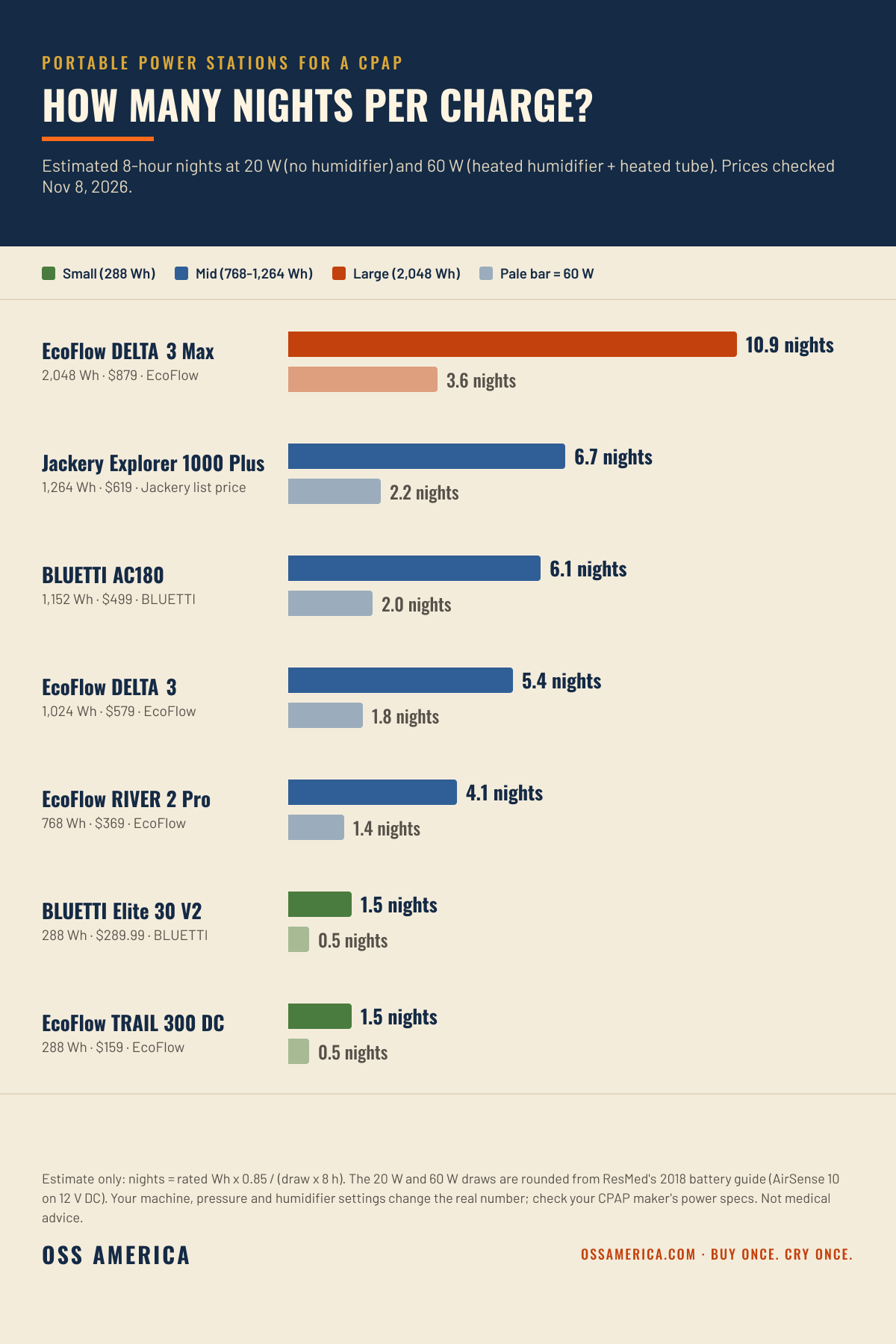
How to read the chart: the humidifier is the whole story. Turn on a heated humidifier and tube and every number drops to about a third, which is why the 1 kWh class is the sensible middle: about two humidified nights or five dry ones. These are estimates; pressure, mask leak, humidifier settings, temperature and the station's own standby draw all move the real number, so do a trial night at home.
The 7 best portable power stations for a CPAP, ranked
EcoFlow DELTA 3 Portable Power Station (1024Wh)
Best overall power station for a CPAP
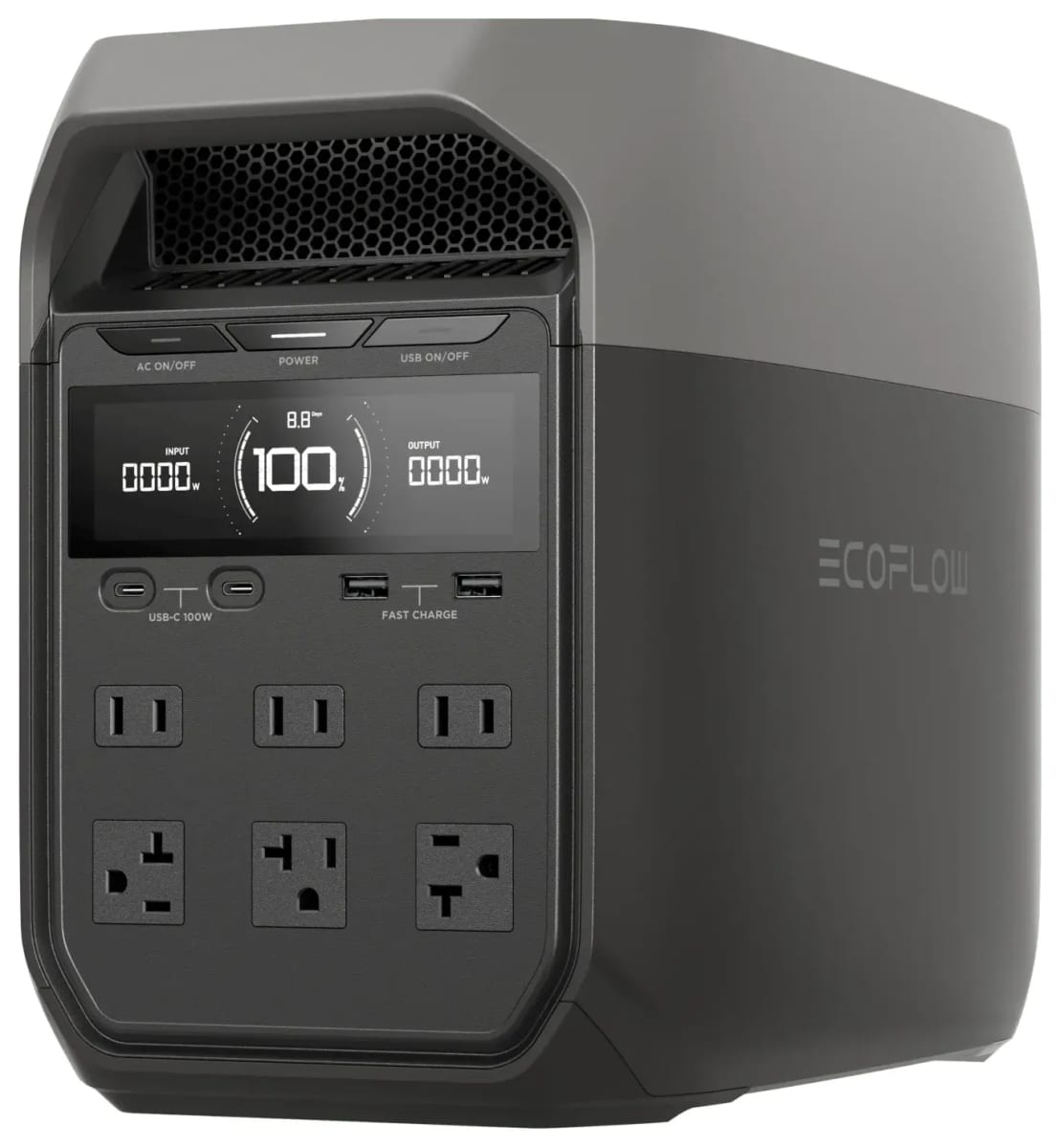
EcoFlow: $579.00 (regular $699.00), in stock on November 8 · Capacity: 1,024 Wh LFP · Weight: 27.6 lb · CPAP estimate: about 5.4 nights at 20 W, 1.8 at 60 W (our estimate)
The EcoFlow DELTA 3 ticks every box that matters for a sleep machine. It holds 1,024 Wh in LFP (lithium iron phosphate) cells, which EcoFlow rates at 4,000 cycles to 80% capacity. It has a real 12-volt car outlet (12.6V, 10A, 126W max) plus two DC5521 barrel ports, so you can run a CPAP from its DC power cord or converter instead of going through the AC inverter. It has a UPS switchover EcoFlow lists at under 10 milliseconds, and EcoFlow lists the fan at under 30 dB at 600W. A CPAP draws far less than that.
That UPS number matters if you sleep through storms. Leave the CPAP plugged into the DELTA 3 and the DELTA 3 plugged into the wall: when the grid drops, EcoFlow says the station takes over in under 10 ms. That's EcoFlow's claim, so check your CPAP's manual for how it handles a power blip.
On our ResMed-based estimate, a full charge covers roughly five nights with the humidifier off, or a bit under two with a heated humidifier and heated tube. The honest weak spot is the sales record on EcoFlow's own site: just 3 reviews (all five stars) on November 8. It's a current model with a short track record.
| Capacity | 1,024 Wh, LFP, 4,000 cycles to 80%+ |
| AC output | 6 outlets, 1,800W (3,600W surge) |
| 12V DC | Car outlet 126W max + 2 x DC5521 |
| UPS switchover | <10 ms (EcoFlow) |
| Noise | <30 dB at 600W, <40 dB at 1,200W (EcoFlow) |
| Recharge | AC 1,500W; solar 500W max; alternator charger optional |
| Weight | 27.6 lb |
| Warranty | 5 years |
Pros
- + 12V car outlet runs a CPAP DC cord without the inverter
- + Sub-10 ms UPS for storm nights
- + Quiet fan rating at light loads
- + Expandable with EcoFlow extra batteries
Cons
- − Only 3 owner reviews on EcoFlow's site
- − 27.6 lb is heavy for a tent site
- − Under two nights with a heated humidifier
BLUETTI AC180 Portable Power Station (1152Wh)
Best value, and the most-reviewed pick
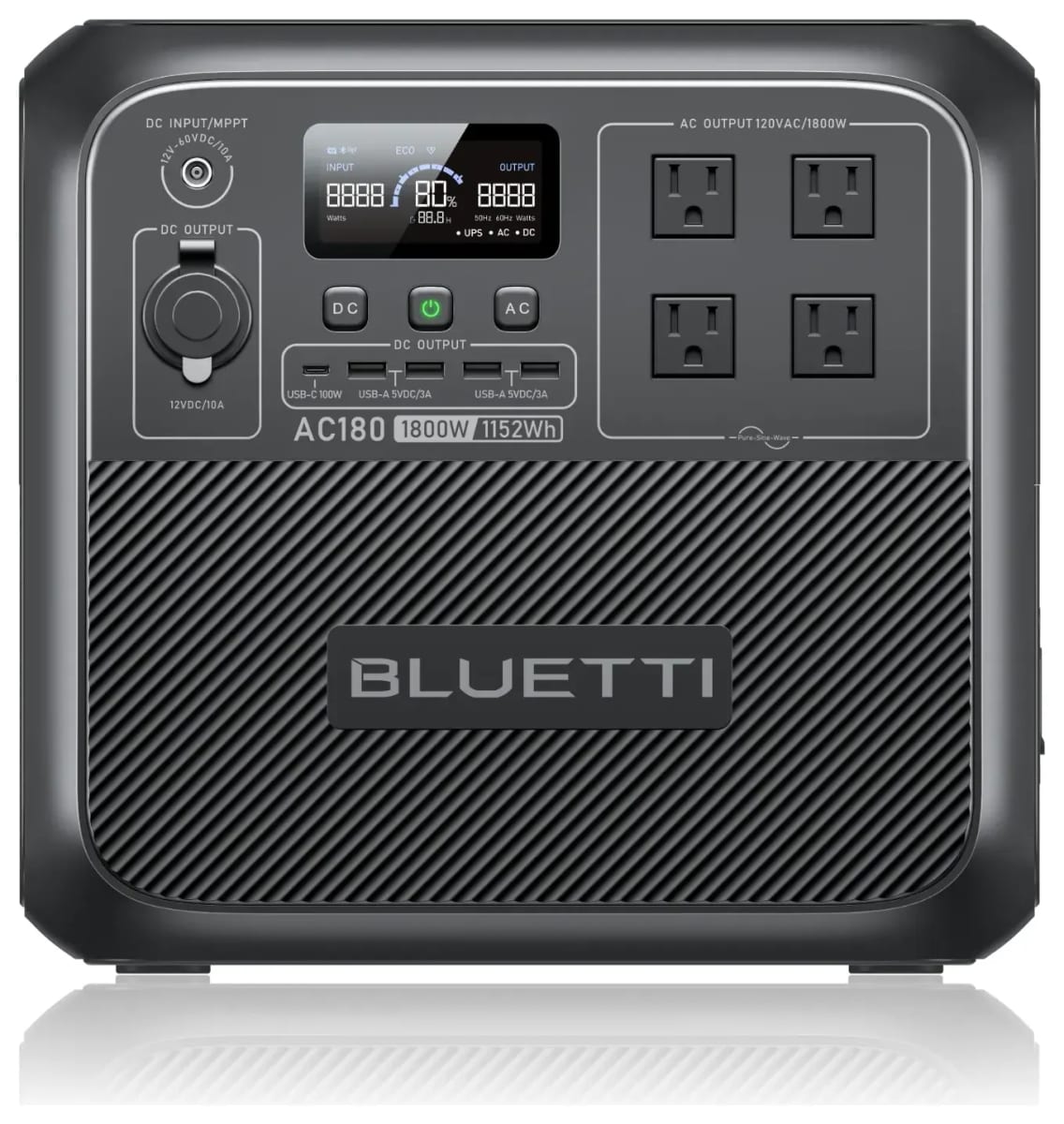
BLUETTI: $499.00, in stock on November 8 · Capacity: 1,152 Wh LiFePO4 · Weight: 35.3 lb · Owner rating: 4.8 from 449 reviews · CPAP estimate: about 6.1 nights at 20 W, 2.0 at 60 W (our estimate)
If you want the most battery per dollar with a real sales record behind it, the BLUETTI AC180 is it. On November 8 it was $499.00 for 1,152 Wh, the lowest price per watt-hour of the 1 kWh-class picks in this guide, and it showed 449 owner reviews averaging 4.8 stars on BLUETTI's site, far more than any other pick here.
BLUETTI lists four 120V outlets (1,800W total, with a 2,700W Power Lifting mode for heating loads), a 12V DC outlet, USB-A, USB-C and a wireless charging pad, LiFePO4 cells rated for 3,500+ cycles, 1,440W AC charging, 500W solar input and a 5-year warranty.
Two things to know before you buy it for a CPAP. First, the AC180 page we read doesn't list a UPS switchover time or a noise rating, so if you need it to take over the instant the power drops, confirm that with BLUETTI before you count on it. Second, weight: the spec table says 35.3 lb and the feature copy says 37 lb. Either way, this lives on a nightstand or in the truck, not in a backpack.
| Capacity | 1,152 Wh, LiFePO4, 3,500+ cycles |
| AC output | 4 x 120V, 1,800W (2,700W Power Lifting) |
| 12V DC | 12V DC outlet (BLUETTI) |
| UPS switchover | Not listed on the AC180 page |
| Recharge | AC 1,440W; solar 500W max; car; generator |
| Weight | 35.3 lb (spec table; 37 lb in feature copy) |
| Warranty | 5 years |
| Owner rating | 4.8 (449 reviews, BLUETTI) |
Pros
- + Most-reviewed station in this guide
- + Lowest price per Wh in the 1 kWh class
- + Expandable with BLUETTI batteries
- + 5-year warranty
Cons
- − No UPS time or noise rating on the page we read
- − Heaviest of the 1 kWh class here
- − Weight listed two ways
EcoFlow RIVER 2 Pro Portable Power Station (768Wh)
Best for CPAP camping trips
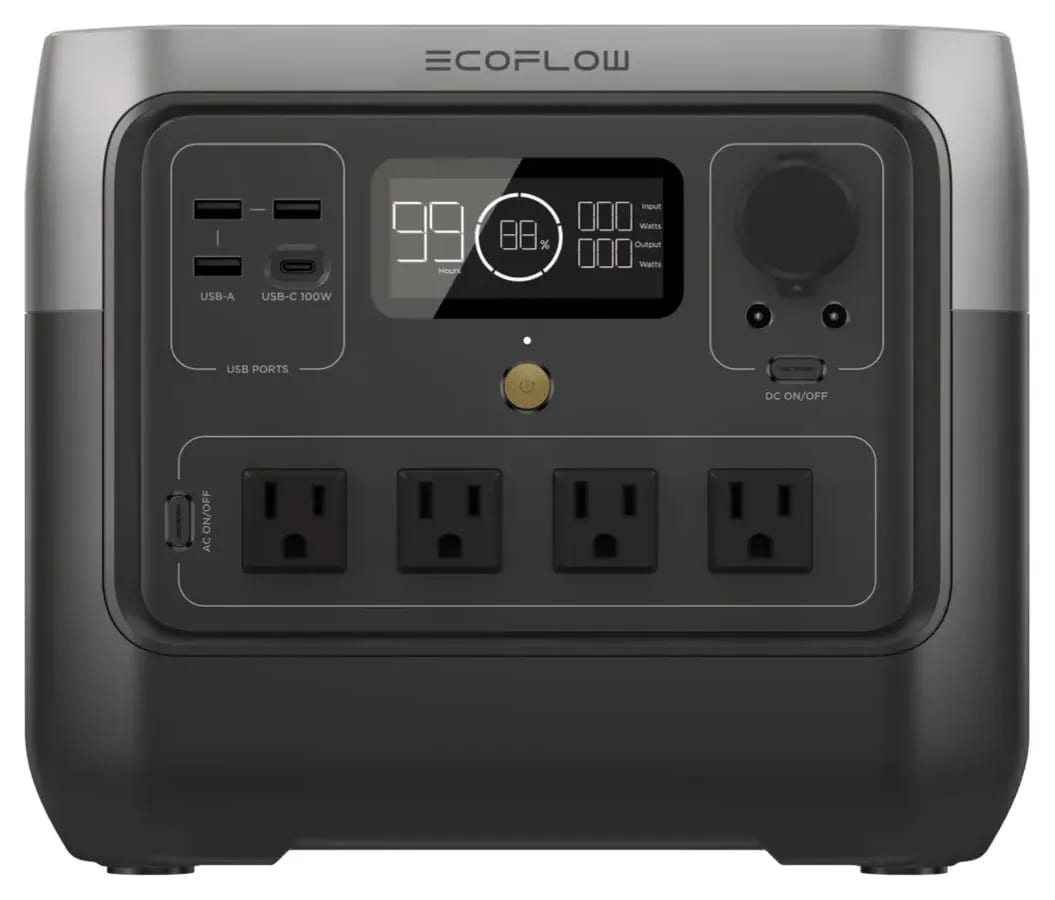
EcoFlow: $369.00 (regular $529.00), in stock on November 8 · Capacity: 768 Wh LFP · Weight: 18.2 lb · Owner rating: 4.9 from 242 reviews · CPAP estimate: about 4.1 nights at 20 W, 1.4 at 60 W (our estimate)
For a weekend at camp, the RIVER 2 Pro is the sweet spot between a 288 Wh box that barely makes one night and a 30-pound station you dread carrying from the truck. EcoFlow lists 768 Wh in LFP cells, 18.2 pounds, a pure sine wave 800W inverter (1,600W X-Boost), a 12.6V car outlet (126W max) and a DC5521 port. At $369.00 it's $160.00 off EcoFlow's regular price, and owners back it: 242 reviews averaging 4.9 stars on EcoFlow's site on November 8.
By our estimate it covers about four nights with the humidifier off, or one long weekend night plus some with a heated humidifier.
Two caveats from EcoFlow's own page: its EPS auto-switch is listed at under 30 ms (slower than the DELTA 3's under 10 ms), and a footnote says it "may make a noise up to 62db" when charging and discharging at high wattage. A CPAP alone is a light load, but don't fast-charge it next to your head at 2 a.m.
| Capacity | 768 Wh, LFP, 3,000 cycles to 80%+ |
| AC output | Pure sine wave, 800W (1,600W X-Boost) |
| 12V DC | 12.6V car outlet, 126W max + DC5521 36W |
| EPS switchover | <30 ms (EcoFlow) |
| Noise | Up to 62 dB at high wattage (EcoFlow footnote) |
| Recharge | AC 940W (0-100% in 70 min, EcoFlow); solar 220W; car 100W |
| Weight | 18.2 lb |
| Owner rating | 4.9 (242 reviews, EcoFlow) |
Pros
- + Big owner-review base, 4.9 stars
- + Light enough to carry to a campsite
- + Car outlet for a CPAP DC cord
- + Fast AC recharge
Cons
- − EPS switchover slower than the DELTA 3
- − Can get loud under heavy charging
- − Older model; EcoFlow doesn't list its warranty in the spec table
BLUETTI Elite 30 V2 Portable Power Station (288Wh)
Best small AC station for one night
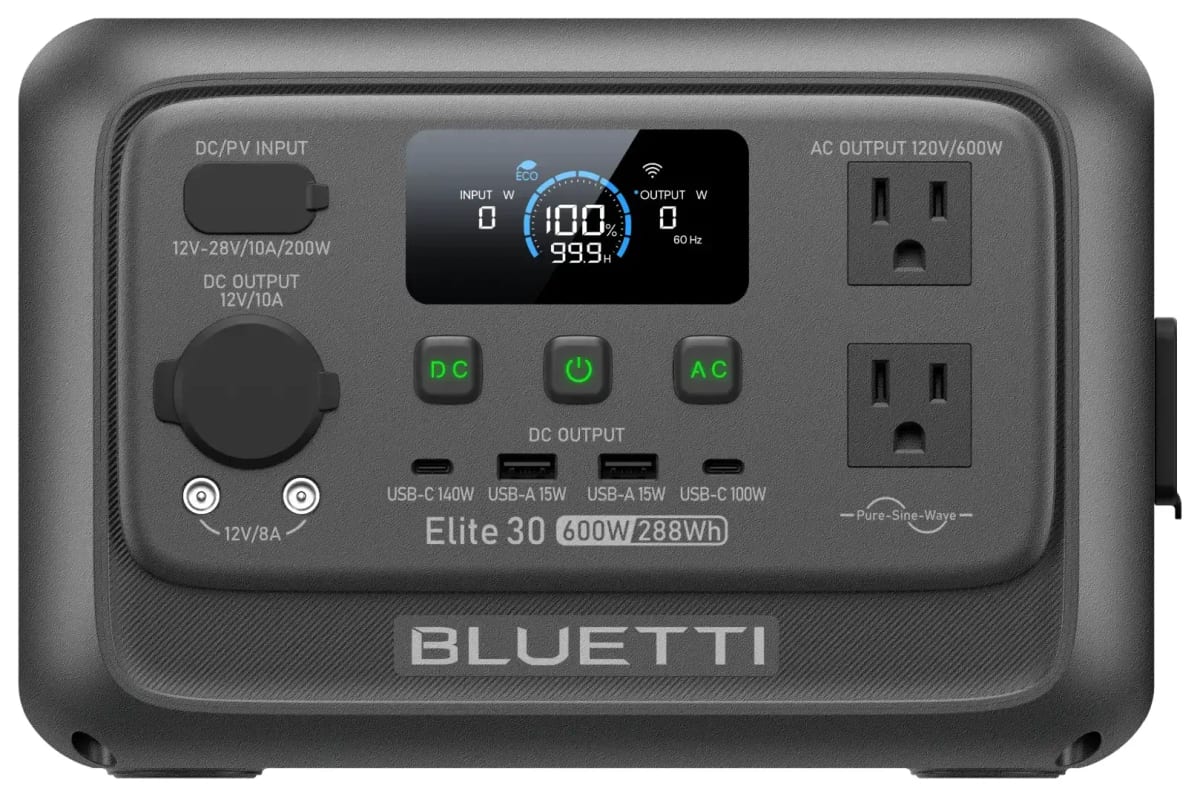
BLUETTI: $289.99, in stock on November 8 · Capacity: 288 Wh LiFePO4 · Weight: 9.48 lb · Owner rating: 4.8 from 107 reviews · CPAP estimate: about 1.5 nights at 20 W, 0.5 at 60 W (our estimate)
The BLUETTI Elite 30 V2 is the smallest station here that still has AC outlets, a UPS and a quiet fan. BLUETTI lists 288 Wh of LiFePO4, a 600W pure sine wave inverter, a 12V/10A car outlet and two 12V/5A DC5521 ports, a UPS switchover of 10 ms or less, a noise level of 30 dB, and a weight of 9.48 pounds. It showed 107 owner reviews averaging 4.8 stars on BLUETTI's site on November 8.
Be realistic about 288 Wh, though. By our estimate that's about one and a half nights with the humidifier off, and only about half a night with a heated humidifier and heated tube running. It's a one-night bridge through a short outage or a single night at a tent site, not a week's supply.
BLUETTI also says the Elite 30 V2 cuts its own standby draw to as little as 4.5W. That matters on a small battery: on a light CPAP load, the station's own overhead is a bigger share of the total.
| Capacity | 288 Wh, LiFePO4, 3,000+ cycles to 80% |
| AC output | Pure sine wave, 600W (1,500W lifting) |
| 12V DC | 12V/10A car outlet + 2 x 12V/5A DC5521 |
| UPS switchover | 10 ms or less (BLUETTI) |
| Noise | 30 dB (BLUETTI) |
| Recharge | AC (80% in 45 min); solar 200W; car; generator |
| Weight | 9.48 lb |
| Warranty | 5 years |
Pros
- + UPS, quiet fan and AC in a 9.5 lb box
- + Car outlet and two DC5521 ports
- + 107 reviews, 4.8 stars
- + 5-year warranty
Cons
- − About half a night with a heated humidifier
- − No battery expansion (BLUETTI FAQ)
- − Costs more than the DC-only TRAIL 300
EcoFlow TRAIL 300 DC Portable Power Station (288Wh)
Best budget DC-only pick (needs your CPAP's DC cord)
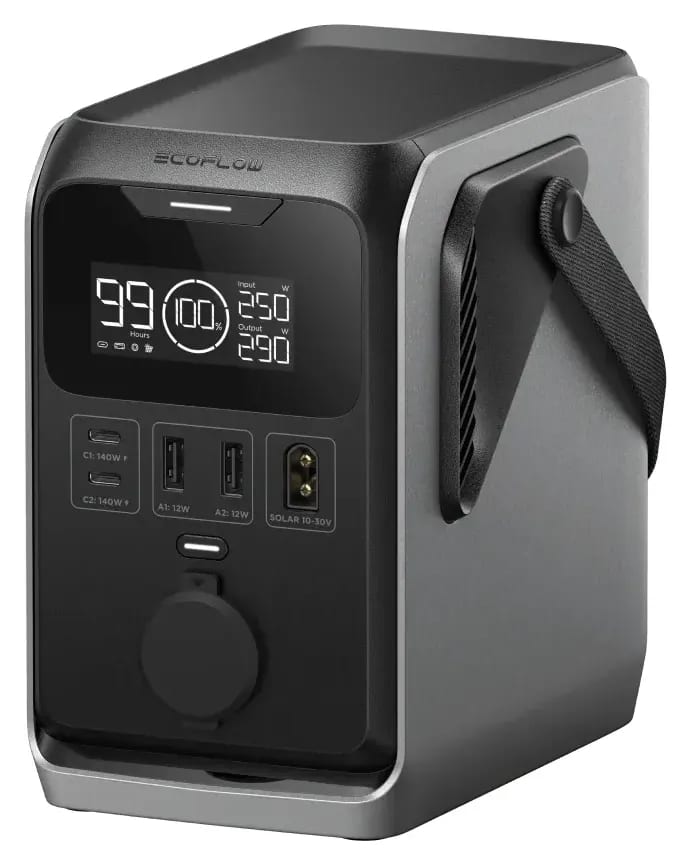
EcoFlow: $159.00 (regular $250.00), in stock on November 8 · Capacity: 288 Wh LFP · Weight: 5.69 lb · CPAP estimate: about 1.5 nights at 20 W, 0.5 at 60 W (our estimate)
The TRAIL 300 DC is the cheapest and lightest way to carry a CPAP night into a tent, with one big condition: it has no AC outlet. EcoFlow lists 288 Wh of LFP cells, a 12V car outlet rated 120W max, two 140W USB-C ports and two USB-A ports, 300W total output, and a weight of 5.69 pounds. So it only works for a CPAP if you have your machine maker's DC power cord or DC/DC converter, the kind ResMed sells for its AirSense machines.
That's not a flaw for CPAP use: ResMed's battery guide says it strongly recommends running its machines from DC-to-DC converters rather than inverters. Just check that your converter's draw fits the 120W car outlet.
At $159.00 with a 3-year warranty it's a strong buy, but the sales signal is thin: EcoFlow showed no owner reviews on the page on November 8. Capacity is the same 288 Wh as the BLUETTI Elite 30 V2, so plan on roughly one and a half humidifier-off nights per charge.
| Capacity | 288 Wh, LFP |
| AC output | None (DC only) |
| 12V DC | Car outlet 120W max |
| USB | 2 x USB-C 140W, 2 x USB-A 12W |
| Total output | 300W |
| Recharge | USB-C 140W; solar/car 110W max |
| Weight | 5.69 lb |
| Warranty | 3 years |
Pros
- + Lightest and cheapest pick here
- + DC-only is ResMed's preferred way to run on battery
- + 140W USB-C recharge from a laptop-style charger
- + 3-year warranty
Cons
- − No AC outlet: you need your CPAP's DC cord or converter
- − No owner reviews shown yet
- − No UPS function
EcoFlow DELTA 3 Max Portable Power Station (2048Wh)
Best for multi-night outages
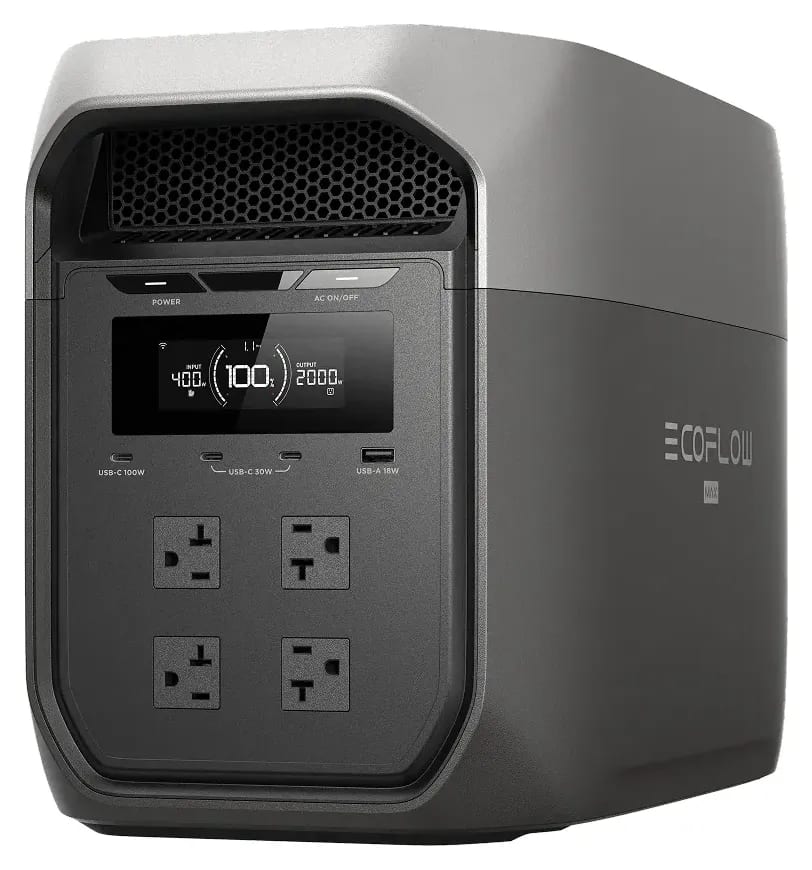
EcoFlow: $879.00 (regular $1,199.00), in stock on November 8 · Capacity: 2,048 Wh LFP · Weight: 44.8 lb · CPAP estimate: about 10.9 nights at 20 W, 3.6 at 60 W (our estimate)
If your worry is a hurricane or ice storm that knocks power out for days, the DELTA 3 Max is the one to buy. EcoFlow lists 2,048 Wh of LFP cells, 2,400W of AC output across four 20A outlets (3,400W X-Boost), a 12.6V cigarette-lighter outlet (126W max), a UPS switchover under 10 ms, 500W of solar input and a 5-year warranty with app registration.
That's enough, by our estimate, for about ten humidifier-off nights or three-plus nights with a heated humidifier and tube. At $879.00 on November 8 (down from $1,199.00), it also costs less per watt-hour than the DELTA 3.
The trade-offs: at 44.8 pounds it stays home, and the standalone listing showed no owner reviews on November 8 (the DELTA 3 Max Series listing sat sixth in EcoFlow's best-selling sort). EcoFlow doesn't list a noise level for it.
| Capacity | 2,048 Wh, LFP |
| AC output | 4 x 20A outlets, 2,400W (3,400W X-Boost) |
| 12V DC | Cigarette-lighter outlet 12.6V 10A, 126W max |
| UPS switchover | <10 ms (EcoFlow) |
| Recharge | AC; solar 500W max; alternator charger optional |
| Weight | 44.8 lb (20.3 kg) |
| Warranty | 5 years (3 + 2 with app registration) |
Pros
- + Days of CPAP power on one charge, by our estimate
- + Sub-10 ms UPS
- + Lower price per Wh than the DELTA 3
Cons
- − 44.8 lb, not a camping box
- − No owner reviews on the standalone listing
- − No noise rating listed
Jackery Explorer 1000 Plus Portable Power Station (1264Wh)
Best Jackery option
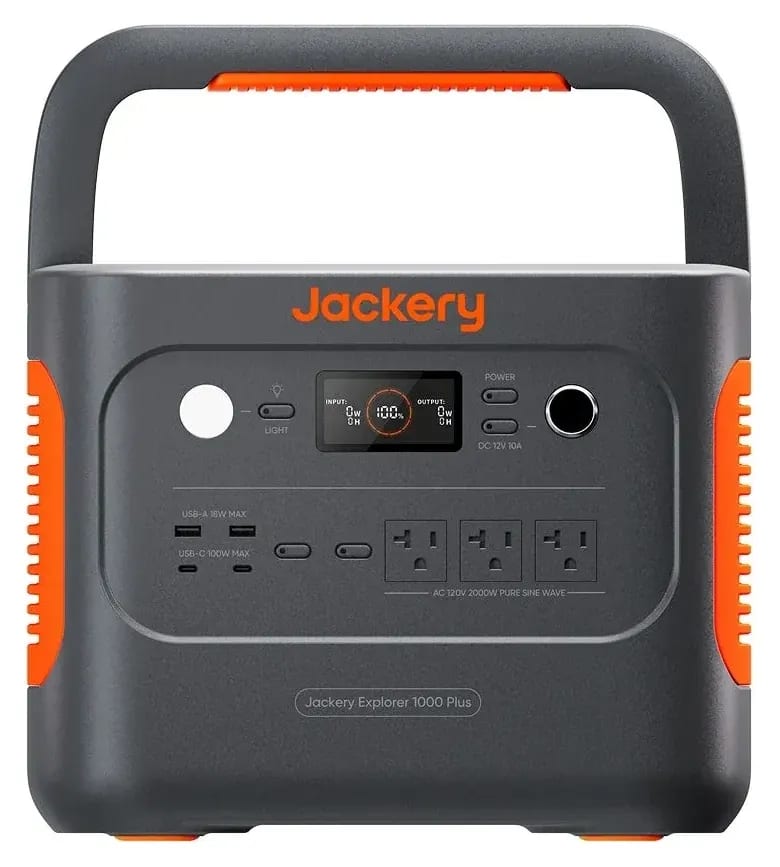
Price: about $619 (Jackery's own list price on jackery.com on November 8, down from $699.00; the button goes to an Amazon search, so check the price there) · Capacity: 1,264 Wh LiFePO4 · Weight: 32 lb · CPAP estimate: about 6.7 nights at 20 W, 2.2 at 60 W (our estimate)
Jackery is the name many people already know, and the Explorer 1000 Plus is its mid-size LiFePO4 model. Jackery lists 1,264 Wh, a 2,000W inverter (4,000W surge) with three AC outlets, a 12V/10A car port, two 100W USB-C ports, 4,000 cycles to 70%+ capacity, 1.7-hour AC charging, up to 800W of solar input and a 3+2-year warranty. It weighs 32 pounds and can be expanded with Jackery battery packs. Jackery's site showed 189 owner reviews, 87% of them five stars, on November 8.
One owner review on Jackery's site matters for CPAP use. The owner found its EPS mode isn't a pass-through UPS, that a fan runs the whole time, and that "the unit shuts off after a period of time" when the load is below a certain level. A CPAP with the humidifier off is exactly that kind of small load. If you go Jackery, test it on a few normal nights first.
| Capacity | 1,264 Wh, LiFePO4, 4,000 cycles to 70%+ |
| AC output | 3 x 120V, 2,000W (4,000W surge) |
| 12V DC | Car port 12V 10A |
| Backup mode | EPS (no switchover time on the page) |
| Recharge | AC 1.7 h; solar 800W max; car 7 h |
| Weight | 32 lb |
| Warranty | 3 + 2 years |
| Owner reviews | 189 on jackery.com (87% five-star) |
Pros
- + Most capacity among the 1 kWh-class picks
- + Strong owner record on Jackery's site
- + Fast 1.7-hour AC charge
- + Expandable
Cons
- − An owner reports it shutting off under small loads
- − EPS is not a pass-through UPS, per that owner
- − Not sold by our tracked stores; link goes to an Amazon search
Which should you buy?
- You want one station for outages and the occasional camping trip: EcoFlow DELTA 3.
- You want the most capacity for the money with lots of owner reviews: BLUETTI AC180.
- You camp or hunt for a weekend and carry it from the truck: EcoFlow RIVER 2 Pro.
- You need one night with AC and a UPS in a small box: BLUETTI Elite 30 V2.
- You have your CPAP's DC cord and want the lightest, cheapest option: EcoFlow TRAIL 300 DC.
- You live where outages last days: EcoFlow DELTA 3 Max.
- You prefer Jackery: Jackery Explorer 1000 Plus, after a few test nights at home.
Comparing more brands? See our best portable power stations guide and our EcoFlow vs BLUETTI comparison.
What to look for in a power station for a CPAP
Your CPAP's real power draw
Start with the machine, not the battery. Your CPAP's manual or power supply label lists its input, and your CPAP maker or equipment supplier can tell you what it actually draws at your pressure. ResMed's battery guide shows how much the humidifier changes things: on an AirSense 10 at 10 cmH2O, draw goes from about 0.93 amps at 12 volts with no humidifier to about 4.92 amps with the humidifier on 8 and a heated tube, more than five times as much.
Capacity in watt-hours
Divide usable watt-hours by your nightly use. This guide assumes 85% of rated capacity reaches the machine over 8-hour nights: 288 Wh gives about 1.5 dry nights, 1 kWh about five, 2 kWh about ten. Expect less in a cold tent; EcoFlow lists 14°F as the DELTA models' minimum discharge temperature.
12V DC output
ResMed's guide says it strongly recommends running its machines from DC-to-DC converters rather than inverters, and ResMed sells an AirSense 11 DC/DC converter (12V or 24V input) that it says can run the machine with its HumidAir humidifier and heated tube. Running from 12V skips the inverter and its losses. Every pick here has a 12V car outlet; check that it's rated for your converter's draw.
Pure sine wave AC
If you plug the CPAP's regular power brick into AC, ResMed's guide calls for a pure sine wave inverter rated at 300W continuous, and warns that some of its heated humidifiers must not be used with inverters at all. EcoFlow (RIVER 2 Pro) and BLUETTI (Elite 30 V2) state pure sine wave on the page.
UPS or EPS switchover, noise and weight
For outages, the station sits between the wall and the CPAP and takes over when the grid drops; switchover times are maker claims, and as the Jackery owner review shows, "EPS" can behave differently from a true UPS. Next to the bed, a quiet fan matters (EcoFlow lists the DELTA 3 under 30 dB at 600W; BLUETTI lists 30 dB for the Elite 30 V2). For camping, weight decides what you'll carry.
Not medical advice: what to check first
We're a gear site, not a medical provider. Before you rely on a battery for therapy, check your CPAP's power specs (watts, DC input, humidifier rules) with the CPAP maker or your equipment supplier, and talk to your doctor about what to do in a long outage. ResMed and Philips both sell DC power accessories for their machines; use the one made for yours.
Do a full trial night on the station at home before a trip or storm season, keep it charged (check it monthly), and if you're on a power company's medical-needs list, let them know about your equipment. Keep the station dry and ventilated, and follow the maker's instructions.
For the rest of your outage kit
A CPAP station is one piece of the plan. See our best emergency generators for whole-house backup, and our best emergency radios for staying informed when the power's out.
Frequently asked questions
What size power station do I need for a CPAP?
Work it out from your machine's draw. Using rounded figures from ResMed's battery guide (about 20 watts without a humidifier, 60 watts with a heated humidifier and tube), 8-hour nights and 85% usable capacity, a 288 Wh station gives about 1.5 dry nights or half a humidified night, and a 1,024 Wh station about 5.4 dry nights or 1.8 humidified. Check your own machine's specs with your CPAP maker or supplier.
How long will a 1000Wh power station run a CPAP?
By our estimate, about five 8-hour nights with the humidifier off and a little under two with a heated humidifier and heated tube. The EcoFlow DELTA 3 (1,024 Wh) works out to about 5.4 and 1.8 nights. Real runtime depends on your pressure, settings and temperature, so test it at home.
Should I run my CPAP on AC or DC from a power station?
DC, if you can. ResMed's battery guide says it strongly recommends DC-to-DC converters over DC-to-AC inverters for running its machines on a battery, and DC skips the inverter's losses. Use your maker's DC cord or converter in the station's 12V outlet.
Can I use a heated humidifier on a power station?
Often, but it costs a lot of runtime: in ResMed's table the humidifier and heated tube push draw from about 11 watts to about 59 watts at the same pressure. ResMed's guide also warns that some of its heated humidifiers must not be used with inverters. Check your machine's manual and ask your supplier.
Can I take a power station camping for my CPAP?
Yes. For a weekend, a 768 Wh station like the EcoFlow RIVER 2 Pro (18.2 lb) covers about 4.1 dry nights by our estimate. For one night with a DC cord, the 5.69 lb EcoFlow TRAIL 300 DC is the lightest option. Makers list operating temperature ranges (EcoFlow lists 14°F as the RIVER 2 Pro's minimum discharge temperature), so keep it dry and out of the worst cold.
Can I recharge it with solar while camping?
Yes. Every pick here takes solar input: 110W on the TRAIL 300 DC, 200W on the Elite 30 V2, 220W on the RIVER 2 Pro, 500W on the DELTA 3, DELTA 3 Max and AC180, and up to 800W on the Jackery Explorer 1000 Plus, per the makers. How much a panel adds per day depends on the panel, the sun and the season.
The bottom line
For most CPAP users, the EcoFlow DELTA 3 is the station to buy: 1 kWh, a car outlet for a DC cord, a fast UPS and a quiet fan. If you'd rather save money and lean on a big owner-review base, the BLUETTI AC180 gives you more capacity for less. Campers should look at the EcoFlow RIVER 2 Pro, and anyone in hurricane or ice-storm country should consider the EcoFlow DELTA 3 Max. Whatever you pick, check your CPAP's power specs, run a test night at home and keep it charged.
Get the free Blackout-Ready Home Checklist — join the OSS America newsletter for honest gear guides like this one, straight to your inbox.
Talk soon,
OSS AMERICA
God · Family · Country · Gear that earns its keep.
FTC Disclosure: OSS America contains affiliate links. We earn a commission from qualifying purchases at no extra cost to you. Every pick is research-based: specs, verified prices and owner reviews.
More reviews
 Portable Power
Essential Off-Grid Power Kit Review: Grid Doctor 3300 Plus a Power Bank for Home and Away
BePrepared's Essential Off-Grid Power Kit pairs the Grid Doctor 3300 and a 200 W panel with a 65 W power bank and its own 15 W panel. What each piece runs, the real price math and who should buy it.
 Portable Power
Grid Doctor 3300 EMP Review: What It Runs, What It Costs and the Best Way to Buy
The Grid Doctor 3300 packs 2,048 Wh, a 3,300 W inverter and built-in EMP surge protection. What it really runs in an outage, what owners say, the fine print on returns, and which bundle to buy.
 Portable Power
EcoFlow DELTA Pro 3 Review (2026): Specs, Real Price, Owner Reviews and Rivals
An honest EcoFlow DELTA Pro 3 review: 4,096Wh, 4,000W, 120/240V, every bundle priced per kWh, what 69 owners say, the either/or 240V catch, and how it stacks up against the DELTA Pro Ultra and BLUETTI Apex 300.
 Portable Power
EcoFlow vs BLUETTI (2026): Which Power Station Gives You More for Your Money?
EcoFlow vs BLUETTI, compared size class by size class: price per kWh, output, weight, cycle ratings, warranty and returns for 1 kWh, 2 kWh, 3 kWh and 240V home backup units, plus which to buy.
 Portable Power
EcoFlow vs Jackery (2026): Which Power Station Gives You More for Your Money?
EcoFlow vs Jackery, compared size class by size class: price per kWh, output, weight, cycle ratings, warranty and returns for 1 kWh, 2 kWh, 3 kWh and 240V home backup units, plus which to buy.
 Portable Power
EcoFlow DELTA Pro Ultra X vs Tesla Powerwall 3 (2026): Which Home Battery Fits Your House?
EcoFlow DELTA Pro Ultra X vs Tesla Powerwall 3, compared from the makers' own specs: capacity, power, solar input, expansion, warranty, weight, installation, pricing and the 2026 tax-credit reality.